

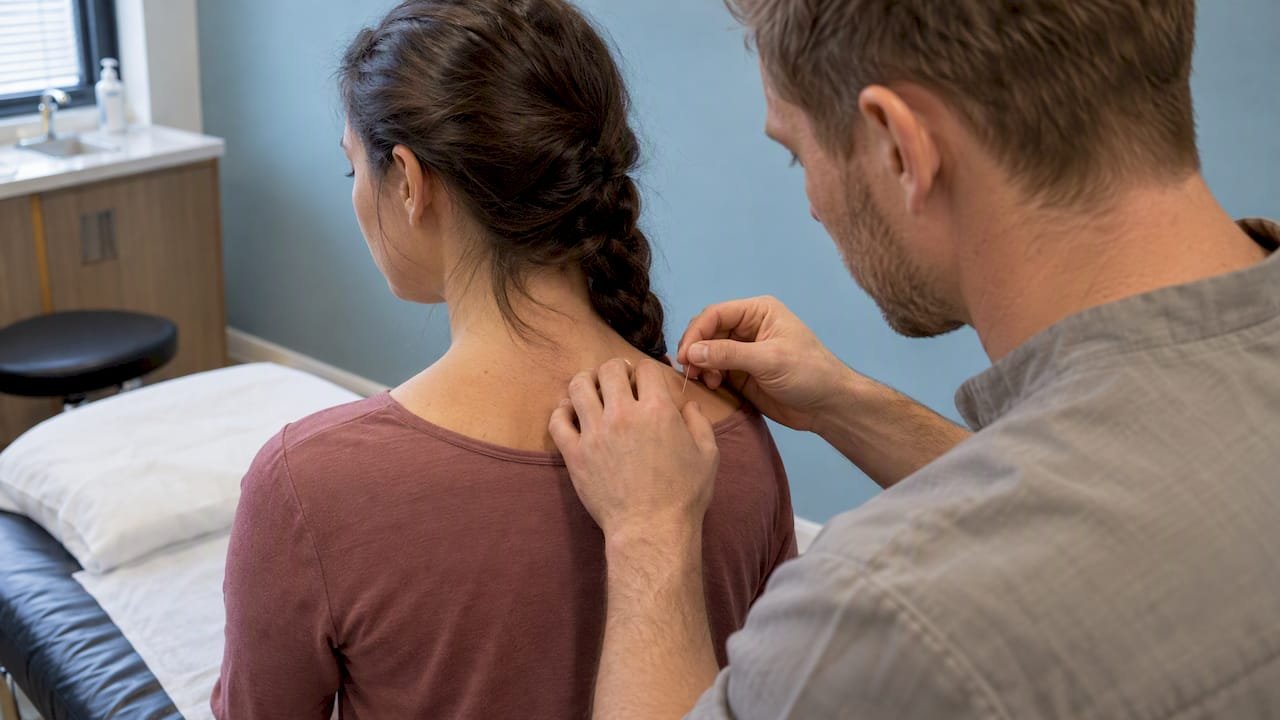
Acupuncture is one of the most common non-drug options people try for neck pain and a stiff neck. It uses very thin needles placed at specific points on the body, and pain is the condition it is most commonly used to treat. A realistic plan is a short, structured series of visits, paired with movement and habit changes, and a medical check first if your symptoms are more than ordinary tightness. This guide covers what the evidence says, what a session feels like, how many visits to plan, who should take precautions, and which symptoms mean you should see a clinician before anything else.
TL;DR
- Acupuncture is widely used for neck pain. A 2018 review found it more effective than no treatment for back or neck pain, with a pain-relieving effect comparable to NSAIDs.
- A typical course is six to 12 sessions over about three months, with needles in place for roughly 10 to 20 minutes per visit.
- Side effects are usually minor (soreness, light bruising). Tell your practitioner if you are pregnant or have a pacemaker.
- Arm weakness, numbness, fever, or neck pain after an injury needs medical care first, not acupuncture.
- Acupuncture works best as one piece of a plan that includes movement, desk habits, sleep, and stress.
Table of Contents
- What acupuncture is, and why people try it for neck pain
- How acupuncture might ease neck pain
- What the evidence says about effectiveness and how long relief lasts
- What happens during a neck pain session
- How many sessions to plan
- Safety, side effects, and who should take precautions
- When to see a doctor first
- What else helps a stiff neck while you are treating it
- Our perspective on neck pain
- Acupuncture and recovery at humn.
- FAQ
- Sources
What acupuncture is, and why people try it for neck pain
Acupuncture is a key component of traditional Chinese medicine. A practitioner inserts very thin needles at chosen points, some near the sore area and some elsewhere on the body. Mayo Clinic describes it as most commonly used for pain, and neck pain is one of the usual reasons people book.
Neck pain is common, and it rarely has one tidy cause. Mayo Clinic lists poor posture, sleeping in awkward positions, tension headache, myofascial pain, osteoarthritis, whiplash and other causes. A stiff neck on waking, a tight band across the upper shoulders after a long day at a laptop, and a neck that locks up when you turn to check a blind spot all fall under the same umbrella. They often respond to the same general approach: calm the tissue down, then restore movement.
That is where acupuncture tends to fit. Many practitioners use it to bring pain down for a period, which can make it easier to move, stretch, and train. For a busy professional, that window matters, because the exercises and habit changes are what keep a sore neck from returning.
How acupuncture might ease neck pain
Nobody has a single settled explanation, and it helps to hear the range of views.
One line of research points to the body’s own chemistry. A review of acupuncture for neck disorders notes that needling may involve the release of neurotransmitters and hormones such as endorphins, serotonin, and ATP. Those are involved in how your nervous system processes pain and tension.
A second view is more cautious. The National Center for Complementary and Integrative Health points out that part of the benefit may come from nonspecific effects, such as your expectations and the relationship with your practitioner, rather than only the needle itself. For a person who carries tension in the neck, a calm hour with someone who listens, examines, and explains is not a small thing. It is part of why many people leave a session feeling looser.
The practical takeaway: you do not need to settle the mechanism debate to decide whether a trial of acupuncture makes sense. You need to know what the evidence says about results, and how to run a sensible trial.

What the evidence says about effectiveness and how long relief lasts
The NCCIH summary reports that a 2018 review found acupuncture more effective than no treatment for back or neck pain, with a pain-relieving effect comparable to NSAIDs. That is a useful comparison if you would rather limit anti-inflammatory pills, or if they do not suit you.
Two honest points about how to read that:
- Relief is usually gradual. Most people do not feel a full change after one visit. The standard approach is a series, with progress checked along the way.
- Results vary by person. Your pain’s cause, how long you have had it, your work setup, your sleep, and your stress all shape the response. This is why a good practitioner asks about all of them.
If the first few sessions bring no change at all, that is useful information too. It is a cue to review the plan with your practitioner and, if needed, your doctor.
What happens during a neck pain session
Expect something quieter than most people imagine.
- Conversation. Per Cleveland Clinic, the acupuncturist discusses your condition and examines your body. For neck pain that usually means where it hurts, what makes it worse, how you sleep, how you work, and how far you can turn your head.
- Needling. Needles go in at the chosen points. A mild ache can occur when a needle reaches the correct depth, and some practitioners move or twirl the needles or add heat or mild electrical pulses.
- Rest. Needles typically stay in for about 10 to 15 minutes according to Mayo Clinic, and Cleveland Clinic gives a range from a few minutes up to 20 minutes. You lie still and breathe.
- Wrap-up. Needles come out, and you talk through how you feel and what to do between visits.
If it is your first time and you want a walkthrough of the room, the questions to ask, and what to wear, our guide to what to expect at your first acupuncture visit covers it step by step.
How many sessions to plan
The answer depends on your condition, how severe it is, and how you respond. Cleveland Clinic says at least five treatments are recommended. Harvard Health describes a usual course as six to 12 sessions over a three-month period.
Here is a simple way to structure a trial:
| Stage | What to do | What to look for |
|---|---|---|
| Before session 1 | Note your baseline: pain 0 to 10, how far you can turn each way, how often you wake with stiffness | A starting point you can compare against |
| Sessions 1 to 3 | Go close together if your practitioner advises it, and keep a short log | Any shift in pain, range, or sleep, even a small one |
| Sessions 4 to 6 | Review the log with your practitioner | A trend. Are good days more frequent? |
| Sessions 7 to 12 | Space visits out as you improve | Whether gains hold between visits |
The log matters. Neck pain fluctuates, and without notes it is hard to tell whether a good week came from the treatment, a lighter workload, or a new pillow.
Safety, side effects, and who should take precautions
Mayo Clinic reports that common side effects include soreness and minor bleeding or bruising, and that risks are low when the practitioner is competent and certified and uses sterile needles. Two groups should speak up before treatment:
- People with a pacemaker. Electrical stimulation can interfere with the device.
- People who are pregnant. Certain points are thought to stimulate labor.
A 2024 review of acupuncture safety and adverse events concluded that most adverse events are preventable through careful choice of needling areas, safe needle depth, good hygiene, and standard operating procedures. For the neck, that is a good reason to choose a practitioner who knows the anatomy there and who asks about your history before they start.
Also tell them about blood thinners, bleeding disorders, and any recent injury. Those are the details that change how a session is planned.
When to see a doctor first
Most neck pain is not dangerous. Mayo Clinic notes that pain from muscle tension or strain often goes away on its own within a few days, and pain lasting several weeks often responds to exercise, stretching, physical therapy, and massage. But some patterns need a clinician before any hands-on or needle-based care.
Call 911 or go to the emergency room if severe neck pain comes with:
- A traumatic injury, such as a car collision, diving accident, or fall
- Weakness in an arm or leg, or trouble walking
- A high fever, which can signal meningitis
Book an office visit if your neck pain:
- Gets worse despite self-care
- Lasts beyond several weeks of self-care
- Radiates down your arms or legs
- Comes with headache, weakness, numbness, or tingling
If headaches are part of your picture, it helps to understand the broader options. This overview of migraine treatment options and when to get care is a good place to sort out which headaches are worth a medical visit and which are tension-type problems that start in the neck.
Cleveland Clinic notes that a healthcare provider will first rule out serious causes such as pressure on the spinal cord, infection, or cancer. Getting that done first is not a detour from acupuncture. It is what makes a trial of it safe.
What else helps a stiff neck while you are treating it
Needles can take the edge off. Your daily habits decide whether it stays off. The same Cleveland Clinic page lists pain medicine, exercise, and stress management among the conservative treatments that help most causes of neck pain.
A few practical moves to pair with a course of acupuncture:
- Break up sitting. Short posture resets through the workday beat one long stretch at night. Our 90-second posture microbreaks and 5-minute routine were written for exactly this.
- Keep your upper body moving. Gentle rotation, shoulder blade control, and thoracic mobility take load off the neck. Our mobility drills for lifters can be done in 10 to 15 minutes.
- Check your sleep setup. Too many or too few pillows can leave you stiff by morning, as the Mayo Clinic causes list notes.
- Return to training gradually. If pain has sidelined your workouts, a structured ramp-up is safer than jumping back in. See our 4-week plan to restart fitness after injury.
- Look one joint over. Neck pain and shoulder pain often travel together. If that sounds like you, read about testing acupuncture for shoulder pain over six to eight sessions.
Stress is part of this too. Many people clench their jaw and raise their shoulders without noticing. Our piece on acupuncture for stress relief explains how that connection is approached.
Our perspective on neck pain
Neck pain is rarely only a neck problem. When someone walks in with a tight neck, we usually hear about long days at a screen, poor sleep, a stressful quarter, and a training routine that stopped working around the same time. Treating the neck in isolation tends to bring temporary relief and a return of the same pattern.
That is why we built humn. around four pillars: Resist, Recover, Renew, and Rhythm. Acupuncture sits in the recovery side of that framework, alongside sauna, compression, and red light therapy. It is a way to settle the tissue and the nervous system so the work that actually changes your neck, strength in the upper back, better movement, and better habits, can take hold.
Our coaching is habits-first and behavior-based. We look at sleep, stress, nutrition, and how you sit and move, then build a plan you can keep. We track progress so you can see whether it is working, and we adjust. We would rather you leave with a neck that stays better than one that feels good for a day.
If you have red-flag symptoms, see your doctor first. If you do not, we think a structured trial of acupuncture inside a broader plan is a smart, low-drama way to start.
Josh
Acupuncture and recovery at humn.
If you live or work near Gaithersburg, MD, acupuncture is available as an add-on to the recovery services at humn., our boutique facility. You can pair it with sauna, compression, and red light therapy, and with small-group training or 1-on-1 coaching that builds the strength and movement habits that keep your neck out of trouble.
See how recovery access works on our recovery page, or look at membership and coaching options to build a plan around your schedule.
FAQ
Can acupuncture help a stiff neck?
It may. Acupuncture is most commonly used for pain, and a 2018 review summarized by NCCIH found it more effective than no treatment for back or neck pain. Many people use it to reduce tension so they can move more freely. If stiffness comes with fever, numbness, or arm weakness, get medical care first.
How many acupuncture sessions does neck pain usually need?
Harvard Health describes a usual course as six to 12 sessions over about three months, and Cleveland Clinic recommends at least five treatments. Your number depends on your condition, its severity, and how you respond. Tracking pain and range of motion helps you and your practitioner judge progress.
Does acupuncture for neck pain hurt?
Most people feel little on insertion. A mild ache can occur when a needle reaches the correct depth, per Mayo Clinic. Soreness or light bruising afterward is common and usually minor.
Is acupuncture safe if I have a pacemaker or I am pregnant?
Tell your practitioner before treatment. Mayo Clinic advises precautions for both: electrical stimulation may interfere with a pacemaker, and some points are thought to stimulate labor. Your practitioner can adjust the approach, and your doctor can advise on your situation.
When should I see a doctor instead of booking acupuncture?
See a doctor first if neck pain follows an injury, spreads down an arm or leg, or comes with weakness, numbness, tingling, or fever. Also go if it worsens despite self-care or lasts beyond several weeks.
Sources
- Acupuncture, Mayo Clinic
- Acupuncture for neck disorders, PubMed Central
- Acupuncture: Effectiveness and Safety, NCCIH
- Acupuncture: What To Know, Cleveland Clinic
- Acupuncture for pain relief: How it works and what to expect, Harvard Health
- Acupuncture: A Review of the Safety and Adverse Events, PubMed
- Neck pain: Symptom, Mayo Clinic
- Neck Pain: Common Causes and Treatments, Cleveland Clinic
No Comments.