

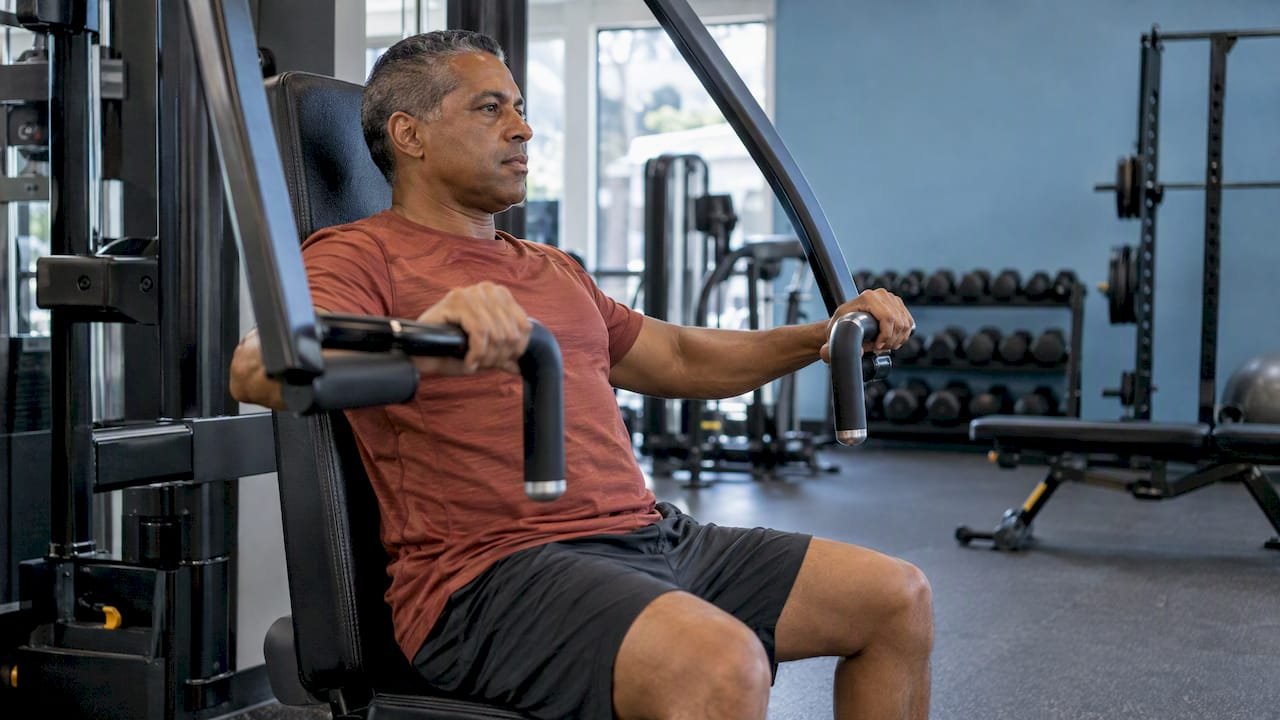
For most adults with high blood pressure, lifting weights is safe and useful. Done regularly, with steady breathing and a doctor who knows your numbers, strength training lowers resting blood pressure over time. Your pressure rises during a set. The benefit shows up in the weeks and months after.
This guide covers what the evidence says, how much to do, how to lift without spiking your pressure, what to check before your first session, and when to stop and call a clinician.
TL;DR
- Resistance training is a recognized, evidence-based way to help manage blood pressure, and it works best alongside aerobic exercise.
- A short rise in pressure during a set is normal. Holding your breath is the habit to remove.
- A typical research-backed dose is about 90 to 150 minutes a week, but your starting point should be set with your doctor.
- Consistency beats intensity. Warm up, cool down, and build slowly.
- Readings consistently at or above 180/120 mm Hg, or chest pain or shortness of breath, mean calling your healthcare professional or seeking emergency care.
Table of Contents
- Is it okay to lift weights if your blood pressure is high?
- What the evidence says about how it works
- Heart rate is not blood pressure
- How to lift safely: the rules that matter
- A sample starter week
- Before you start: check your numbers properly
- When to stop and call someone
- Questions about medication
- Food, sleep and stress belong in the plan
- Our perspective
- Working with a coach on your blood pressure goals
- FAQ
- Sources
Is it okay to lift weights if your blood pressure is high?
Yes, for most people. A common fear is that lifting is dangerous because pressure climbs mid-set. That is true, but it is only half the story. According to the American Heart Association’s professional update on resistance training, consistent training improves blood pressure along with glycemia, lipid profiles and body composition. Acute spikes are normal. Over time, structural and vascular adaptations lower your resting pressure.
A 2023 meta-analysis of strength training in hypertensive adults is not the one we cite here for numbers, so we stay with the guideline figures: according to the 2017 ACC/AHA guideline slide set, dynamic resistance training alone can lower systolic pressure by roughly 2 to 4 mm Hg in people with hypertension. That sounds small. Across a population it is meaningful, and it stacks with aerobic work, diet, sleep and medication.
One caveat matters more than any number. If your blood pressure is uncontrolled, or you have heart disease, talk with your doctor before starting. They may want your readings stable first.
What the evidence says about how it works
Resting pressure falls with regular training
The guideline-style dose is dynamic resistance training at 50 to 80% of your one-rep max: about six exercises, three sets each, ten reps per set, adding up to 90 to 150 minutes per week, per the ACC/AHA slide set. You do not start there. Most beginners work at the light end and build.

The higher your starting point, the bigger the payoff
The ACSM describes the law of initial values: people with the highest baseline pressure often see the largest drops from an exercise program. For adults in the early stages of hypertension, training is a first-line lifestyle tool, not an afterthought.
Each workout helps too
After a session, pressure can stay lower for hours. This is called post-exercise hypotension, and a 2023 review in PMC notes it is more pronounced in people who already have hypertension. In a randomized crossover trial in resistant hypertension, researchers compared aerobic, resistance and combined sessions on ambulatory pressure. Combined sessions are the ones associated with longer-lasting reductions. That is a good reason to pair lifting with cardio rather than choosing one. Our guide on how to combine cardio and strength training shows how to split the week.
Heart rate is not blood pressure
When your heart rate jumps during a hard set, it feels like your pressure must be doubling. It does not work that way. The American Heart Association explains that heart rate and blood pressure are different responses: healthy vessels dilate during exercise to let blood flow, which keeps the pressure increase more modest.
That is why the goal is not to avoid effort. It is to apply effort in a controlled way.
How to lift safely: the rules that matter
Never hold your breath
The single most important technique cue. Holding your breath, the Valsalva maneuver, can cause sharp spikes in pressure. The AHA says to keep breathing steady and consistent through every movement. A simple pattern: exhale as you push or stand, inhale as you lower. If you cannot talk in short sentences between reps, the weight is too heavy for now.
Warm up and cool down on purpose
Spend several minutes raising your heart rate and breathing gradually before loading anything. Afterward, do not stop abruptly and sit down. The same AHA page warns that stopping too suddenly can cause a drop in pressure, with dizziness or muscle cramping. Walk it down for a few minutes.

Choose consistency over intensity
Experts writing for the AHA describe an individualized plan covering frequency, intensity, time and type, combining resistance and aerobic work, as the gold standard for adherence and control. Three moderate sessions you actually attend beat one brutal session you dread.
Use more muscle, less ego
Heavy, max-effort lifts are not the point. Start with machine and bodyweight patterns, goblet squats, rows, presses and carries at a weight you can move for ten smooth reps with room to spare. Progress by adding a rep or a small amount of load, not by chasing a personal record.
A sample starter week
This is an illustration of structure, not a prescription. Your doctor and coach should adjust it to you.
| Day | Session | Notes |
|---|---|---|
| Mon | Full-body strength, 30 to 40 minutes | 5 to 6 exercises, 2 sets of 10 to start, easy-to-moderate load |
| Tue | Brisk walk, 20 to 30 minutes | Conversational pace |
| Wed | Rest or gentle mobility | Sleep and stress get attention |
| Thu | Full-body strength, 30 to 40 minutes | Same pattern, small progression |
| Fri | Brisk walk or easy cycling | Warm up, then cool down gradually |
| Sat | Optional third strength session | Only if recovery feels good |
| Sun | Rest |
The AHA’s general target is at least 150 minutes of moderate aerobic activity each week. Strength sessions sit on top of that. Build toward it across weeks rather than in week one.
Before you start: check your numbers properly
If you have a home cuff, measure well, because a bad reading leads to bad decisions. The AHA advises no exercise, smoking or caffeine within 30 minutes of a reading. Sit quietly for at least five minutes, back supported, feet flat, arm at heart level. Take at least two readings a minute apart, in the morning before medication and breakfast and again in the evening before supper.
This also answers a common question: why does my pressure look high right after I train? Because you just trained. Measure at rest, not post-workout, and bring your log to your appointments. The AHA stresses that home monitoring does not replace regular visits with your provider.
For reference, the AHA and American College of Cardiology describe a normal adult reading as under 120 over 80 mmHg. The ACSM notes the guideline redefined hypertension at 130 systolic or 80 diastolic.
When to stop and call someone
A single high reading is not a reason to panic. Sit, wait five minutes and test again. If readings stay at or above 180/120 mm Hg, the AHA says to contact your healthcare professional immediately, and seek emergency care if you have chest pain or shortness of breath. Do not train on a day like that.
During a session, stop and get medical help for chest pain, severe shortness of breath, or faintness. If you take blood pressure medication, ask your prescriber whether it affects how you should train, and whether any changes in dizziness after standing up are something to report.
Questions about medication
Most types of strength training, including weight lifting, are safe for people who take blood pressure medication, according to the guidance Google surfaces for this query. Still, medicines differ. Some can make you lightheaded when you stand fast from the floor or bench. Tell your coach what you take, rise slowly between exercises, and keep water nearby. Never change a dose on your own because you have started exercising. Your pressure may improve, and your doctor decides what follows.
Food, sleep and stress belong in the plan
Lifting is one lever. The AHA lists several others: medication, more exercise, fruits and vegetables, not smoking, less salt and alcohol, lower stress and weight loss. If food is where you want to start, this walkthrough of DASH diet meal planning shows how to turn the eating pattern into a weekly routine.
Stress and sleep are just as practical. A few minutes of slow breathing before bed or between meetings helps, and our piece on breathwork for stress gives a five-minute version. The same breathing habit helps under the bar.
Our perspective
We coach adults in Gaithersburg who are busy, often stressed, and often told “just exercise more” without a plan. Blood pressure comes up more than people expect.
What we see is that the problem is rarely knowledge. It is the gap between a guideline and a Tuesday at 6 a.m. That is why we build around habits first. A member with high blood pressure does not need a heroic program. They need a repeatable one: a warm-up that is never skipped, breathing cues from the first rep, loads that leave room, and a coach who notices when sleep or stress has changed the day’s plan.
We also think of training as one part of a system. Our four pillars are Resist, Recover, Renew and Rhythm. Strength work is the first. Recovery, sleep, nutrition and daily rhythm decide whether it keeps working. We are coaches, not your physician, so we ask members to share their doctor’s guidance and we train within it.
The measure we care about is whether you are still training a year from now. For deeper reading on how a modest weekly dose adds up, see what 90 minutes of strength training a week does.
— Josh
Working with a coach on your blood pressure goals
If you would rather not design this alone, our membership combines small-group personal training and coaching and guidance, with recovery access and 1:1 nutrition coaching available. Coaches build the plan around your habits and keep progress visible. Before a first session, bring your doctor’s guidance and your home readings, and we will work from there. Not sure whether personal training is worth it? Our 90-day test explains how to judge it.
If pain, not pressure, is the thing limiting you, see our guides to training with bad knees and lower back pain.
FAQ
What exercises should be avoided with high blood pressure?
No exercise is banned across the board, but some habits deserve caution. Avoid breath-holding, max-effort lifts and fast, jerky reps until your pressure is well controlled and your doctor agrees. Heavy lifting with a held breath is the pattern that causes the sharpest spikes. Ask your clinician about any movement that makes you dizzy or short of breath.
Can I exercise if my blood pressure is 140/90?
Many adults at that level are encouraged to exercise, because activity is part of managing it. The ACSM notes that people with higher starting pressure often see larger drops. Confirm with your doctor first, particularly if you have other heart risk factors or take medication.
How long is blood pressure lowered after strength training?
It varies. Research on post-exercise hypotension shows that longer or harder sessions generally produce a longer effect, and combined aerobic and resistance sessions tend to last longest. During the set itself, pressure rises temporarily. Check your resting readings, not post-workout ones.
Is strength training better than cardio for blood pressure?
Neither wins on its own. The best-supported approach combines both, with aerobic activity as the base and resistance work added on top. If you only have time for a few sessions, a mix is the safer bet.
Sources
- 2017 ACC/AHA guideline slide set
- AHA: Resistance exercise training, 2023 update
- ACSM: Exercise for the prevention and treatment of hypertension
- ACSM: What’s new in the exercise and hypertension pronouncement
- PMC: Post-exercise hypotension review
- PMC: Combined aerobic and resistance exercise in resistant hypertension
- AHA: Are heart rate and blood pressure the same?
- AHA: Getting active to control high blood pressure
- AHA: Physical activity as first-line treatment commentary
- AHA: Home blood pressure monitoring
- AHA: Blood pressure toolbox talk
- AHA: How to accurately measure blood pressure at home
No Comments.