


If sleep is your primary problem, start with Calm. If you want to actually learn how to meditate and build a daily habit, Headspace is the stronger pick. That’s the short version, and no clinical trial has conclusively proven one superior to the other — so the real question is which one you’ll still open in week three.
One-line picks by goal:
- Sleep and bedtime wind-down: Calm. Its Sleep Stories and celebrity narrators are the reason most people subscribe for nighttime help.
- Learning to meditate from scratch: Headspace. The structured basics course walks you through technique the way a coach would.
- Quick stress relief during the day: Headspace’s SOS sessions and short focus meditations are built for this.
- Anxiety management: Either app can help, but Headspace’s course-based format gives you a clearer skill progression. Neither replaces clinical care.
- Ambient listening and soundscapes: Calm, without question.
Voice and tone matter more than most comparison articles admit. Some people find Calm’s narrators soothing; others find them slow. Some love Headspace’s animated, coach-like delivery; others find it a bit chipper. Test both during their free trials before you commit.
Table of Contents
- How do Headspace and Calm actually compare side by side?
- What does Headspace do well, and where does it fall short?
- What does Calm do well, and where does it fall short?
- How do you choose between Headspace and Calm?
- Key Takeaways
- A coach’s perspective on using these apps well
- How humn. complements what these apps can’t do alone
- Where to check current pricing, trials, and clinical research
How do Headspace and Calm actually compare side by side?
Both apps carry similar annual pricing in the U.S. and offer limited free tiers, but the experience inside each one is fundamentally different. Headspace is a curriculum; Calm is a library. That single distinction drives almost every other difference below.
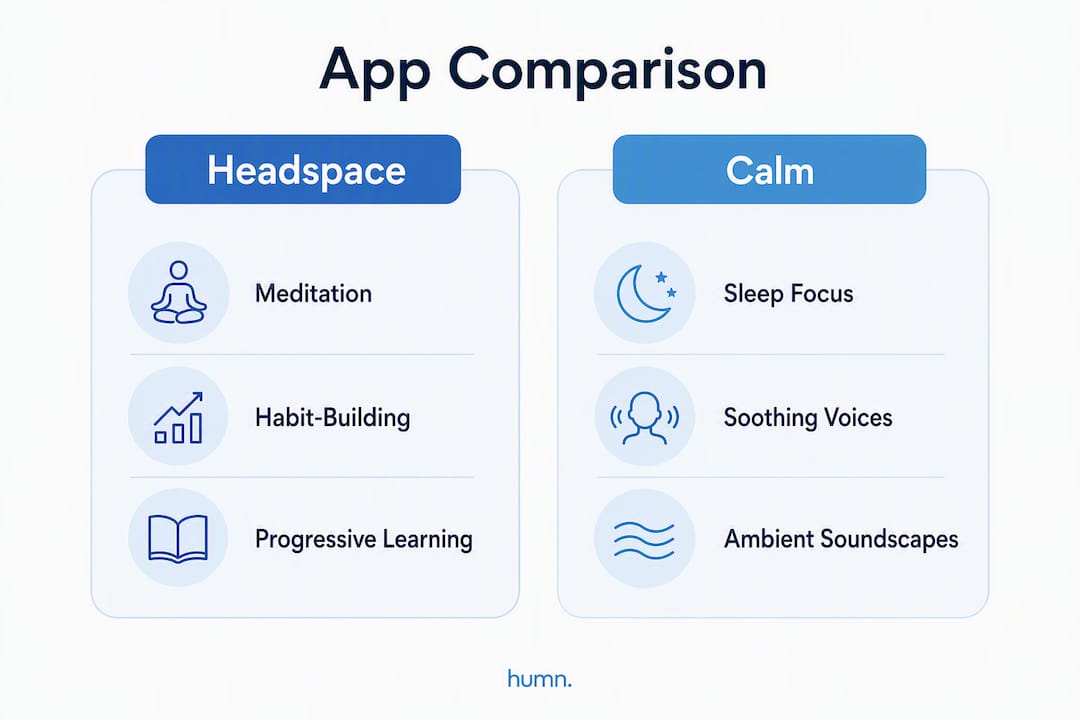
| Dimension | Headspace | Calm |
|---|---|---|
| Best for | Beginners, habit-builders, daytime focus | Sleep, ambient listening, self-directed browsing |
| Free tier | Limited basics content | Limited sessions and stories |
| Monthly price | $12.99–$14.99 (U.S., typical; verify for current offers) | $12.99–$14.99 (U.S., typical; verify for current offers) |
| Annual price | $65–$75 (U.S., typical; verify for current offers) | $65–$75 (U.S., typical; verify for current offers) |
| Family/student plans | Yes (check current site for pricing) | Yes (check current site for pricing) |
| Content types | Courses, single sessions, sleepcasts, focus music | Sleep Stories, soundscapes, guided meditations, music |
| Teaching style | Structured curriculum with progression | Browsable library, mood-based navigation |
| Voice and narration | Andy Puddicombe (warm, coach-like); some celebrity guests | Multiple narrators; celebrity Sleep Stories (Matthew McConaughey, etc.) |
| Special features | Animated explainers, streaks, SOS sessions, basics course | Sleep Stories, Daily Calm, Calm Body, masterclasses |
| Platform support | iOS, Android, web | iOS, Android, web |
| Offline access | Premium: downloadable sessions | Premium: downloadable content |
| Personalization | Goal-setting onboarding, streaks, progress tracking | Mood check-ins, curated playlists |
| Trial | Free trial available (length varies by promotion) | Free trial available (length varies by promotion) |
| Cancellation | Cancel anytime; billing complaints exist on Trustpilot | Cancel anytime; billing complaints exist on Trustpilot |
Persona-driven picks:
- If you lie awake at night and want something to pull you under, try Calm first.
- If you’ve tried meditating before and quit because you didn’t know what you were doing, Headspace’s basics course is worth the trial.
- If you want background audio for work or recovery, Calm’s soundscape library is deeper.
- If streaks and progress tracking keep you honest, Headspace is built around that.
- If you hate committing to a sequence and prefer browsing by mood, Calm’s library will feel more natural.
Pricing and trial lengths shift with promotions and regional offers. Always verify on each app’s official page before subscribing.
What does Headspace do well, and where does it fall short?
Headspace structures meditation as a skill you learn progressively, starting with a basics course that covers breathing, body scans, and focused attention before moving into themed packs on anxiety, sleep, and performance. Andy Puddicombe’s narration is calm but purposeful, like a coach who expects you to show up. The animated explainers that accompany many sessions are genuinely useful for beginners who want to understand why a technique works, not just follow instructions.

The habit infrastructure is real. Streaks, reminders, and a visible progress dashboard give you something to protect. For adults who need external accountability to build a new behavior, that structure does meaningful work.
Pros:
- Beginner-friendly onboarding with a clear starting point
- Structured courses that build technique over time
- SOS sessions (1–3 minutes) for acute stress during the day
- Animated explainers make concepts accessible
- Streak tracking and reminders support daily habit formation
- Focus music and daytime sessions extend usefulness beyond meditation
Cons:
- Content can feel repetitive once you’ve completed the core courses
- Less useful if you want a large, browsable library to explore freely
- The coach-like tone won’t appeal to everyone
- Free tier is narrow; most content requires a subscription
Pricing snapshot: Annual and monthly plans fluctuate over time. Check Headspace’s official site for current pricing and any active promotions before subscribing.
Headspace is available on iOS, Android, and web. Premium subscribers can download sessions for offline use, which matters if you want to meditate on a flight or in a gym with spotty Wi-Fi.
Top use cases: Learning to meditate for the first time; building a consistent daily practice; short focus sessions before high-concentration work; anxiety skill-building through structured courses.
Pro Tip: Start with Headspace’s free “Basics” course before judging the app. The first three sessions are the weakest onboarding; by session five, the technique instruction gets genuinely useful.
What does Calm do well, and where does it fall short?
Calm leads with sleep. Its Sleep Stories, narrated by voices ranging from Matthew McConaughey to Stephen Fry, are the feature that consistently draws subscribers and keeps them. Reviewers across multiple platforms name sleep content as Calm’s standout asset, and the format, a slow, meandering narrative designed to bore you pleasantly into sleep, works for a lot of people who’ve tried everything else.

Beyond sleep, Calm’s library is wide. Soundscapes, nature audio, breathing exercises, body movement sessions, and masterclasses from well-known figures give you a lot to explore. That breadth is both the appeal and the friction point. A large, browsable catalog can create choice overload, especially for someone who just wants one reliable thing to do every night.
Pros:
- Sleep Stories are genuinely effective for many users and hard to find elsewhere
- Celebrity narrators add novelty and variety
- Deep soundscape and ambient audio library
- Daily Calm gives you a consistent, low-friction entry point
- Mood-based navigation suits self-directed users
- Masterclasses add depth for users who want more than guided sessions
Cons:
- No structured curriculum; beginners may feel lost without a starting point
- Large library can feel overwhelming rather than helpful
- Some celebrity content feels more like marketing than meditation
- Free tier is limited; the best content sits behind the paywall
Pricing snapshot: Annual and monthly plans fluctuate over time. Check Calm’s official site for current pricing and trial terms.
Calm is available on iOS, Android, and web. Premium subscribers can download content for offline use.
Top use cases: Bedtime wind-downs and sleep onset; long-form ambient listening during work or recovery; mood-based relaxation when you don’t want to follow a sequence; soundscapes for focus or background audio.
Pro Tip: If you’re using Calm for sleep, skip the browsing and go straight to Sleep Stories. Spending ten minutes choosing a story defeats the purpose. Pick one narrator you like and use the same story for a week.
How do you choose between Headspace and Calm?
The strongest predictor of sustained app use is fit between format and personality. People who like learning from a structured program stick with Headspace. People who prefer browsing and self-directing stick with Calm. Most people choose the app that matches their ideal self rather than their real habits, which is why a short trial with a scoring plan beats any comparison article.
Decision checklist
Work through these before you download anything:
- Primary goal: Is it sleep, stress relief, learning technique, or building a daily habit? Sleep points to Calm; everything else leans Headspace.
- Structure preference: Do you want someone to tell you what to do next, or do you prefer browsing? Curriculum vs. library.
- Voice sensitivity: Listen to a 60-second sample of each app’s main narrator. If one grates on you, that’s disqualifying.
- Daytime vs. nighttime use: Headspace has more daytime content; Calm is stronger at night.
- Price sensitivity: Both apps cost roughly the same annually. If budget is tight, compare current trial lengths and decide which gives you more time to evaluate.
- Habit infrastructure need: If you need streaks and reminders to stay consistent, Headspace is built for that. Calm is more passive.
A 7–14 day trial plan
Days 1–3 (Headspace): Complete sessions 1–3 of the Basics course. Note how easy it is to open the app, whether the narration keeps your attention, and whether you feel calmer after.
Days 4–7 (Calm): Use a Sleep Story on two nights and the Daily Calm on two mornings. Track how long it takes you to fall asleep and whether you opened the app without prompting.
Days 8–14: Return to whichever app you opened more naturally. Use it daily and score it on the questions below.
Scoring questions (rate each app 1–5 after the trial)
- Did the narrator’s voice make you want to keep listening?
- Did sessions feel the right length, or did you check the timer?
- Did you open the app without being reminded?
- Did sleep feel easier on nights you used it?
- Were the instructions clear enough that you knew what to do?
- Did you feel less stressed after a session?
- Was billing and cancellation information easy to find?
- Would you pay for this at full price?
Add the scores. The higher number is your app.
Red flags to watch for
- Billing or cancellation confusion: app-store ratings for both apps are generally high, but Trustpilot complaints frequently focus on billing and subscription management. Read the cancellation terms before you enter payment details.
- Content that increases anxiety: if browsing the library makes you feel behind or overwhelmed, that’s a usability problem, not a personal failing.
- Persistent crashes or sync failures: a buggy experience breaks the habit faster than anything else.
Neither Headspace nor Calm is a clinical treatment. Both can support symptom management for mild anxiety or sleep difficulty, but if your sleep problems are severe or persistent, or if you’re managing depression or panic, app-based mindfulness is an adjunct, not a replacement for licensed clinical care. Find each app’s data and privacy policy on its official site before subscribing.
Pro Tip: Set a calendar reminder for one day before your trial ends. Both apps require you to cancel before the trial expires to avoid being charged. This is the single most common complaint in user reviews.
Key Takeaways
Calm is the clearer pick for sleep; Headspace is the clearer pick for learning meditation and building a daily habit, but the app you’ll actually use consistently is the one that fits how you naturally engage with content.
| Point | Details |
|---|---|
| Sleep vs. habit-building | Calm leads on sleep content; Headspace leads on structured learning and daily habit formation. |
| Pricing is similar | Annual plans for both apps run roughly $65–$75 in the U.S.; verify current pricing on each official site. |
| Format fit predicts adherence | Curriculum learners stick with Headspace; library browsers stick with Calm. Match format to personality, not aspiration. |
| Test before you commit | Use the 7–14 day trial plan and score both apps on voice, ease of use, sleep help, and likelihood to open unprompted. |
| humn. as a complement | For readers who need accountability beyond an app, humn.'s lifestyle coaching integrates sleep, recovery, and habit work into personalized programs. |
A coach’s perspective on using these apps well
The apps work best when they’re one piece of a larger system, not the whole plan.
What I see with clients who use Headspace or Calm consistently is that the app didn’t change their sleep or stress on its own. What changed was that the app gave them a reliable anchor for a behavior they were already trying to build. A two-minute breathing session before bed isn’t clinically transformative. But it signals to your nervous system that the day is done, and over weeks, that signal compounds.
The misuse pattern I see most often is over-browsing. Someone downloads Calm, spends 20 minutes exploring the library, never actually meditates, and concludes the app doesn’t work. The same thing happens with Headspace when people skip the basics course and jump straight to advanced content. The app becomes a thing you have, not a thing you do.
For clients at humn. who are in active training blocks, short Headspace sessions before high-focus workouts have shown up as genuinely useful, not for relaxation, but for attention. A five-minute body scan before a strength session changes how present someone is during the work. On recovery nights after hard training, Calm’s Sleep Stories are a better fit. The goal is sleep quality, and a narrated story is less cognitively demanding than a guided meditation that asks you to notice your breath.
The deeper issue is that the best app is the one you’ll use after the first two weeks. Most people quit around day 10, right when the novelty wears off and the habit hasn’t formed yet. That’s the gap where behavior-based coaching does what an app can’t: it holds you accountable to the system, not just the streak.
If you’re using either app to manage something serious, anxiety, chronic insomnia, or persistent low mood, pair it with professional support. The apps are useful adjuncts. They’re not treatment.
How humn. complements what these apps can’t do alone
Apps give you the tool. Coaching gives you the plan, the accountability, and someone who adjusts when the plan stops working.
At humn. in Gaithersburg, MD, sleep and stress aren’t afterthoughts. They’re built into the program from day one, alongside strength training, recovery modalities like sauna and red light therapy, and personalized habit coaching. If you’ve tried Headspace or Calm and found that the app helps in the moment but doesn’t move the needle on your sleep quality or stress baseline, that’s usually a sign the problem needs a systems approach, not a better app.
1-on-1 coaching at humn. means a real coach who knows your schedule, your training load, and your recovery patterns. They can tell you when to use a five-minute session and when to skip it in favor of an earlier bedtime. That kind of personalization is what an app, by design, can’t provide.
If you’re a busy professional in the Montgomery County area who wants more than a subscription, explore what a humn. membership looks like and see whether it fits where you are right now.
Where to check current pricing, trials, and clinical research
Pricing and trial terms change frequently. Always verify directly on each app’s official page before entering payment information.
- Healthline: Headspace vs. Calm comparison — regularly updated editorial comparison with pricing context
- PMC: mindfulness app research — peer-reviewed evidence on app-based mindfulness efficacy
- PubMed: meditation app clinical trials — indexed research for readers who want to dig into the clinical literature
- Trustpilot: Headspace reviews — user-reported billing and cancellation experiences
- Psychology Today: why people stop using meditation apps — behavioral research on app adherence
- Mental wellness during recovery — practical guidance on using mindfulness tools during physical rehabilitation
This article is general information, not clinical advice. If you’re managing a diagnosed sleep disorder, anxiety disorder, or depression, confirm any app-based approach with a licensed healthcare provider.
No Comments.