


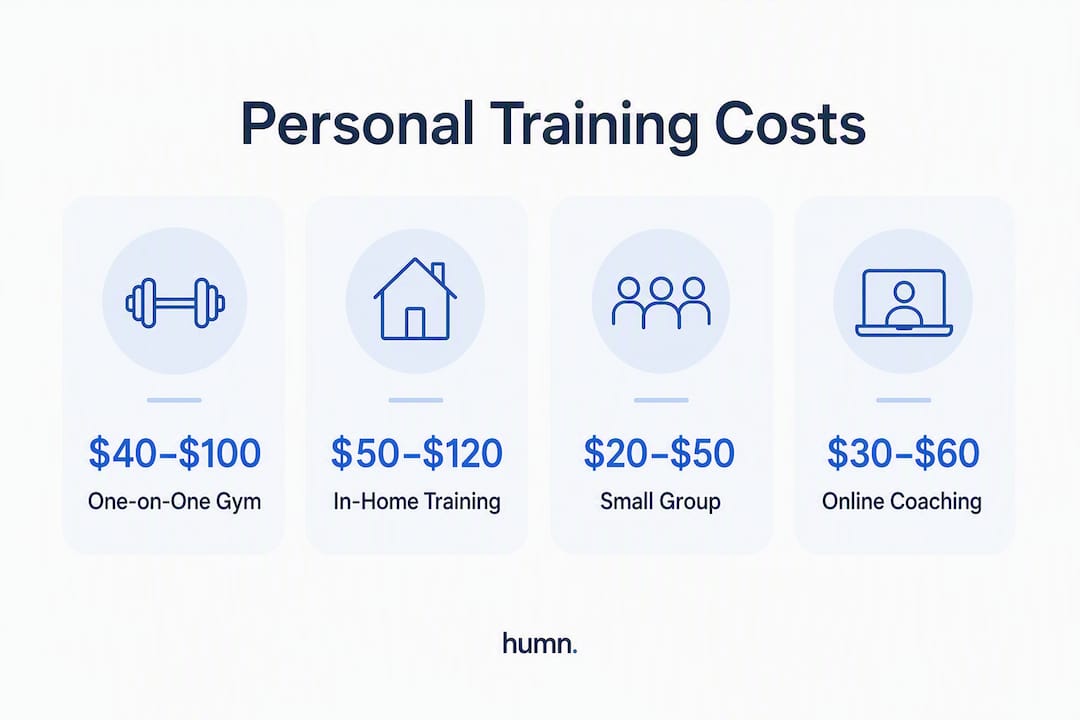
Personal training in the U.S. varies widely in price depending on format, location, and what’s included. Commercial gym sessions typically cost between $40 and $100 per session, with a national average around $55–$70 per session. In-home training often includes additional charges for travel and runs $50–$120 per session. Online coaching uses monthly packages, commonly $100–$400/month, while live virtual sessions typically cost $30–$80 per session. Small-group training costs less per person than individual sessions. Top-tier trainers in major cities tend to charge $150–$300+ per hour due to higher demand and overhead.
For monthly budgets, the calculation involves multiplying your per-session rate by the number of weekly sessions, then by an approximate number of weeks in a month. For example, attending multiple sessions per week can lead to a monthly cost in the several hundreds of dollars range.
Quick reference:
- Gym one-on-one: $40–$100 per session, national average $55–$70.
- In-home training: $50–$120 per session due to travel and personalized attention.
- Online coaching: $100–$400/month for structured programs; live virtual sessions $30–$80 per session.
- Small-group (2–5 people): lower per-person rates than one-on-one sessions.
- Elite/specialist (major metros): $150–$300+ per hour for top-tier trainers.
Table of Contents
- How much does personal training cost by format?
- What drives the price difference between two trainers in the same city?
- What pricing models do trainers use, and what’s a realistic monthly budget?
- What do you actually get at each price tier?
- Is hiring a personal trainer actually worth it for your goals?
- How do you evaluate a trainer before committing?
- How can you lower your personal training cost without losing quality?
- When does premium, systems-based coaching deliver better value?
- Key Takeaways
- The case for paying more than the average rate
- What coaching at humn looks like for busy adults in Gaithersburg
How much does personal training cost by format?
Format is the first thing that moves the number. Here’s how the main delivery models compare across typical per-session rates and estimated monthly spend at two common frequencies.
| Format | Per-Session Range | Monthly Cost Examples |
|---|---|---|
| Gym one-on-one | $40–$100 (national average $55–$70) | monthly costs vary by session frequency and price tier |
| In-home training | $50–$120 per session due to added travel and service | monthly spend reflects session cost and frequency |
| Online (live virtual) | $30–$80 per session | monthly estimate depends on session count and plan |
| Online (monthly program) | $100–$400/month | costs independent of session frequency |
| Small-group (2–5 ppl) | per person rates lower than one-on-one (commonly $25–$45/person) | monthly spend scales with attendance |
| Boutique/studio | $65–$120 per session reflecting premium services | monthly cost depends on session rate and frequency |
| Elite/specialist (metro) | $150–$300+ per hour | monthly budget higher based on usage |
Monthly estimates use the 4.3-week formula from the BLUF above. Actual costs vary with package discounts and membership structures.
Metro vs. non-metro pricing matters a lot. In mid-size U.S. cities like Columbus, OH or Raleigh, NC, solid one-on-one coaching typically runs $50–$80/session. In New York or Los Angeles, elite trainer rates push $150–$300+ per hour. That gap isn’t just prestige — it reflects real differences in facility rent, insurance, and what clients in those markets will pay.
The national average of $55–$70 is a useful anchor, but the full market range runs from about $40 at budget gyms to $300+ for elite coaches in major metros. Most people shopping for quality coaching in a mid-size market commonly pay between $50 and $80 per session.
What drives the price difference between two trainers in the same city?
Two trainers can work in the same zip code and charge $60 versus $150 per session. Here’s why.

Credentials and specialization are the clearest signal. Trainers holding NCCA-accredited certifications like NASM-CPT, ACE-CPT, or NSCA-CSCS typically command higher rates. Add a specialty credential in corrective exercise, sports performance, or oncology fitness, and the rate climbs further. These credentials reduce your risk as a buyer and reflect real continuing education hours.
Experience and client outcomes matter just as much. A trainer with five years of documented client results can justify a premium that a newly certified trainer cannot. Testimonials, before/after data, and referral volume are all proxies for this.
Overhead and facility costs explain more of the gap than most clients realize. A trainer renting space at a boutique studio pays for that square footage, commercial insurance, scheduling software, and equipment maintenance — all before they see a dollar of take-home pay. A gym-employed trainer has lower overhead but often splits revenue with the facility, which caps their rate. Independent trainers in private studios price higher partly because they have to.
Session length and frequency shift the per-session math. A 30-minute session at $50 is a higher hourly rate than a 60-minute session at $80. Frequency discounts are common: committing to three sessions per week often unlocks a lower per-session rate than booking one at a time.
Bundled services are where premium pricing gets its clearest justification. Higher-cost sessions frequently include personalized nutrition planning, recovery modalities, and habit coaching as standard inclusions — services that would cost extra (or simply not exist) at a budget gym.
Metro premium in practice: Elite, highly-certified trainers in New York, Los Angeles, and Miami regularly charge $150–$300+ per hour. In a mid-size U.S. city, a trainer with equivalent credentials typically charges $75–$120.
What pricing models do trainers use, and what’s a realistic monthly budget?
Trainers structure their services in four main ways, and the model you choose changes your monthly outlay significantly.
| Pricing Model | Typical Cost | Notes |
|---|---|---|
| Drop-in (single session) | $40–$100 | Highest per-session rate; no commitment |
| Session package (10-pack) | $360–$900 | 10–20% discount vs. drop-in |
| Monthly membership | $400–$600/mo | Fixed sessions/month; often includes extras |
| Online subscription | $100–$400/mo | Program + check-ins; lower live-session frequency |
| Hybrid (in-person + app) | $250–$500/mo | Mid-to-high price; combines accountability models |
Sample monthly budgets by goal:
- Maintenance (1x/week, gym one-on-one): $55–$70 × 4.3 = ~$236–$301/month. Suitable for someone already fit who wants accountability and occasional programming updates.
- Beginner strength (2x/week, gym or small-group): $55–$80 × 2 × 4.3 = $473–$688/month one-on-one; $25–$45 × 2 × 4.3 = ~$215–$387/month in small-group.
- Weight loss (3x/week, one-on-one or hybrid): $75 × 3 × 4.3 = ~$968/month one-on-one; a hybrid subscription with two in-person sessions plus app support might run $250–$500/month.
- Athletic prep (3–4x/week, specialist): $120–$300 × 3–4 × 4.3 = $1,548–$5,160/month. This tier usually includes performance testing, sport-specific programming, and recovery support.
Package economics are worth understanding before you sign anything. Buying a 10-session block typically reduces your effective per-session cost by 10–20% compared with drop-in pricing. Always check: Do unused sessions expire? Can you roll them over? What’s the refund policy if you get injured? A package with a 60-day expiry and no rollover is a worse deal than it looks at the headline price.
Online coaching has shifted the pricing architecture for many trainers. Monthly subscription tiers — where you pay a flat rate for programming, check-ins, and messaging support — often deliver better value per dollar than sporadic drop-in sessions, especially for clients who are self-motivated and just need structure.
What do you actually get at each price tier?
Price and value don’t always move together, but there are consistent patterns across budget, mid-market, and premium tiers.
Budget tier ($40–$55/session)
- Basic movement instruction and session supervision
- Standardized or template-based programming
- Minimal between-session contact
- No nutrition guidance or recovery services
- Often a gym-employed trainer with limited scheduling flexibility
Mid-market tier ($55–$120/session)
- Custom programming based on an initial fitness assessment
- Regular progress tracking and program adjustments
- Some nutrition guidance (general principles, not clinical)
- App-based check-ins or messaging between sessions
- Flexible scheduling; often an independent or boutique trainer
Premium/elite tier ($120–$300+/session)
- Comprehensive intake assessment (movement screen, health history, goal mapping)
- Fully individualized programming with weekly or bi-weekly adjustments
- Integrated nutrition planning, often with a registered dietitian or certified nutrition coach
- Recovery services (sauna, compression, red light therapy, or similar)
- Habit and lifestyle coaching addressing sleep, stress, and behavior patterns
- Regular progress reviews with measurable outcome tracking
A quick checklist to compare offers side-by-side:
- Is there a formal assessment before programming starts?
- How often does the program get updated?
- What’s included between sessions (messaging, app, check-ins)?
- Is nutrition guidance included, and at what depth?
- Are recovery services part of the package or billed separately?
- What does a progress review look like, and how often does it happen?
Session length also matters in practice. A 30-minute session is enough for a focused strength block if you’re already warmed up and know the movements. A 60-minute session allows for a proper warm-up, skill work, the main training block, and a cooldown or debrief. For beginners or clients with complex needs, 45–60 minutes is the realistic minimum for a quality session.
Pro Tip: Ask any trainer you’re evaluating to walk you through what a typical 60-minute session looks like from start to finish. A vague answer is a red flag; a specific one tells you a lot about their process.
Is hiring a personal trainer actually worth it for your goals?
For most people, the honest answer is: it depends on what you’re trying to accomplish and how well you do with self-directed work.
Where a trainer adds clear value:
- You’re new to strength training and need to learn movement patterns safely
- You’ve been stuck at a plateau for more than 8–12 weeks
- You’re returning from injury or managing a chronic condition
- Accountability is your weak point — you start programs but don’t finish them
- You want faster results than you’ve achieved on your own
Where lower-cost or DIY options make more sense:
- You have solid training experience and just need a program to follow
- Your schedule is too unpredictable for consistent in-person sessions
- Your primary goal is general fitness maintenance, not a specific performance target
- Budget is a hard constraint and group classes or online programs can meet your needs
The ROI timeline for coaching is real but not instant. Most clients working with a qualified trainer 2–3 times per week see measurable strength or body composition changes within 8–12 weeks of consistent effort. That’s the window to evaluate whether the investment is producing results. If you’re not seeing any signal by week 12, the program, the trainer, or the frequency needs to change.
Fitting training into a busy schedule is often the bigger obstacle than cost. A trainer who can work around your calendar and keep sessions efficient is worth more to a time-pressed professional than a marginally cheaper option that requires you to rearrange your week.
How do you evaluate a trainer before committing?
Credentials are the floor, not the ceiling. Here’s what to check and what to ask.
Credentials to verify:
- NCCA-accredited certification: NASM-CPT, ACE-CPT, or NSCA-CSCS are the most recognized
- Specialty credentials relevant to your goals (corrective exercise, sports performance, pre/postnatal, etc.)
- Current CPR/AED certification
- Professional liability insurance
- Scope of practice: a trainer should not be diagnosing injuries or prescribing clinical nutrition plans
Questions to ask in a consultation:
- What does your initial assessment process look like?
- How do you track client progress, and how often do you adjust programming?
- What’s your experience with clients who have my specific goal?
- What happens if I miss a session or need to pause?
- Can I speak with a current or past client?
Red flags to walk away from:
- Refuses to show or discuss credentials
- Guarantees specific results (“lose 20 pounds in 30 days”)
- No structured assessment before your first training session
- High-pressure sales tactics or urgency around signing a long-term contract
- No clear process for tracking progress over time
- Vague answers about what’s included in the package
Pro Tip: Book a trial session before committing to a package. Most reputable trainers offer one. Use it to evaluate their coaching cues, how they handle your questions, and whether the session felt personalized or generic.
How can you lower your personal training cost without losing quality?
Cost reduction doesn’t have to mean settling for less. These tactics work.

Small-group training is the single most effective cost lever. Splitting a trainer’s time across 2–5 clients cuts your per-session cost by 40–60% compared with one-on-one, while keeping the programming structured and the coaching present. The trade-off is less individual attention per session. For most intermediate clients, that’s a reasonable exchange. You can explore small-group training formats to understand how different group structures affect the experience.
Online or hybrid coaching drops the price further. A hybrid model — two in-person sessions per month plus app-based programming and weekly check-ins — can deliver strong accountability at $250–$500/month, well below the cost of three weekly in-person sessions. The trade-off is more self-directed work between sessions.
Buy packages, not drop-ins. A 10-session block typically saves you 10–20% per session. Just confirm the expiry date and rollover policy before you pay.
Off-peak scheduling sometimes unlocks lower rates. Trainers with open slots on weekday mornings or early afternoons may negotiate on price for clients who can fill those times consistently.
Negotiate a pilot package. Ask for a 4-session introductory rate before committing to a 20-session block. Most trainers will agree, and it protects you from locking into a poor fit.
Pro Tip: If a trainer’s standard rate is above your budget, ask whether they offer small-group slots or a hybrid option before walking away. Many trainers prefer a lower-margin client who shows up consistently over a full-rate client who cancels.
When does premium, systems-based coaching deliver better value?
The standard per-session comparison misses something important for busy adults: what you’re actually buying at the premium tier is a system, not just a workout.
Consider a client profile that’s common in markets like Gaithersburg, MD: a professional in their late 30s or 40s, working long hours, dealing with chronic stress and disrupted sleep, and frustrated that previous gym memberships produced no lasting change. Sporadic one-on-one sessions at a commercial gym addressed the workout but nothing else. The result was predictable: progress stalled, motivation faded, and the membership lapsed.
A systems-based coaching program changes the inputs. Instead of just training sessions, the client gets an integrated approach across multiple domains:
| Service Component | Client Outcome | Why It Raises Value |
|---|---|---|
| Movement assessment + custom programming | Faster strength gains, fewer injuries | Training matches actual capacity, not a template |
| Nutrition coaching | Improved body composition, sustained energy | Addresses the variable that training alone can’t fix |
| Recovery services (sauna, compression, red light) | Better sleep, reduced soreness, faster adaptation | Accelerates the result from each training session |
| Habit and lifestyle coaching | Behavior change that sticks | Removes the “I know what to do but don’t do it” gap |
| Regular progress reviews | Accountability and program refinement | Catches stalls early before they become plateaus |
The monthly cost for this kind of program is higher than a gym membership. But the comparison isn’t “premium coaching vs. cheap coaching.” It’s “premium coaching vs. three years of inconsistent effort that produces nothing.”
Evidence-based fitness coaching that integrates recovery and lifestyle work tends to produce faster, more durable outcomes for time-pressed adults than disconnected hourly sessions. The value-per-outcome math often favors the premium option, even when the sticker price looks steep.
Pro Tip: Ask any premium program to show you what a typical 90-day client journey looks like — what gets assessed, what gets adjusted, and what outcomes past clients have reported. If they can’t answer that specifically, the “premium” label may not be backed by a real system.
Key Takeaways
Personal training costs range from $40 to $300+ per session depending on format, location, and included services, with the national average for gym one-on-one sessions sitting around $55–$70.
| Point | Details |
|---|---|
| Know your per-session range | Gym one-on-one averages $55–$70; in-home runs $50–$120; online programs cost $100–$400/month; live virtual sessions $30–$80 per session. |
| Calculate monthly cost accurately | Multiply your per-session rate by weekly sessions and by 4.3 to get a realistic monthly figure. |
| Packages save 10–20% | Buying a 10-session block typically reduces your effective per-session cost by 10–20% vs. drop-in pricing. |
| Higher prices often include more | Premium tiers commonly bundle nutrition coaching, recovery services, and habit work — not just extra sessions. |
| humn for busy adults | humn in Gaithersburg, MD offers small-group and 1-on-1 coaching with integrated recovery and lifestyle coaching under one membership. |
The case for paying more than the average rate
Most pricing guides stop at the per-session number. That’s the wrong place to stop.
The clients I see get the most from their investment aren’t necessarily the ones paying the most per session. They’re the ones whose program addresses the full picture: training, recovery, nutrition, and the behavioral patterns that determine whether any of it sticks. A $65/session gym trainer who writes you a new program every 12 weeks and checks in between sessions will outperform a $120/session trainer who just counts your reps and moves on to the next client.
That said, there’s a real threshold where the premium is justified. If you’re a busy professional whose biggest obstacles are stress, inconsistent sleep, and a schedule that makes it hard to show up three times a week, a program that only addresses the workout is solving the wrong problem. Systems-based coaching — the kind that integrates habit work, recovery, and lifestyle alongside training — tends to produce results that stick for this group in a way that isolated sessions simply don’t.
My honest recommendation: start by identifying your actual obstacle. If it’s knowledge or technique, almost any qualified trainer will help. If it’s behavior, consistency, or recovery, pay for the program that addresses those things directly. And in either case, evaluate the investment at the 8–12 week mark. Measurable progress by then means the program is working. No signal by week 12 means something needs to change.
What coaching at humn looks like for busy adults in Gaithersburg
If you’ve been comparing per-session rates and still feel like something’s missing from the picture, humn offers a different way to think about the investment. Rather than selling individual sessions, humn operates on a membership model that integrates 1-on-1 coaching, small-group training, and recovery services — sauna, compression therapy, red light therapy, and acupuncture — under one roof in Gaithersburg, MD.

The intake process starts with a full assessment: movement screening, health history, and goal mapping. From there, coaches build a program across humn’s four-pillar framework — strength, recovery, renewal, and rhythm — so the training, recovery, and lifestyle work reinforce each other instead of competing for your limited time. Nutrition and habit coaching are included, not add-ons.
For busy adults who’ve tried the standard gym approach and found it doesn’t hold, 1-on-1 coaching at humn is built specifically for that gap. Small-group options bring the per-session cost down while keeping the coaching quality high. To see what membership includes and how pricing is structured, review humn’s membership options or book a consultation directly at livehumn.com.
Useful sources
- NASM Blog — How Much Does a Personal Trainer Cost? — Industry perspective on pricing tiers and what premium sessions typically include, from one of the most recognized certification bodies in the U.S.
- UseCalcPro — Personal Trainer Cost Calculator — Pricing calculator with per-session and monthly estimates across formats; useful for running your own budget scenarios.
- Gymkee — Personal Training Rates — Breakdown of trainer rates by market, including metro premium data for New York, Los Angeles, and Miami.
- Gym Membership Tips — How Much Should a Personal Trainer Cost? — Aggregated national average data and market range analysis across multiple 2026 pricing guides.
- Trainerize — How to Price Personal Training — Trainer-side perspective on pricing models, online coaching packages, and hybrid subscription structures.
- Results Gym Alexandria — The Real Cost of Hiring a Private Trainer — Practical breakdown of package economics, session-block discounts, and what to check in contract terms.
- Trainero Blog — How Much Does a Personal Trainer Cost? — Credential-to-rate correlation data and guidance on evaluating trainer qualifications.
- BLS.gov — Fitness Trainers and Instructors — Bureau of Labor Statistics occupational data on trainer employment, earnings, and industry outlook.
- NASM.org — Primary source for NASM certification standards and scope-of-practice guidance; useful when verifying a trainer’s credentials.
No Comments.