


Recovery is the biological window when training stimulus becomes lasting adaptation. Without it, you are not building fitness — you are just accumulating damage.
- Physiology snapshot: Exercise creates microscopic tissue tears and depletes glycogen. During recovery, protein synthesis rebuilds muscle above its previous baseline, glycogen stores refill, and the nervous system recalibrates — a process called supercompensation.
- Practical payoff: Consistent, well-structured recovery translates to better performance, fewer overuse injuries, and a training career that lasts years instead of months.
- Where to start: Sleep comes first. Then nail post-workout nutrition. Everything else — compression, cold water immersion, massage — is context-dependent.
Table of Contents
- Why recovery is a fitness pillar: the adaptation mechanism
- The four pillars you need to prioritize first
- How poor recovery leads to injury and what to watch for
- How to program recovery into your weekly training
- What the research actually says about recovery tools
- Recovery myths worth dropping and tips worth keeping
- What to do this week: your recovery action plan
- Sleep quality versus quantity: which one matters more?
- Your recovery needs are not the same as everyone else’s
- The mental side of recovery most athletes underestimate
- How recovery fits into long-term training periodization
- Emerging recovery methods: what the current evidence supports
- Key Takeaways
- The part of recovery most coaches still get wrong
- Recovery coaching at humn: what it actually looks like
- Useful sources
Why recovery is a fitness pillar: the adaptation mechanism
Training is the stimulus. Adaptation is the goal. Those two things happen at different times, and that gap is exactly why recovery is a fitness pillar in any serious program.
When you lift, sprint, or push hard aerobically, you create acute stress: micro-tears in muscle fibers, glycogen depletion, and a temporary spike in cortisol. The body’s response to that stress — not the stress itself — is what makes you fitter. During the recovery window, muscle protein synthesis ramps up to repair and reinforce damaged fibers, the liver and muscles reload glycogen from dietary carbohydrates, and the nervous system shifts from high-alert sympathetic drive back toward parasympathetic baseline. That shift is not optional. Recovery is a nervous-system state change from “fight or flight” to “rest and digest,” and without it, healing stalls.
The hormonal picture matters here. Growth hormone is primarily secreted during deep sleep, driving tissue repair and fat metabolism. Cut sleep short and you suppress that release while cortisol stays elevated — a catabolic combination that erodes the very gains you trained for. The supercompensation curve has a narrow window: return to maximal training too early and you interrupt the rebuilding process, stacking fatigue instead of fitness.
- Micro-tears → protein synthesis → stronger, denser muscle fibers
- Glycogen depletion → carbohydrate-driven repletion → restored energy capacity
- Cortisol spike → sleep-driven GH release → net anabolic balance
- Sympathetic overdrive → parasympathetic recovery → nervous-system readiness
The four pillars you need to prioritize first
These four pillars are the minimum foundation for reliable adaptation and injury prevention. Get them right before spending a dollar on any adjunct tool.
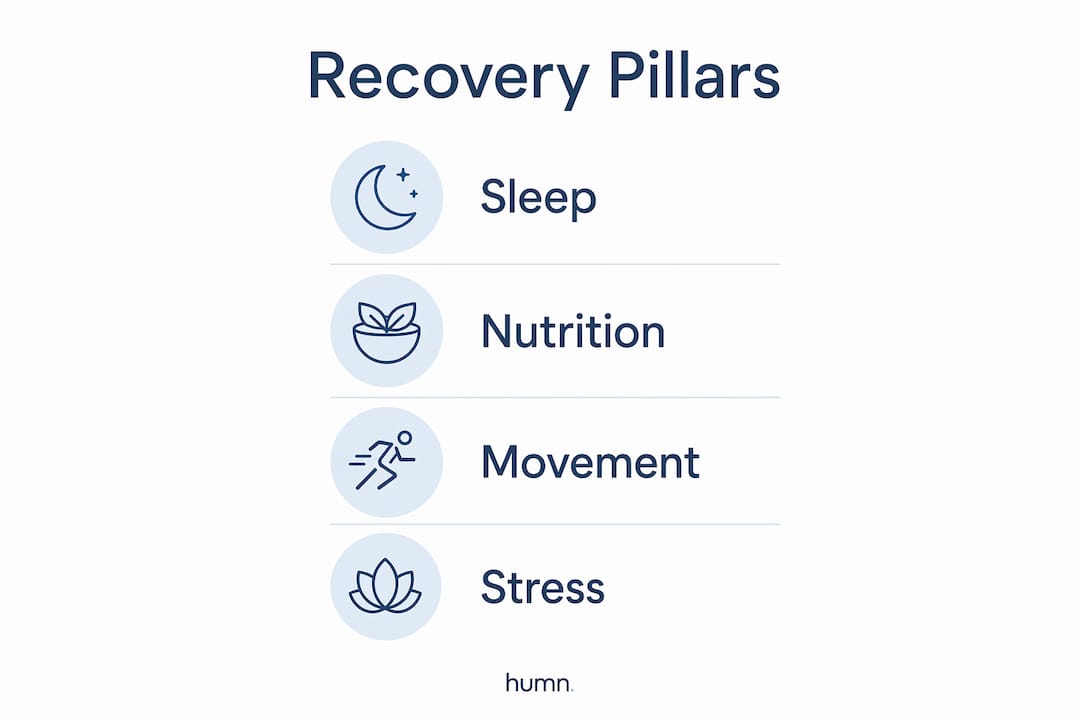
Sleep
Sleep is where the most consequential recovery biology happens. Aim for consistent, quality sleep with the same bedtime and wake time every day, including weekends. Consistency of sleep timing matters as much as duration because it stabilizes circadian rhythms that regulate cortisol and growth hormone cycles.

Do this today: Set a hard “screens off” time 30 minutes before bed and keep your room cool and dark.
Nutrition and hydration
Post-workout fueling is not optional. Carbohydrates and protein within roughly 45 minutes after intense training give your body the raw materials for glycogen resynthesis and muscle protein synthesis simultaneously. A ratio of roughly 3:1 carbohydrates to protein works well for most athletes after endurance-heavy sessions; strength-focused sessions lean toward equal parts.
Do this today: Pack a recovery snack (Greek yogurt and a banana, or a protein shake with a piece of fruit) and eat it within the hour after training.
Active recovery and movement
Low-intensity activity on easy days increases circulation, clears metabolic waste products, and delivers nutrients to repairing tissue faster than complete rest. A 20-minute walk, easy cycling, or a mobility session qualifies. The goal is blood flow, not additional training stress.

Do this today: Replace one “do nothing” rest day with a 20-minute walk or a light yoga session.
Stress management
Chronic psychological stress runs through the same physiological pathways as training stress. Elevated cortisol from life stressors is catabolic, suppresses immune function, and degrades sleep quality — all of which directly undermine adaptation. Balancing work, fitness, and recovery is not a lifestyle preference; it is a performance variable.
Do this today: Add one 10-minute decompression habit daily — a walk outside, breathwork, or simply sitting without a screen.
Pro Tip: When time or resources are tight, triage in this order: sleep first, then protein timing, then movement and stress tools. Skipping sleep to fit in an ice bath is the wrong trade every time.
How poor recovery leads to injury and what to watch for
Poor recovery does not just slow progress — it sets the stage for overuse injuries, tendon failure, and stress fractures because tissues are loaded again before they have fully repaired. Failure to allow adequate healing increases inflammation and degeneration in tendons, joints, and ligaments. The damage compounds quietly until something breaks.
Warning signs of under-recovery:
- Persistent muscle soreness lasting more than 72 hours after a session
- Elevated resting heart rate (3–5+ beats above your normal baseline)
- Disrupted sleep or difficulty falling asleep despite fatigue
- Mood decline, irritability, or loss of motivation to train
- Performance drops across multiple sessions, not just one bad day
- Increased frequency of minor illness (colds, infections)
Decision checklist when warning signs appear:
- Monitor for 3–5 days. Track resting HR, sleep quality, and session RPE. Use a training log or HRV app to spot trends rather than reacting to a single bad day.
- Modify training variables. Reduce volume by 30–50%, swap hard sessions for easy movement, and prioritize sleep and nutrition aggressively.
- Consult a clinician if signs persist beyond 2 weeks. A physical therapist, sports medicine physician, or primary care provider can rule out stress fractures, tendinopathy, or hormonal imbalance with imaging or bloodwork. Do not train through structural pain.
Flexibility work also plays a role in keeping tissues resilient under load — injury prevention strategies for athletes often start with mobility and range-of-motion work that reduces the mechanical stress concentrated at vulnerable joints.
How to program recovery into your weekly training
Planned recovery is not passive — it is periodization in action. Deload weeks do not just prevent burnout; they reveal the fitness that accumulated fatigue was masking. Deload weeks typically reduce training volume by 40–60% while maintaining intensity, and most athletes benefit from regularly scheduling them every 4–6 weeks to prevent performance decline.
Sample weekly microcycle:
| Day | Session intensity | Recovery action |
|---|---|---|
| Monday | Hard (strength/intervals) | Post-workout protein + carbs within 45 min |
| Tuesday | Easy (active recovery) | 20-min walk or mobility work |
| Wednesday | Moderate | Normal nutrition, 7–9 hrs sleep |
| Thursday | Hard (strength/intervals) | Post-workout fueling, early bedtime |
| Friday | Easy or rest | Light movement, stress decompression |
| Saturday | Moderate | Full nutrition, hydration focus |
| Sunday | Full rest or active recovery | Sleep priority, no structured training |
Programming rules:
- No more than two hard sessions in a row without an easy day between them
- Schedule deloads every 4–6 weeks, reducing volume by 40–60% each time, or sooner when warning signs appear
- During high life-stress periods (travel, poor sleep runs), treat the week as a deload regardless of where it falls in your cycle
- Pair hard lower-body and hard upper-body sessions on back-to-back days before an easy day rather than stacking two full-body hard sessions
Pro Tip: When external stress is high — a work deadline, travel, a run of bad sleep — cut training volume by 30–40% and keep intensity moderate. Trying to hit a peak week during a high-stress period almost always backfires.
What the research actually says about recovery tools
Basic recovery — sleep, nutrition, and scheduled rest — has the largest and most consistent effect on adaptation. Adjunct tools have real but specific, context-dependent benefits. Reaching for a cold plunge before fixing your sleep is like optimizing your tire pressure while running on empty.
What meta-analyses show about common modalities:
- Cold water immersion (CWI): Speeds short-term clearance of soreness and some muscle damage markers. Chronic use after strength sessions can blunt anabolic signaling and attenuate long-term hypertrophy — most useful during competition congestion, not routine training blocks.
- Compression garments: Modest positive effects on perceived soreness and some markers of muscle damage; evidence on power output is mixed.
- Massage: Reduces perceived soreness and psychological tension; limited direct effect on structural tissue repair but supports parasympathetic shift.
- Sleep: The single most evidence-backed recovery intervention. No adjunct tool compensates for chronic sleep debt.
- Nutrition timing: Carbohydrate and protein co-ingestion post-workout consistently supports glycogen resynthesis and muscle protein synthesis across populations.
“With enough time, the body often recovers naturally. Targeted recovery tools are most useful when competition density requires accelerated recovery — not as a daily ritual during normal training cycles.”
— BASES Expert Statement on Recovery Strategies
humn’s four-pillar framework — Resist, Recover, Renew, and Rhythm — maps directly onto this evidence hierarchy. Resist is the training stimulus; Recover covers sleep and nutrition; Renew addresses active recovery and movement quality; Rhythm integrates stress management and lifestyle consistency. The framework prioritizes the high-evidence foundations first and treats adjunct tools as supplements, not substitutes.
Recovery myths worth dropping and tips worth keeping
Quick tips for immediate application:
- Set a consistent sleep and wake time — even on weekends — to stabilize your cortisol and growth hormone cycles.
- Eat a carbohydrate-and-protein snack within 45 minutes of finishing an intense session.
- On easy days, move for 20–30 minutes at a pace where you can hold a full conversation.
- Track resting heart rate each morning. A sustained elevation of 5+ beats signals accumulated fatigue.
- Monitor HRV with a wearable (Whoop, Garmin, Oura Ring) and treat a multi-day downward trend as a deload trigger, not a motivation problem.
Myth vs. fact:
| Myth | Fact |
|---|---|
| You must be completely inactive on rest days | Active recovery — light walking, mobility work — often clears soreness faster than full rest |
| Cold water immersion after every workout guarantees gains | Chronic post-strength CWI can blunt hypertrophy; save it for competition blocks or acute soreness management |
| More training always means more progress | Past a threshold, additional volume without adequate recovery produces cumulative fatigue, not adaptation |
| Soreness means you had a good workout | Soreness is a sign of tissue stress, not quality. Persistent soreness is a warning sign, not a badge |
| You can catch up on sleep over the weekend | Sleep debt is not fully repaid in two nights; consistent nightly duration matters more than weekend binges |
If you can only change one habit right now, make it sleep. Consistent 7–9 hours of quality sleep improves protein synthesis, hormonal balance, mood, and performance simultaneously. Protein timing is a close second — it costs almost nothing and the evidence for it is strong across training populations.
What to do this week: your recovery action plan
Recovery is the engine of adaptation and athletic longevity. Without it, training is just stress with no return.
Three-item priority checklist:
- Sleep first. Commit to 7–9 hours with a consistent bedtime for the next seven days. Track it.
- Nail protein timing. Eat a carbohydrate-and-protein meal or snack within 45 minutes of every hard session this week.
- Schedule one deload element. If warning signs are present, cut this week’s volume by 40–60%. If not, replace one hard session with an active recovery day.
One-week micro-plan:
- Sleep goal: In bed by the same time every night; 7–9 hours minimum.
- Easy recovery sessions: Two sessions of 20–30 minutes of light movement (walking, cycling, mobility).
- Deload element: Reduce total weekly training volume by 40–60% if you have had two or more warning signs in the past week.
Sleep quality versus quantity: which one matters more?
Both matter, but quality has the edge when you have to choose. Eight hours of fragmented, light sleep does not deliver the same hormonal output as six hours of deep, uninterrupted sleep — though six hours is still too short for most people. The goal is enough total sleep AND enough slow-wave and REM sleep within it.
Slow-wave sleep is when growth hormone peaks. REM sleep is when the nervous system consolidates motor patterns and emotional regulation. Alcohol, late-night eating, and inconsistent sleep timing all suppress slow-wave sleep specifically, which is why two people logging the same hours can have very different recovery outcomes. A wearable that tracks sleep stages (Oura Ring, Whoop, Garmin) gives you a clearer picture than total hours alone. If your deep sleep is consistently under 15–20% of total sleep time, the fix is usually sleep timing consistency and reducing alcohol, not just going to bed earlier.
Your recovery needs are not the same as everyone else’s
Age, genetics, training history, and life stress all shift how much recovery you need and how fast you bounce back. A 22-year-old training for the first time recovers differently from a 45-year-old with a decade of accumulated training volume — and both recover differently from a competitive athlete in a peak training block.
Older athletes generally need more recovery time between hard sessions because protein synthesis rates slow with age and hormonal output (testosterone, growth hormone) declines. Beginners often recover faster from individual sessions but are more vulnerable to overuse injuries because their connective tissue adapts more slowly than their cardiovascular system. Highly trained athletes can tolerate more volume but are also more sensitive to the consequences of under-recovery because they train closer to their physiological ceiling. Genetics influence everything from muscle fiber composition to sleep architecture to inflammatory response — which is why two athletes on identical programs can have wildly different recovery needs. The practical answer is to use objective markers (resting HR, HRV, RPE trends, sleep quality) rather than copying someone else’s schedule. A personalized fitness plan built around your actual stress load and recovery capacity will always outperform a generic template.
The mental side of recovery most athletes underestimate
Physical recovery and psychological recovery share the same biological substrate. Chronic mental stress elevates cortisol, suppresses immune function, and degrades sleep quality — the same cascade that physical overtraining produces. You can have a perfectly programmed training week and still under-recover if your mind never fully downshifts.
Mental rest means deliberately stepping away from performance-related thinking: no analyzing your last session, no scrolling training content, no planning the next block. Relaxation techniques with the strongest evidence include diaphragmatic breathing (which directly activates the parasympathetic nervous system), progressive muscle relaxation, and mindfulness meditation. Even 10 minutes of intentional downregulation after a hard session accelerates the sympathetic-to-parasympathetic shift that recovery depends on. Athletes who treat mental decompression as part of their training program — not a luxury — tend to show more consistent performance across weeks and better tolerance for high-volume training phases.
How recovery fits into long-term training periodization
Recovery is not just what happens between sessions — it is a structural element of any well-designed long-term training plan. Adaptive fitness programming builds recovery phases into the architecture of a training year, not as gaps in the schedule but as deliberate phases that allow supercompensation to express itself.
At the microcycle level (weekly), easy days and hard days alternate to prevent cumulative fatigue. At the mesocycle level (3–6 weeks), a deload week resets fatigue and reveals the fitness built during the preceding block. At the macrocycle level (months to a year), transition phases between training seasons allow full systemic recovery — connective tissue, hormonal baseline, and psychological motivation all need longer windows than a single deload provides. Skipping any of these levels is where athletes accumulate the kind of fatigue that eventually forces an unplanned break. Planned recovery at every level is what separates athletes who improve year over year from those who plateau or get injured.
Emerging recovery methods: what the current evidence supports
The recovery tool market moves fast, and the evidence often lags behind the marketing. A few emerging methods have enough current support to be worth knowing about.
Compression technology has advanced beyond simple sleeves. Pneumatic compression devices (NormaTec is a widely recognized example) use sequential inflation to drive venous return and lymphatic clearance. Short-term evidence supports reduced perceived soreness and faster return to performance in competition-dense schedules, though the effect size is modest compared to sleep and nutrition.
Neurofeedback is an emerging area where real-time EEG feedback trains the brain toward parasympathetic-dominant states. Early research suggests it may reduce perceived stress and improve sleep quality in athletes, but the evidence base is still thin and the cost-to-benefit ratio is hard to justify for most people outside elite sport.
Red light therapy (photobiomodulation) has a growing body of research suggesting it may reduce muscle damage markers and inflammation when applied before or after training. The mechanisms involve mitochondrial stimulation. Evidence quality varies widely across studies, and optimal dosing protocols are not yet standardized.
Heart rate variability biofeedback is more established than neurofeedback and more accessible. Devices like Whoop and Oura Ring give daily HRV scores that, tracked over time, reliably reflect cumulative fatigue and readiness. Using HRV trends to guide deload timing is one of the most practical applications of emerging recovery technology for everyday athletes.
The consistent pattern across all emerging tools: they work best as supplements to a strong foundation of sleep, nutrition, and programmed rest. None of them rescue a broken recovery baseline.
Key Takeaways
Recovery is when adaptation happens — without it, training is just accumulated stress that produces fatigue, not fitness.
| Point | Details |
|---|---|
| Recovery drives adaptation | The supercompensation process — tissue repair, glycogen repletion, hormonal reset — happens during recovery, not during training. |
| Sleep is the highest-leverage tool | Growth hormone peaks during deep sleep; chronic sleep debt raises cortisol and directly impairs muscle protein synthesis and aerobic capacity. |
| Program deloads every 4–6 weeks | Reducing volume by 40–60% during a deload week clears accumulated fatigue and reveals fitness that was masked by tiredness. |
| Adjunct tools are context-dependent | Cold water immersion, compression, and massage have specific benefits but cannot substitute for sleep and nutrition; chronic CWI after strength sessions may blunt hypertrophy. |
| humn builds recovery into every program | humn’s four-pillar framework (Resist, Recover, Renew, Rhythm) structures sleep, nutrition, active recovery, and stress management as non-negotiable programming elements. |
The part of recovery most coaches still get wrong
Recovery is treated as passive in most gyms — something that happens by default when you are not training. That framing is the problem. Recovery is active, programmable, and measurable. The athletes who make the most consistent long-term progress are not the ones who train the hardest; they are the ones who recover the most deliberately.
What gets overlooked most often is the interaction between pillars. Sleep, nutrition, stress management, and movement are not independent levers — they are a system. Missing one degrades the others. A client who eats perfectly and trains intelligently but sleeps five hours a night is not recovering. The cortisol stays elevated, the growth hormone release is suppressed, and the tissue repair that should happen overnight simply does not. No amount of post-workout protein or ice baths compensates for that deficit.
The other thing coaches underestimate is the psychological load. Mental fatigue is physiologically real — it shares the same cortisol-driven pathway as physical overtraining. Athletes who never mentally decompress are running a cortisol surplus that their training program never accounts for. Building in deliberate mental rest is not soft; it is physiology.
The practical takeaway: treat recovery with the same intentionality you bring to your training sessions. Schedule it, track it, and adjust it when the signals tell you to. That is the difference between a training program and a performance system.
Recovery coaching at humn: what it actually looks like
Most gyms give you a workout. humn gives you a system. For athletes and fitness enthusiasts who want their recovery to be as structured as their training, humn’s 1-on-1 coaching integrates sleep coaching, nutrition timing, stress management, and deload programming directly into your plan — not as add-ons, but as the foundation.

Clients working with humn coaches in Gaithersburg, MD, get a behavior-based program built around their actual schedule, stress load, and recovery capacity. That means fewer injuries, more consistent progress, and a training plan that holds up over months and years — not just the next six weeks. If you are ready to train smarter and recover with the same intention you bring to your workouts, book a session with humn and see what a recovery-first approach actually produces.
Useful sources
- Supercompensation and the Physiological Basis of Adaptation — Journal of Applied Physiology: The foundational peer-reviewed paper explaining how training stimulus and recovery produce adaptation; essential reading for understanding the supercompensation model.
- The Importance of Rest and Recovery for Athletes — MSU Extension: Practical institutional guidance covering sleep, hormonal dynamics, and monitoring tools for individualized recovery; useful for coaches and athletes alike.
- Rest and Recovery Are Essential for Athletes — UCHealth Today: Clinical perspective on physiological and psychological recovery, including the role of stress, active recovery, and injury prevention.
- BASES Expert Statement on Recovery Strategies: Practitioner consensus from the British Association of Sport and Exercise Sciences on when and how to deploy adjunct recovery tools; particularly useful for understanding competition-block versus training-block strategy.
- Systematic Review and Meta-Analysis on Recovery Modalities — PMC: Peer-reviewed meta-analysis examining the evidence for compression, cold water immersion, and massage; the source for understanding context-dependent benefits and the risks of chronic CWI after strength training.
- The Importance of Recovery in Any Exercise Plan — Nuffield Health: Accessible clinical overview of nutrition timing and recovery programming; good reference for the 45-minute post-workout fueling window.
- Why Recovery Is More Important Than Training — Sportian Network: Expert piece covering deload structure and timing, including the 40–60% volume reduction guideline and the 4–6 week deload cycle.
No Comments.