


Functional nutrition coaching is a systems-based, behavior-focused practice that helps you translate personalized nutrition recommendations into repeatable daily habits that support strength, recovery, and long-term performance. It’s best suited for fitness and lifestyle clients who already train consistently but struggle to connect what they eat to how they feel, recover, and perform. At humn in Gaithersburg, MD, this approach is woven into every coaching relationship through its four-pillar framework: Resist, Recover, Renew, and Rhythm.
Table of Contents
- What is functional nutrition coaching, really?
- How does a functional nutrition coaching program actually work?
- What should you expect in a session and over the first 3 months?
- What are the real benefits for fitness and lifestyle clients?
- How does functional nutrition coaching differ from dietitians, functional medicine, and diet programs?
- What coaches will not do and when you need clinical help instead
- How do you choose the right functional nutrition coach?
- A sample 12-week roadmap for a strength-focused client
- What evidence supports this approach, and how does humn implement it?
- Key Takeaways
- Why functional nutrition coaching belongs at the center of humn’s approach
- humn’s nutrition coaching is built into your training, not bolted on
- Useful sources for further reading
What is functional nutrition coaching, really?
At its core, functional nutrition coaching is systems-based and personalized, treating the body as a network of interconnected systems rather than a collection of isolated symptoms. Digestion, hormones, sleep quality, stress response, and training recovery all influence each other. A coach looks at those relationships, not just your macros.
The practice is also behavior-first. Rather than handing you a rigid meal plan, a functional nutrition coach uses habit design, accountability check-ins, and small testable experiments to build skills you keep long after the program ends. Personalization comes from your history: food patterns, training schedule, sleep quality, stress load, and lifestyle context. This is not clinical diagnosis. It’s pattern recognition applied to your daily life.
Key principles behind the approach:
- Root-cause orientation: coaches look past surface symptoms (low energy, poor recovery) to identify contributing patterns
- Biochemical individuality: what works for one person may not work for another, even with identical training loads
- Whole-food emphasis: nutrient-dense foods over supplements or elimination extremes
- Behavior and environment as primary levers: lifestyle drivers like stress and sleep shape eating behavior as much as food knowledge does
- Sustainability over perfection: coaches prioritize iterative progress and treat setbacks as data, not failure
Pro Tip: If you’re already training 3–5 days per week but your energy, sleep, or body composition isn’t moving, that’s usually the signal that nutrition coaching will give you more leverage than adding another workout.
How does a functional nutrition coaching program actually work?
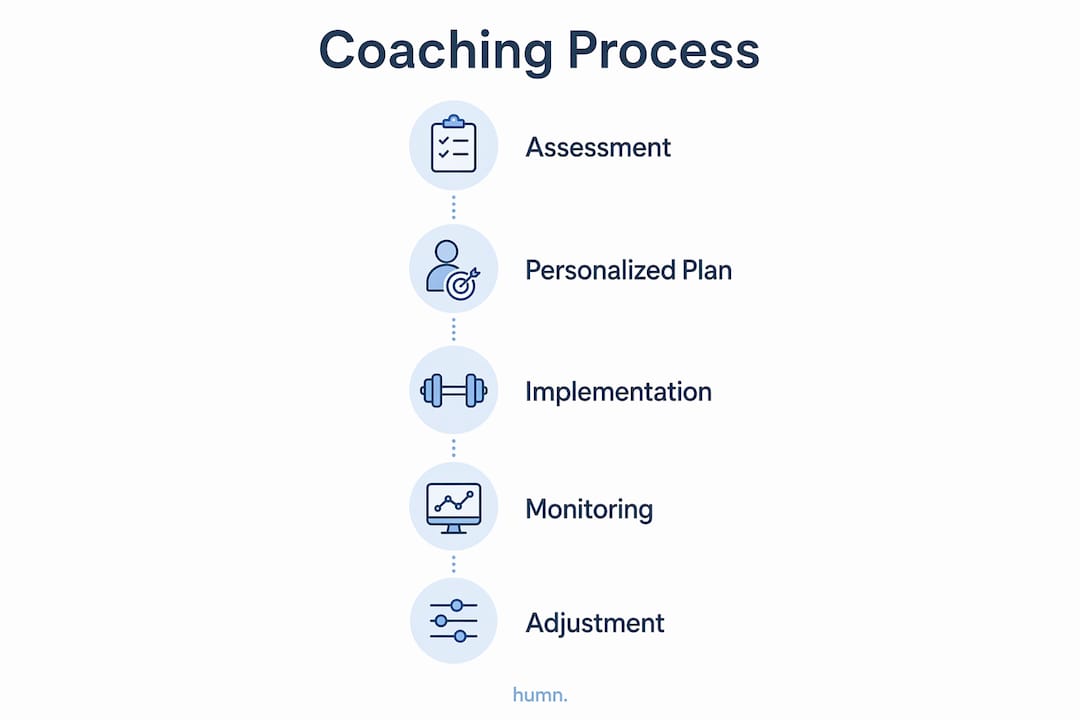
A typical program moves through four phases: intake assessment, baseline data review, small-habit experiments, and adaptive adjustment. Most clients see measurable improvements within a few weeks when they engage consistently.
Phase-by-phase breakdown:
- Intake (weeks 0–2): Your coach collects a detailed health history, current food patterns, training schedule, sleep data, and stress context. This is where goals get defined and prioritized.
- Baseline and goal-setting (weeks 2–4): Together, you identify 1–2 specific, measurable targets. A coach may also flag whether functional testing (hormone panels, stool analysis) could be useful and refer you to a clinician if so.
- Micro-habit experiments (weeks 4–8): Small, targeted changes are introduced one at a time. Protein timing, a single nutrient-dense food swap, or a consistent pre-sleep routine. Each change is tracked and evaluated before the next is added.
- Adaptive adjustment (weeks 8–12 and beyond): The coach reviews what’s working, modifies what isn’t, and scales habits that stick. Maintenance coaching continues at reduced frequency once core habits are embedded.
Before your first call, gather:
- A 3–5 day food log (photos or written)
- Your current training schedule and weekly volume
- Sleep duration and quality notes (even rough estimates)
- Any recent bloodwork or lab results you have access to
What should you expect in a session and over the first 3 months?
A single session typically runs about an hour and follows a consistent structure: a brief check-in on the past week, a review of any tracked data (food log, sleep score, training quality), and collaborative micro-goal setting for the coming week. The coach asks questions more than they prescribe answers.

Session frequency usually starts frequent, then shifts to less often as habits stabilize. Coaches adjust cadence around training cycles, competition prep, or travel periods. A client heading into a heavy training block may need more frequent check-ins; someone in a maintenance phase may check in monthly.
Common early adjustments coaches make:
- Shifting meal timing to align with training windows
- Adding a protein anchor to breakfast to reduce afternoon energy crashes
- Introducing a consistent sleep window to improve recovery metrics
- Swapping one processed convenience food for a whole-food alternative
Progress in the first 3 months is rarely linear. You might feel better in week 3, plateau in week 6, and see a clear shift in training quality by week 10. That non-linear arc is normal. Accountability and adaptive coaching are what keep clients on track through the dips, not willpower.
What are the real benefits for fitness and lifestyle clients?
The clearest gains show up in four areas: training consistency, recovery quality, sustained energy, and food literacy. These aren’t abstract wellness outcomes. They’re measurable.
Outcomes clients typically track over several weeks:
- Morning energy rating (1–10 scale, logged daily)
- Sleep duration and subjective quality
- Training performance trends (load, reps, perceived effort)
- Body-composition changes tracked via consistent weigh-ins or progress photos
- Protein intake relative to training volume
Coaching emphasizes sustainable behavior change and tools clients can use independently after the program ends. That’s the food literacy piece. You stop needing someone to tell you what to eat because you understand why certain choices support your training and which ones undermine it.
For strength-focused clients, eating for athletic performance is less about hitting a perfect macro split every day and more about building consistent patterns around training load. A coach helps you find those patterns without turning every meal into a math problem.
How does functional nutrition coaching differ from dietitians, functional medicine, and diet programs?
The primary difference is scope and purpose. A functional nutrition coach is a behavior-change specialist, not a licensed clinician.
| Category | Functional Nutrition Coach | Registered Dietitian (RD) | Functional Medicine Practitioner |
|---|---|---|---|
| Legal authority | No clinical license | Licensed clinician | Licensed clinician (MD, DO, ND) |
| Scope | Habits, behavior, lifestyle | Medical nutrition therapy, diagnosis | Diagnosis, lab interpretation, treatment |
| Methods | Habit design, accountability, food education | Clinical assessment, therapeutic diets | Comprehensive lab testing, treatment protocols |
| Typical outcomes | Consistency, food literacy, performance | Disease management, clinical nutrition | Root-cause disease resolution |
| When to use | Behavior change, performance, lifestyle | Medical conditions, eating disorders, clinical needs | Chronic illness, complex lab findings |
Coaches and clinicians work best together. A coach can implement the dietary recommendations an RD or physician makes, providing the accountability and habit-design support that clinical appointments rarely have time for. Functional nutrition is patient-centered and evidence-informed, drawing from functional medicine principles while staying within a non-clinical scope.
What coaches will not do and when you need clinical help instead
Functional nutrition coaches in the U.S. are not licensed clinicians. They do not diagnose conditions, interpret lab results, prescribe supplements, or provide Medical Nutrition Therapy (MNT). That boundary protects you.
Refer to a clinician when you notice:
- Unexplained weight loss or gain despite consistent habits
- Persistent fatigue that doesn’t respond to sleep or nutrition changes
- Digestive symptoms that are severe or worsening
- Lab results outside normal ranges (flagged by a physician)
- Any history of disordered eating
A coach can coordinate with your physician or RD once clinical care is in place. Bring your food log, sleep data, and training notes to that appointment. Clinicians rarely have time to gather that context themselves, and your coach’s records give them a clearer picture.
Pro Tip: Ask any coach you’re considering: “What would make you refer me to a dietitian or doctor?” A confident, specific answer is a green flag. Hesitation or a vague response is not.
How do you choose the right functional nutrition coach?
Start with credentials, then evaluate fit through a discovery call.
Credentials worth looking for:
- Precision Nutrition (PN1 or PN2) certification
- National Academy of Sports Medicine (NASM) Certified Nutrition Coach
- Functional Medicine Coaching Academy (FMCA) certification
- Institute for Integrative Nutrition (IIN) Health Coach credential
- American Fitness Professionals & Associates (AFPA) Nutrition Coach certification
None of these are clinical licenses. They signal training in behavior change, nutrition science, and coaching methodology. An RD credential is a clinical license and indicates a different (and broader) scope.
Questions to ask on a discovery call:
- How do you track client progress beyond food logs?
- How do you handle clients who need clinical support?
- What does your first 4 weeks look like in practice?
- Can you describe a client situation where you adjusted the plan mid-program?
Pricing and commitment:
| Format | Typical pricing varies by format and commitment, including single sessions, monthly retainers, fixed-term packages, and ongoing integrated coaching. |
Red flags: guaranteed results in a fixed timeframe, any suggestion of prescribing medications or supplements, one-size-fits-all meal plans with no intake process, and pressure to commit before a discovery call.
A sample 12-week roadmap for a strength-focused client
The goal over several weeks: improve recovery quality and training consistency by building foundational nutrition habits tailored to your strength program frequency.
Week-by-week highlights:
- Weeks 1–2: Intake and baseline. Coach reviews food log, sleep data, and training schedule. Client tracks morning energy and post-workout recovery ratings.
- Weeks 3–4: First experiment. Add a protein anchor to breakfast (30g target). Track energy at 10 AM and 2 PM for two weeks.
- Weeks 5–6: Meal timing adjustment. Shift the pre-workout meal 90 minutes before training. Note perceived effort and session quality.
- Weeks 7–8: Sleep window experiment. Consistent lights-out time within a 30-minute window. Coach reviews recovery scores weekly.
- Weeks 9–10: Progress check. Coach reviews all tracked metrics. Adjust protein distribution across meals if morning anchor is stable.
- Weeks 11–12: Integration and maintenance plan. Client can sustain three habits independently. Coach reduces frequency to biweekly and sets a 30-day check-in.
For competition weeks, travel, or illness, the coach simplifies the plan to one non-negotiable habit rather than abandoning structure entirely. Adaptive programming keeps clients from losing momentum when life gets complicated.
Specific habit examples tied to training load:
- Distribute protein across 3–4 meals rather than back-loading it at dinner
- Use a fitness habit loop to anchor post-workout nutrition to an existing routine
- Reduce refined carbohydrates on rest days, increase them on heavy training days
What evidence supports this approach, and how does humn implement it?
Functional nutrition is a systems-based, personalized approach supported by functional medicine research and behavior-change science. The Institute for Functional Medicine describes it as a practice that “helps reveal nutritional imbalances and possible root causes” while providing a therapeutic path through nutrient-dense dietary treatments.
Behavior-change frameworks used in coaching, including habit stacking, self-monitoring, and motivational interviewing, are grounded in established psychological research. Coaches act as behavior-change experts who support implementation and accountability, complementing clinical care rather than replacing it.
“Every bite we take sends signals to the body that influence our hormones, digestion, inflammation, and even mood. When we eat to support the body’s natural processes, we create the conditions for healing, resilience, and longevity.” — Functional Medicine Coaching Academy
How humn implements this framework:
- Resist: Strength programming designed around progressive overload, with nutrition coaching aligned to training load and recovery demands
- Recover: Dedicated recovery access and coaching on sleep, stress, and post-training nutrition to reduce injury risk and improve adaptation
- Renew: Lifestyle habit work that addresses the behavioral drivers of inconsistent eating and energy management
- Rhythm: Long-term sustainability built through repeatable routines, not periodic resets
humn’s behavior-based fitness programs integrate nutrition coaching directly with training, so the two reinforce each other rather than running in parallel.
Key Takeaways
Functional nutrition coaching works because it treats behavior, environment, and food as one system, and builds habits that outlast the coaching relationship itself.
| Point | Details |
|---|---|
| Systems-based approach | Coaches address digestion, sleep, stress, and training as interconnected levers, not isolated variables. |
| Behavior-first methods | Small, testable experiments replace rigid meal plans; progress builds through iteration, not perfection. |
| Timeline for results | Most clients see measurable improvements within 6–12 weeks of consistent engagement. |
| Know when to refer | Coaches do not diagnose or prescribe; symptoms requiring clinical care need an RD or physician. |
| humn’s integration | humn combines nutrition coaching with strength training and recovery under its Resist, Recover, Renew, Rhythm framework. |
Why functional nutrition coaching belongs at the center of humn’s approach
The four-pillar framework at humn isn’t just a marketing structure. It reflects a genuine belief that strength, recovery, lifestyle, and rhythm are inseparable. You can’t optimize one without addressing the others. Functional nutrition coaching is where that integration becomes concrete.
Generic diet programs give you a plan. What they don’t give you is someone who adjusts that plan when your sleep falls apart in week 6, or when a work trip derails your meal prep. That adaptive layer is what separates coaching from content. Clients at humn get both the framework and the person who holds them accountable to it, week after week, in a boutique setting built for exactly this kind of long-term work.
The case for this approach isn’t theoretical. Clients who combine 1-on-1 fitness coaching with nutrition support consistently report better training quality and more sustainable body-composition changes than those who address training and nutrition separately. The integration is the advantage.
humn’s nutrition coaching is built into your training, not bolted on
Most nutrition programs exist in a separate lane from your training. At humn, they’re the same lane. The premium coaching model integrates habit-first nutrition support directly with your strength programming and recovery work, so every recommendation your coach makes is grounded in what you’re actually doing in the gym that week.

Your first call with a humn coach covers a full lifestyle and training assessment: current food patterns, sleep quality, training history, and your specific performance goals. From there, you’ll get a clear picture of what a 12-week engagement looks like and which service format fits your schedule. No guesswork, no generic handouts. Book your discovery call at livehumn.com and find out what coaching that actually integrates with your training feels like.
Useful sources for further reading
These sources are worth bookmarking if you want to go deeper on any aspect of functional nutrition coaching.
- Institute for Functional Medicine (IFM): The primary clinical reference for functional nutrition principles; best for understanding the evidence base behind systems-based nutrition.
- Functional Medicine Coaching Academy (FMCA): Explains the coach’s role in applying functional nutrition principles; useful for understanding what a certified health coach actually does.
- Academy of Nutrition and Dietetics (eatright.org): The authoritative source on scope of practice for nutrition professionals in the U.S.; go here for clinical questions and RD referrals.
- IFN Academy: Practical overview of functional nutrition for practitioners and clients; good starting point for understanding personalization methods.
- ACHS (American College of Healthcare Sciences): Covers whole-food emphasis and biochemical individuality; useful for certification research.
- Healthline: What Does a Nutrition Coach Do?: Consumer-friendly breakdown of coach scope and legal limits; best for readers comparing coach vs. dietitian options.
- mindbodygreen: Functional Nutrition: Accessible explainer on how functional nutrition differs from conventional dietary advice; good for sharing with clients new to the concept.
- humn (livehumn.com): For readers in the Gaithersburg, MD area looking for integrated coaching that combines strength training, recovery, and nutrition support under one roof.
No Comments.