


For most healthy adults, a safe sauna session runs 5 to 20 minutes, with beginners starting closer to 5 or 10 minutes and building up gradually. Skip the sauna entirely if you’ve had a recent cardiac event, unstable angina, or if you’ve been drinking. Anyone pregnant or managing a chronic condition should get medical clearance before making sauna sessions a habit.
TL;DR:
- Sessions should be limited to 5–20 minutes, with newcomers starting closer to 5 or 10 minutes, especially in traditional dry saunas.
- People with recent cardiac events, unstable angina, or certain chronic conditions need medical clearance before sauna use or should avoid it altogether.
- Hydration is essential before, during, and after sessions, and alcohol should be avoided as it significantly increases the risk of sudden health emergencies.
- Using lower benches and removing metal jewelry reduces overheating and burn risks, especially for beginners and those feeling overheated.
- Frequent supervision, proper facility safety measures, and honest screening are critical to prevent heat-related injuries and medical emergencies.
Table of Contents
- Sauna Safety Guidelines: The Quick Checklist
- Sauna Temperatures and Time Limits by Type
- Who Should Skip the Sauna or Talk to a Doctor First
- Before, During, and After: Reducing Heat-Related Risk
- Recognizing Heat Illness and When to Call for Help
- Facility Safety Checklist for Sauna Operators
- What Recommended Clothing Should You Wear in a Sauna?
- Sauna Use for Children and Older Adults
- How We Put Sauna Safety Into Practice at humn.
- Our Take: Safety Guidance Works Best When Someone Enforces It
- How humn. Helps You Sauna Safely
- Sources
- FAQ
Sauna Safety Guidelines: The Quick Checklist
Before your first session, or your five hundredth, run through this list. It covers the mistakes that cause most sauna injuries.
- Start with 5 to 10 minutes if you’re new; experienced users can go up to 20.
- Never enter a sauna after drinking alcohol. Combining heat and alcohol is a documented contributor to sudden sauna deaths in Finnish data, showing up in a significant fraction of cases.
- Delay your session if you’re dehydrated, feverish, or feeling unwell.
- Go with someone else, or make sure staff can check on you. Solo sessions in unsupervised facilities are riskier than they look.
- Sit on a lower bench if you start feeling overheated. Heat rises, so the top bench can run noticeably hotter than the bottom one.
- Take off metal jewelry before you go in. It heats up fast and can burn skin.
- Skip the sauna immediately after an intense workout. Let your heart rate settle first.
- Exit right away if you feel dizzy, nauseated, or notice your heart pounding irregularly.
Pro Tip: Set a timer on your phone before you go in. Sauna heat is disorienting enough that most people lose track of time within the first five minutes.
Sauna Temperatures and Time Limits by Type
Traditional dry saunas run 150 to 195°F (65 to 90°C), while infrared saunas heat the body more directly at a lower ambient temperature, typically 120 to 150°F (49 to 65°C). That difference matters for how long you should stay in each.
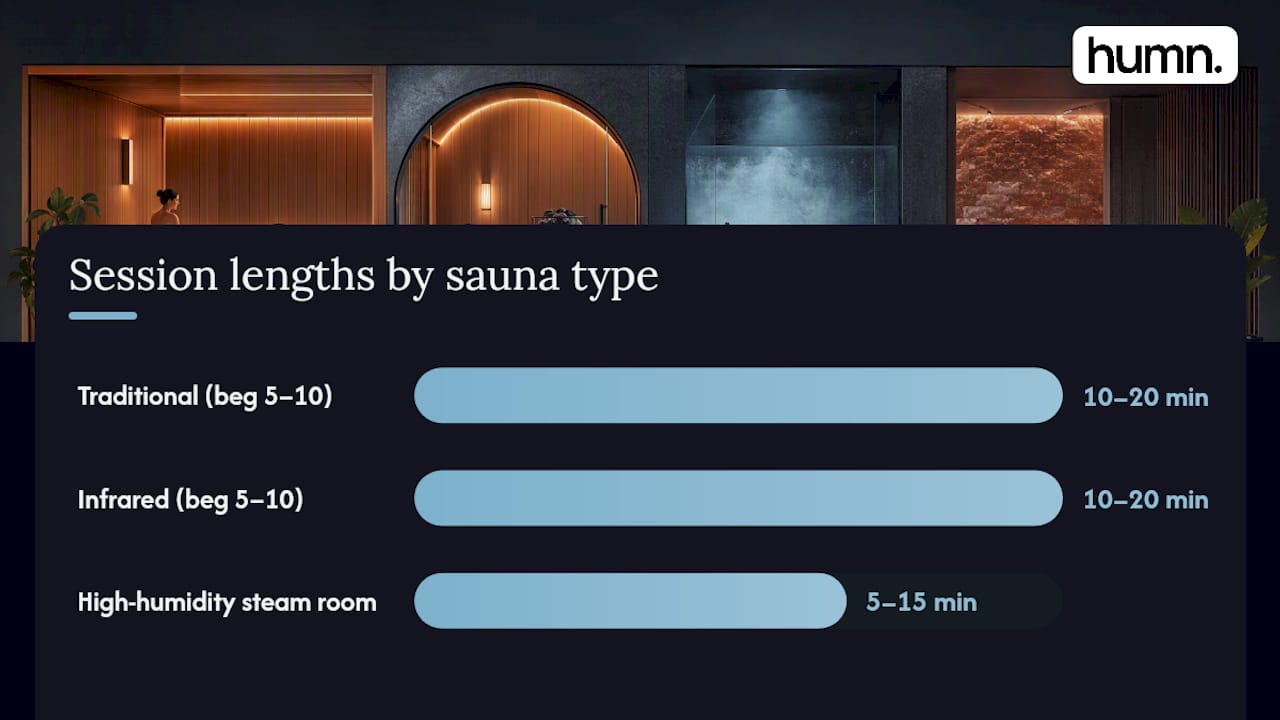
A clinical review of sauna bathing found that most sessions fall between 5 and 20 minutes, often repeated 1 to 3 times with a cooling break between rounds. Going past 30 minutes in a traditional sauna offers little added benefit and raises the risk of dehydration or overheating.
Humidity changes the math. The old sauna operator’s Rule of 200 says that room temperature (in Fahrenheit) plus relative humidity percentage should stay near 200 for a comfortable, safe session.
| Sauna type | Typical temperature | Suggested session length |
|---|---|---|
| Traditional dry sauna | 150–195°F (65–90°C) | 10–20 minutes, beginners 5–10 |
| Infrared sauna | 120–150°F (49–65°C) | 10–20 minutes, beginners 5–10 |
| High-humidity steam room | Lower temp, high humidity | 5–15 minutes, adjust per Rule of 200 |
For routine users, 3 to 4 sessions a week tends to be a sustainable rhythm that pairs well with training recovery without overtaxing the body.
Who Should Skip the Sauna or Talk to a Doctor First
Not everybody handles heat stress the same way. Some conditions rule out sauna use outright; others just call for a conversation with a doctor first.
- Absolute no-go conditions: unstable angina, a heart attack within the past few weeks to months, severe aortic stenosis, decompensated heart failure, or an uncontrolled arrhythmia. These aren’t situations where “starting slow” applies. Skip the sauna until a cardiologist clears you.
- Conditions that need medical clearance, not automatic avoidance: pregnancy, especially in the first trimester, uncontrolled high blood pressure, advanced kidney disease, epilepsy, and multiple sclerosis. A 2018 review found pregnant women could sit in a dry sauna at 70°C and 15% humidity for up to 20 minutes without crossing the core temperature threshold linked to birth defects, but that finding doesn’t apply to anyone with pregnancy complications.
- Medications that change how your body handles heat: diuretics increase dehydration risk, beta-blockers blunt your heart rate response to heat stress, anticholinergics reduce sweating, and stimulants or tricyclic antidepressants can interfere with temperature regulation. If you take any of these regularly, ask your prescriber whether sauna use needs modification.
- What to bring to that clinician conversation: your current medication list, your most recent blood pressure and heart rate readings, and a plain description of any symptoms you’ve noticed, including fatigue, dizziness, or chest discomfort during heat exposure.
The Harvard Health guidance on sauna use notes that heart rate can climb substantially during a session, which is exactly why people with controlled but real cardiac history should ease in rather than jump to a 20 minute session on day one.
Before, During, and After: Reducing Heat-Related Risk
Good sauna habits aren’t complicated, but they’re easy to skip when you’re in a hurry.
Before you go in: drink fluids ahead of time, skip alcohol and heavy meals, and if you just finished an intense workout, give your heart rate a few minutes to come down first.
During the session:
- Sit lower if the heat feels intense.
- Cap yourself at 2 to 3 rounds with breaks between them.
- Check in with yourself, or have a buddy check in with you, every few minutes.
After you leave: cool down gradually rather than jumping straight into a cold shower, rehydrate with cool fluids, and add electrolytes if you did multiple rounds. Stand up slowly. A quick drop in blood pressure after sitting in heat is a real cause of fainting.
If you’re new to sauna use, build tolerance over 7 to 14 days rather than pushing for a long session right away. You’ll know you’re ready to increase your time when a session that used to feel intense starts feeling manageable. For a deeper breakdown of fluid needs across multiple sessions, humn.'s sauna hydration protocol is worth a look.
Pro Tip: Lose your sauna habit for a week and your heat tolerance drops with it. Ease back in at your original beginner pace rather than picking up where you left off.
Recognizing Heat Illness and When to Call for Help
A severe headache, confusion, or fainting inside or after a sauna session is not something to wait out. Get out of the heat immediately, move to a cool area, remove excess clothing, and apply cool water or ice packs to the neck, armpits, and groin. If the person is conscious, give small sips of cool water.
Call 911 for suspected heatstroke, if someone loses consciousness, or if confusion doesn’t clear quickly once they’re cooled down. Don’t assume they’ll “walk it off.”
Alcohol and certain medications make this more dangerous because they mask the warning signs your body would otherwise send. Someone who’s been drinking may not notice they’re overheating until they’re already in trouble, which is part of why alcohol shows up so often in sauna-related emergencies.
Facility Safety Checklist for Sauna Operators
Individual users can only follow safety guidelines a facility actually supports. A well-run sauna room does its part too.
- Monitor temperature and humidity regularly, and keep ventilation and electrical systems inspected on a set schedule.
- Install non-slip flooring and check bench stability, since wet wood surfaces are a common slip hazard.
- Post clear signage: recommended session limits, contraindications, a no-alcohol policy, and emergency contact information.
- Train staff to recognize heat illness symptoms, respond to emergencies, and screen new members for red-flag conditions before their first session.
Industry best-practice guidance treats these controls as standard, not optional, and facilities that enforce them consistently see fewer incidents than those that leave safety to individual judgment.
What Recommended Clothing Should You Wear in a Sauna?
Loose, breathable clothing or a plain towel is the standard recommendation, and the choice mostly comes down to hygiene and comfort rather than safety mechanics. A towel to sit on protects the bench from sweat and protects your skin from a surface that’s been baking at 150°F or higher.
Synthetic athletic wear is a poor choice. Materials that don’t breathe trap heat against skin and can make it harder for sweat to evaporate, which is the whole point of sitting in a sauna in the first place. Cotton or linen wraps work better if you’d rather not go bare.
Jewelry is the one item that actually creates risk rather than just discomfort. Metal rings, necklaces, and watches heat up quickly and can cause burns on contact with skin, so take them off before you go in.

Footwear is a judgment call. Bare feet are common in private and home saunas, but shared facilities often recommend sandals or flip flops between the changing area and the sauna room itself, mainly to avoid fungal infections picked up from damp floors.
If your facility requires a shower before entering, that’s not just etiquette. Rinsing off lotions, sunscreen, and deodorant residue keeps those products from heating on your skin and reduces the smoke and odor that build up on hot surfaces. It also matters for the next person using the bench after you.
Sauna Use for Children and Older Adults
Children regulate heat differently than adults; their sweat glands are less developed and their body surface to mass ratio makes them heat up faster. Most pediatric guidance leans toward avoiding saunas for young children altogether, and where they are allowed, sessions should run only a few minutes with close adult supervision the entire time.
Older adults face a different set of concerns. Age related changes in cardiovascular response mean a sauna raises heart rate and shifts blood flow the same way it does for anyone else, but with less physiological reserve to absorb that stress. That doesn’t mean seniors need to avoid saunas. It means shorter sessions, a lower bench, closer attention to symptoms like dizziness or chest tightness, and a straightforward conversation with a doctor if there’s any history of heart disease, blood pressure medication, or balance issues that make a hot, slippery room riskier.
Both groups benefit from the same core adjustment: shorter time, lower temperature exposure, and someone else in the room who knows what warning signs look like.
How We Put Sauna Safety Into Practice at humn.
Sauna access is recommended as part of a supervised recovery environment, not a solo add-on. Members follow a structured session progression, starting shorter and building up, paired with the hydration protocol our coaching team developed from the same clinical guidance cited throughout this article.
Check-ins matter here. Before a first sauna session, it is important to consider recent illness, medications, and known cardiac history, similar to triage questions a clinician might ask. The key difference with supervised recovery spaces is that someone monitors how you are doing in the heat, not just whether the sauna is occupied.
Our Take: Safety Guidance Works Best When Someone Enforces It
Most sauna safety advice online is technically correct and practically useless, because it assumes users will self-regulate perfectly every time. They won’t. People lose track of time, skip hydration because they’re in a hurry, and ignore dizziness because they don’t want to “waste” their session. The guidance in this article only works if something or someone actually enforces it.
That’s the gap conventional advice misses. Time limits and temperature ranges are the easy part. Supervision, honest screening before someone with an unstable heart condition walks into 190°F heat, and a culture where stepping out early isn’t seen as failure, that’s what actually prevents the rare but real incidents the research describes.
If you take one thing from this guide, prioritize the screening conversation over the session length. A cleared, well-hydrated person doing 20 minutes is fine. An uncleared person with an undisclosed heart condition doing 10 minutes is not.
— Josh
How humn. Helps You Sauna Safely
Sauna access can be integrated into a supervised recovery system rather than a solo, unattended room. That’s the practical difference for anyone who’s read this far and realized that most sauna injuries come down to a lack of oversight rather than bad intentions.

Members get sauna time alongside compression and red light therapy, all run through the same recovery services coaches monitor as part of your broader program. Sessions typically follow hydration protocols like those referenced here, and screening questions similar to contraindications are asked before exposure to heat. If managing a health condition or taking medication that affects heat tolerance, medical clearance is recommended before sauna use.
Ready to see how supervised recovery fits into your routine? Check out humn. membership options and book a visit to start with a session length that actually matches where you are.
This article is general information, not a substitute for advice from a qualified doctor. Consult a qualified healthcare professional about your own circumstances before acting on anything here.
Sources
- Saunas and your health — Harvard Health
- Systematic review on sauna use in pregnancy (2018) — PubMed
- Heat Stress: Overview — NIOSH/CDC
- Are saunas good for you? — Poison Control
FAQ
What are the safety precautions for using a sauna?
Stay hydrated before and after, avoid alcohol entirely, and limit sessions to 5 to 20 minutes, starting shorter if you’re new. Exit immediately if you feel dizzy, nauseated, or notice heart palpitations, and skip the sauna if you have an unstable cardiac condition or recent illness.
What is the Rule of 200 in a sauna?
The Rule of 200 is a rough guideline stating that a sauna’s temperature in Fahrenheit plus its relative humidity percentage should stay near 200 for a tolerable, safe session. A hotter room with lower humidity feels similar to a cooler room with higher humidity, and either extreme calls for a shorter stay.
What are the do’s and don’ts of sauna use?
Do hydrate beforehand, start with short sessions, and sit lower if you feel overheated. Don’t drink alcohol before or during a session, don’t go in dehydrated or feverish, and don’t ignore dizziness or an irregular heartbeat.
Who should not use a sauna?
People with unstable angina, a recent heart attack, severe aortic stenosis, decompensated heart failure, or uncontrolled arrhythmia should avoid saunas entirely. Pregnant women and people with uncontrolled hypertension, advanced kidney disease, epilepsy, or multiple sclerosis should get medical clearance before using one.
How often can you safely use a sauna each week?
Routine, healthy users typically tolerate 3 to 4 sessions a week without issue, though beginners should build up gradually over 7 to 14 days rather than starting at that frequency. Anyone managing a chronic condition should confirm frequency with a doctor first.
No Comments.