


Do this now: chin tuck for 5 reps, shoulder rolls for 10 seconds, then a seated chest opener for 15 seconds. That takes 60 to 90 seconds and covers the three spots that tighten fastest at a desk. Repeat it every 30 to 60 minutes, and add two longer 5-minute routines somewhere in your workday. That’s the whole strategy, backed by research on short workplace exercise routines. Everything below just fills in the how and why.
TL;DR:
- Short, frequent posture routines, like a 90-second resets every 30 to 60 minutes, significantly reduce neck, shoulder, and back pain.
- The longer five-minute exercises focus on strengthening key muscles such as the glutes, back, and hips to support better posture over time.
- Proper form during stretches, including chin tucks and scapular squeezes, is essential for lasting improvement and avoiding injury.
- Combining these movements with ergonomic workstation adjustments enhances their effectiveness and prevents the reintroduction of strain.
- Consistent practice over weeks, rather than occasional stretching, is necessary to correct longstanding postural issues.
Table of Contents
- Two Ready-To-Use Posture Exercises for Desk Workers
- How to Do the Highest-Value Moves Correctly
- How Often Should You Do Posture Exercises at Work?
- When to Modify or See a Clinician
- Desk-Friendly Exercises by Body Area
- Why Desk Work Wrecks Your Posture
- What Better Posture Actually Gets You
- Ergonomic Tips That Make These Exercises Work Better
- How Coaches Layer This Into a Real Program
- Ready for More Than a Quick Fix?
- Sources
- FAQ
Two Ready-To-Use Posture Exercises for Desk Workers
You need exactly two routines in your back pocket: one that takes less time than pouring coffee, and one that takes about as long as reading this section.
The 90-second hourly reset works through the body from the top down, which keeps you from bouncing between muscle groups when time is short. Start with 5 slow chin tucks, pulling your head straight back like you’re avoiding a low doorway. Move into 10 shoulder rolls, backward, big and slow. Follow with a 15-second seated chest opener, hands clasped behind your chair back, chest lifted. Finish with a 10-second seated spinal twist each direction. That sequence, recommended by practitioner guides like SitSense, interrupts sitting often enough to matter without pulling you away from work for long.
The 5-minute full routine goes deeper and adds light strengthening, which the 90-second version skips for time. Here’s the breakdown:
- Chin tucks, 10 reps, 2 second hold each. Resets forward head posture from screen-staring.
- Shoulder blade squeezes, 10 reps, 3 second hold. Fires the muscles between your shoulder blades that slouching shuts off.
- Thoracic extension over the chair back, 8 reps. Opens the mid-back stiffness that builds from hours of rounding forward.
- Seated spinal twist, 20 seconds each side. Loosens the lower back and improves rotation you lose while seated.
- Standing hip flexor stretch, 20 seconds each leg. Counters tight hips from prolonged sitting.
- Wrist flexor and extensor stretch, 15 seconds each direction. Relieves strain from typing and mousing.
- Glute bridge, 12 reps. Wakes up glutes that go dormant for hours at a time.
- Seated cat-cow, 8 slow reps. A gentle full-spine mobilizer to close out the routine, a move TechRadar’s desk-yoga guide recommends for exactly this purpose.
Run the 5-minute version once mid-morning and once mid-afternoon, and the 90-second version on the hours in between.
How to Do the Highest-Value Moves Correctly
Form separates a stretch that fixes posture from one that just feels good for a second. These six moves deliver the most benefit per minute, and each has a specific way to get it right.
- Chin tuck: Sit tall, draw your chin straight back (not down) until you feel a stretch at the base of your skull. You should feel a gentle pull, not a crunch. A 6-week trial found chin tucks combined with scapular work measurably improved forward head posture and neck disability scores in office workers, so this one is worth doing right.
- Scapular squeeze: Pull your shoulder blades down and back, like you’re pinching a pencil between them. Common error: shrugging the shoulders up instead of drawing them down. Keep your neck relaxed the entire time.
- Thoracic extension over the chair back: Place your upper back against the top of your chair, hands behind your head, and arch gently backward over it. Stop the moment you feel any sharp pinch in your lower back. This should feel like relief in the mid-back, not strain anywhere else.
- Seated spinal twist: Rotate from your ribcage, not your neck. Keep your hips squared to the desk so the twist stays in the upper spine.
- Standing hip flexor stretch: Step one foot back, bend the front knee, and tuck your pelvis slightly under. You should feel the stretch in the front of the hip, not the lower back.
- Glute bridge: Lie back (or use a wall variation if floor space is off limits), push through your heels, and squeeze your glutes at the top rather than arching your lower back to get there.
Progress any of these by moving from seated to standing versions, adding a few reps, or holding the static stretches an extra 5 to 10 seconds each week. If you want to build actual strength around these positions instead of just mobility, a program like humn.'s lower back pain strength training approach layers progressive loading on top of these basics.
Pro Tip: Do the thoracic extension and hip flexor stretch back to back. They target opposite ends of the “desk slump” and take under a minute together.
How Often Should You Do Posture Exercises at Work?
Frequency beats intensity here. Occupational health guidance from the CCOHS recommends breaking up sitting roughly every hour, and research on workplace exercise routines backs shorter, more frequent breaks over occasional long ones. A realistic weekly rhythm looks like this:
- Every 30 to 60 minutes: the 90-second microbreak, triggered by a calendar alert or a recurring phone reminder.
- Mid-morning and mid-afternoon: one 5-minute full routine each, ideally around the same time daily so it becomes automatic.
- First thing at your desk: a quick posture reset (chin tuck plus shoulder squeeze) before you even open email.
Anchor the habit to something you already do, like a coffee refill or a meeting transition, and stack the stretch onto it rather than trying to remember it cold. If your calendar is the real obstacle, tactics from prioritizing fitness with a busy schedule apply just as well to two-minute stretch breaks as to full workouts.
When to Modify or See a Clinician
Stretching manages symptoms; it doesn’t diagnose them. If you feel sharp pain, numbness, tingling that runs down an arm or leg, or pain that wakes you at night, stop self-treating and see a physical therapist or physician. Those are signs of something beyond ordinary desk stiffness.
For everyday limitations, modify rather than skip. No floor space for glute bridges? Do a standing wall version instead. Open office and self-conscious about stretching? Use the hands-behind-chair chest opener or a seated cat-cow with hands resting on your hips, both of which look unremarkable to a passing coworker. Limited shoulder mobility? Shrink the range on scapular squeezes rather than forcing it. These moves are meant to relieve everyday tightness, not push through genuine injury.
Desk-Friendly Exercises by Body Area
Breaking exercises down by region makes it easy to target whatever’s bothering you most on a given day, rather than always defaulting to the same full sequence.
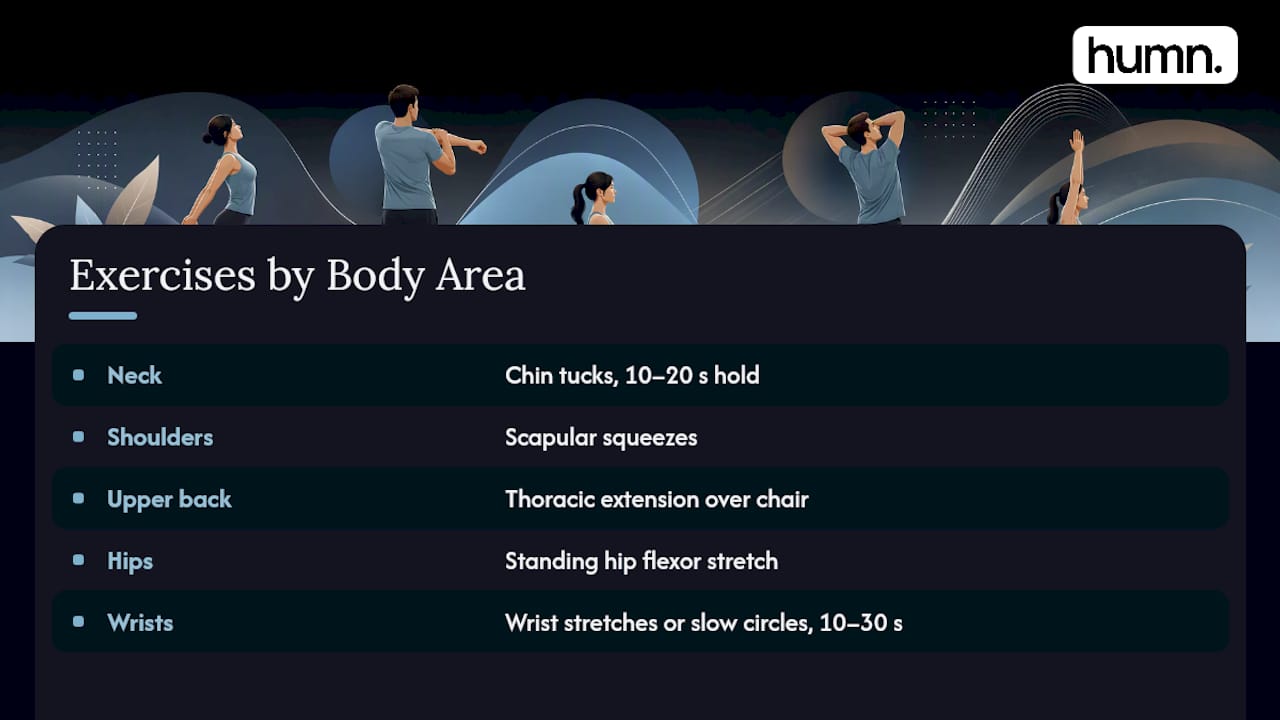
Neck: Chin tucks and slow neck side-bends, holding each side 10 to 20 seconds, directly counter the forward head lean that comes from staring at a monitor.
Shoulders: Shoulder rolls and scapular squeezes reverse the rounded, hunched position most people fall into within 20 minutes of typing.
Upper back: Thoracic extension over the chair and seated cat-cow restore the extension and rotation that stiffen up when you round forward for hours.
Hips: Standing hip flexor stretches and seated figure-four stretches (ankle crossed over the opposite knee, leaning forward gently) loosen hips that stay flexed all day.
Wrists: Flexor and extensor stretches, plus slow wrist circles, ease strain built up from typing and mousing. Healthline’s deskercise guide recommends holding each stretch 10 to 30 seconds, which lines up well with what most people can fit into a short break.
Pick two or three from different areas rather than repeating the same one, since tightness rarely stays in a single spot for long.
Why Desk Work Wrecks Your Posture
Hours of sitting create a predictable pattern of dysfunction, and it isn’t just “bad posture” in the vague sense people usually mean.
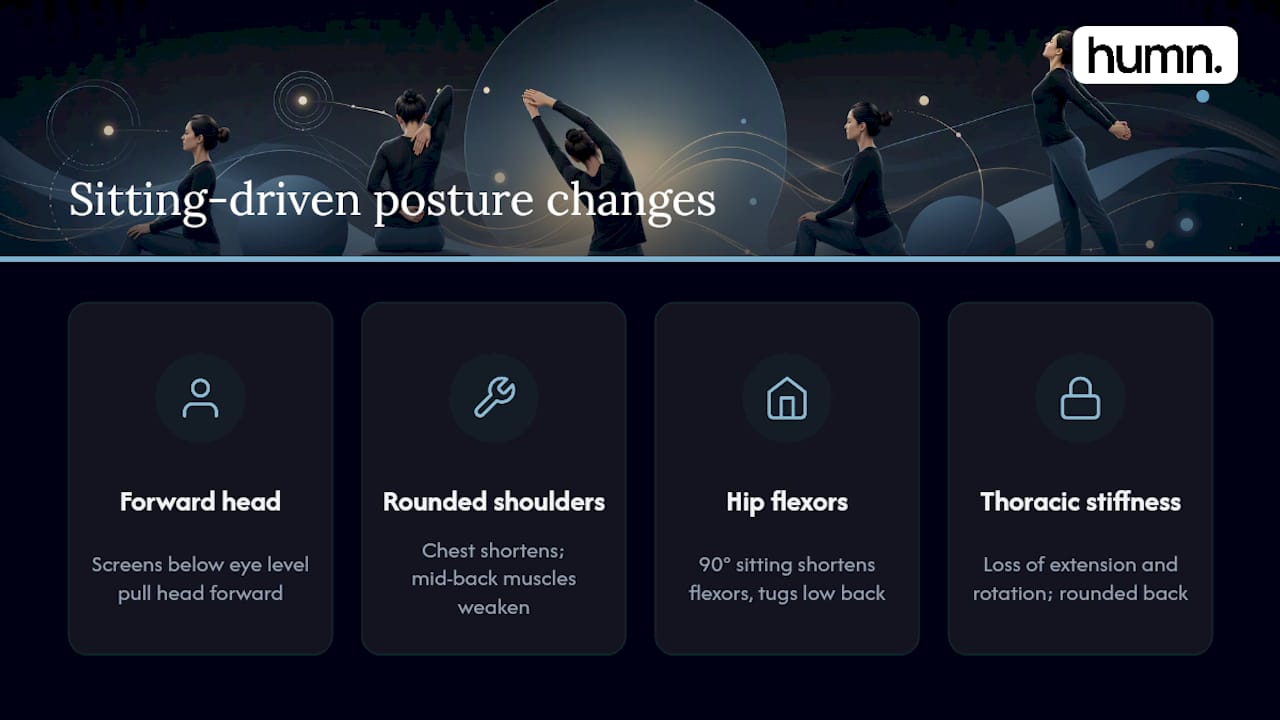
Forward head posture develops because screens sit below eye level and closer than reading distance used to be, pulling the head forward and loading the neck with far more effective weight than it carries when upright. Rounded shoulders and a collapsed chest happen because the muscles in front (chest, front of shoulder) shorten from being in a flexed position all day, while the muscles between the shoulder blades weaken from disuse. Tight hip flexors result from sitting at 90 degrees for hours, which shortens the muscle and can quietly pull on the lower back. Add a stiff thoracic spine, the mid and upper back losing its normal extension and rotation, and you get the classic slumped, rounded desk silhouette. None of this happens because someone is lazy about “sitting up straight.” It happens because muscles adapt to whatever position they spend the most time in, and most desk jobs spend eight hours a day reinforcing the same slouched shape.
What Better Posture Actually Gets You
Improved sitting posture isn’t just a cosmetic fix. A 2022 systematic review found that short workplace exercise routines reduced musculoskeletal pain intensity by 43 to 63 percent and pain duration by 53 to 70 percent across the neck, shoulders, and back. That’s a meaningful drop in the kind of nagging discomfort that makes an 8-hour workday feel unbearable by hour six.
Beyond pain reduction, better alignment tends to improve breathing mechanics, since a collapsed chest restricts the diaphragm’s range of motion. Many people also report feeling more alert after movement breaks, even when the breaks don’t directly boost measurable work output. That’s worth taking seriously on its own: feeling less drained by 3 p.m. matters, whether or not it shows up in a productivity metric.
Long-term, addressing posture now heads off the compounding problem of chronic stiffness, which gets harder to reverse the longer it sits unaddressed. Fixing forward head posture at year one is a very different project than fixing it after a decade of it going unmanaged.
Ergonomic Tips That Make These Exercises Work Better
Stretches fight an uphill battle against a workstation that’s actively working against you. A monitor set below eye level will drag your neck forward again within minutes of finishing a chin tuck, no matter how well you did the exercise.
Set your screen so the top third sits at eye level, roughly an arm’s length away, so you’re not leaning in or tilting down to read it. Keep your feet flat on the floor or a footrest, hips slightly higher than knees, which keeps the pelvis in a neutral position instead of tucking under or tipping forward. Your keyboard and mouse should sit close enough that your elbows stay near your sides at roughly a 90-degree angle, rather than reaching forward and rounding your shoulders to compensate.
None of this replaces the exercises above. It just means the 90 seconds you spend resetting your posture doesn’t get undone the moment you go back to typing. Ergonomics and movement work together: one removes the source of strain, the other actively counters what’s already accumulated.
How Coaches Layer This Into a Real Program
At humn., we think of these microbreaks as the entry point, not the destination. Our four-pillar framework, Resist, Recover, Renew, and Rhythm, treats a 90-second posture reset the same way it treats sleep or nutrition: a daily input that either supports or undermines strength work. A coach might build a client’s week around two structured Resist sessions, then use the 5-minute desk routine as the “Rhythm” habit that keeps mobility from backsliding between them. If you want to see how those pieces connect into a full weekly plan, our busy professional workouts approach shows how short, consistent habits and heavier training sessions work together rather than against each other.
Written by Josh for humn.
Ready for More Than a Quick Fix?
Desk stretches solve the daily discomfort. They don’t rebuild the strength that keeps your spine, hips, and shoulders resilient for the long run. That takes a program built around your actual life, not a generic routine copied from a blog. humn.'s membership options pair small-group training and 1-on-1 coaching with recovery access, so the posture work you start at your desk gets backed by real strength training and a coach who tracks your progress over months, not minutes.
Sources
- Stretches to Do at Work Every Day — Healthline
- Best Desk Exercises for Better Posture (SitSense blog)
- A desk yoga teacher recommends 3 beginner-friendly exercises for better posture — TechRadar
FAQ
How Can I Improve My Posture While Working at a Desk?
Combine frequent movement with a better setup: do a 60 to 90 second microbreak (chin tucks, shoulder rolls, chest opener) every 30 to 60 minutes, and raise your monitor to eye level so you’re not leaning forward all day. Short, consistent routines outperform occasional long stretching sessions, according to research on workplace exercise interventions.
Can You Correct Years of Bad Posture?
Yes, to a meaningful degree, though it takes longer than a few sessions. A 6-week trial found that chin tucks and scapular exercises produced measurable improvements in forward head posture and neck disability among office workers, showing that consistent practice over weeks, not days, drives real change.
What Are the Best Exercises for Office Workers to Do at Their Desk?
Chin tucks, shoulder blade squeezes, seated chest openers, thoracic extension over the chair back, and seated spinal twists cover the areas that tighten fastest at a desk. Practitioner guides like SitSense recommend running through this sequence roughly once an hour for the best results.
What Are Four Signs of Poor Posture?
Common signs include a forward-jutting head, rounded shoulders that curl inward, a slumped or collapsed upper back, and hips that feel tight or stiff when you stand up after sitting. Any persistent numbness, tingling, or pain that wakes you at night is a different issue and warrants a clinician’s evaluation rather than more stretching.
No Comments.