


Before you touch a barbell or lace up for a run, get clinician clearance if your injury involved medical care. Once you’re cleared, follow a graded three-phase restart: restore range of motion, rebuild strength and tolerance, then reintroduce speed and impact. Start well below your old training load and let your body’s response over the next 24 hours, not the calendar, decide when you progress.
TL;DR:
- Maintaining daily tracking of pain, swelling, and sleep helps assess progress more reliably than relying on how you feel moment-to-moment.
- Gradually increasing resistance and volume over several weeks reduces the risk of re-injury while rebuilding strength and tissue tolerance.
- Training the uninjured side preserves neural and muscular strength but requires careful attention to prevent compensatory movement patterns.
- Progression should be driven by tissue response within 24 hours, not by fixed timelines or past performance levels.
- Supervised coaching supports adherence and personalized adjustments, making a safe return more effective than self-guided programs.
Table of Contents
- Clinician-Backed Dos and Don’ts for Restarting Exercise
- The Three-Phase Restart Plan That Actually Works
- How Do You Know You’re Ready to Progress?
- A Sample 4-Week Restart Template
- Why You Should Keep Training the Uninjured Side
- Where humn.'s Framework Fits Into a Safe Comeback
- Get a Supervised Bridge From Rehab to Real Training
- Sources
- FAQ
Clinician-Backed Dos and Don’ts for Restarting Exercise
A handful of rules separate a smooth comeback from a second injury. Before your next session, run through these.
- Do get specific limits from your doctor or physical therapist, and ask exactly which movements to avoid and for how long.
- Do prioritize pain-free range of motion and bodyweight movement before adding any external load.
- Do schedule short, frequent sessions instead of a few brutal ones. Frequency rebuilds tissue tolerance faster than intensity does.
- Don’t chase the weights or pace you remember. Detraining affects strength, tendons, and aerobic capacity at different rates, so your “old normal” isn’t a safe starting point.
- Don’t test painful movements just to see what happens, and never train through new swelling or sharp pain.
- Don’t rely on pain at rest as your only readiness gauge. How the tissue handles load, and how it recovers afterward, matters more than how it feels sitting still.
The Three-Phase Restart Plan That Actually Works
Recovery from an injury almost never moves in a straight line. The staged model physical therapists use restores range of motion first, then strength and tissue tolerance, and only then speed or impact. Skipping ahead is the single most common reason people get hurt twice.
- Restore range. Daily mobility drills and controlled single-joint movement come first. Keep sessions short (10 to 15 minutes is plenty) and stop the moment anything feels sharp rather than stiff.
- Rebuild capacity. Once range feels normal, start strength work at roughly half your prior load or lower. Favor slow, tempo-controlled reps over heavy singles, train more often at lower intensity, and add about 10% volume per week only if the previous week was fully tolerated.
- Reintroduce intensity. Speed, heavier loads, and impact work (jumping, sprinting, cutting) come last, and only after several consecutive sessions with no flare-ups.
Progress is earned by how the tissue responds overnight, not by what a spreadsheet says you should be doing by week three.
Pro Tip: Keep a one-line log after every session, noting pain, swelling, and sleep quality. Decisions based on a week of trend data beat decisions based on how you feel in the moment, which is often the worst possible judge of readiness.
How Do You Know You’re Ready to Progress?
Three practical checks tell you more than any calendar. First, can you move the joint through a full, controlled range without compensating? Second, can you tolerate bodyweight movement, then light load, without sharp pain during or after? Third, does any soreness resolve within 24 hours, or does it linger?
Certain signs mean stop, not slow down.
- Sharp, stabbing, or electric pain during movement.
- New or increasing swelling around the joint.
- A sense of the joint giving way or feeling unstable.
- Pain that gets worse, or doesn’t settle, for more than 48 hours.
- You’re changing your gait, posture, or lifting mechanics to avoid discomfort.
If any of these show up, cut your load by 30 to 50% and get back in front of your physical therapist or doctor before pushing further. Reassessment now is cheaper than a second injury later.
A Sample 4-Week Restart Template
This is a starting frame, not a prescription. Adjust volume and exercise selection to your specific injury and your clinician’s limits.
- Week 1: Daily range-of-motion work plus two short sessions (20 to 25 minutes) of low-impact aerobic or resistance work at very low intensity.
- Week 2: Same frequency, slightly higher volume on movements that felt good in week one. Add a few sets of light, controlled loaded work.
- Weeks 3 to 4: Increase total weekly volume gradually, add sets and reps on tolerated exercises, and if nothing flares up, introduce mild intervals or concentric-focused loading.
For a knee, that might mean swapping loaded squats for step-ups before progressing to lunges. For a shoulder, isometric holds come before overhead pressing. For a lower back, hip-hinge patterning and core bracing come well before any spinal loading. The structure stays the same across injuries. Only the exercises change.
Why You Should Keep Training the Uninjured Side
Working the healthy side of your body isn’t just about morale, though it helps with that too. Cross-education research shows that training one limb preserves strength and neural drive on the opposite, injured side, even while it’s resting.
- Single-leg RDLs or step-ups on the healthy leg while the injured one recovers.
- Unilateral presses or rows on the uninjured arm during a shoulder rehab window.
- Core and cardiovascular work that doesn’t load the injured area at all.
Watch for one thing: compensatory patterns can creep in if you favor one side for too long. Reintroduce bilateral movement as soon as your clinician gives the go-ahead, and don’t let a temporary workaround become a permanent habit.
Pro Tip: If you’re not sure whether an exercise loads the injured area indirectly, film yourself from the side. Compensation shows up in the hips and spine long before you feel it.
Where humn.'s Framework Fits Into a Safe Comeback
A restart plan works best when it’s built into a system, not improvised week to week. humn.'s four pillars map cleanly onto the phases above: Resist covers the strength work of phase two, Recover supports tissue tolerance through sauna, compression, and red light therapy, Renew addresses the sleep and nutrition that actually drive tissue repair, and Rhythm keeps the habit consistent enough to matter.
Habit-first coaching solves the part most restart plans ignore: adherence. A phased plan only works if someone actually follows it for four straight weeks. If you want individualized progression instead of guessing at percentages alone, a supervised bridge from rehab to training is worth considering.
— Josh
Get a Supervised Bridge From Rehab to Real Training
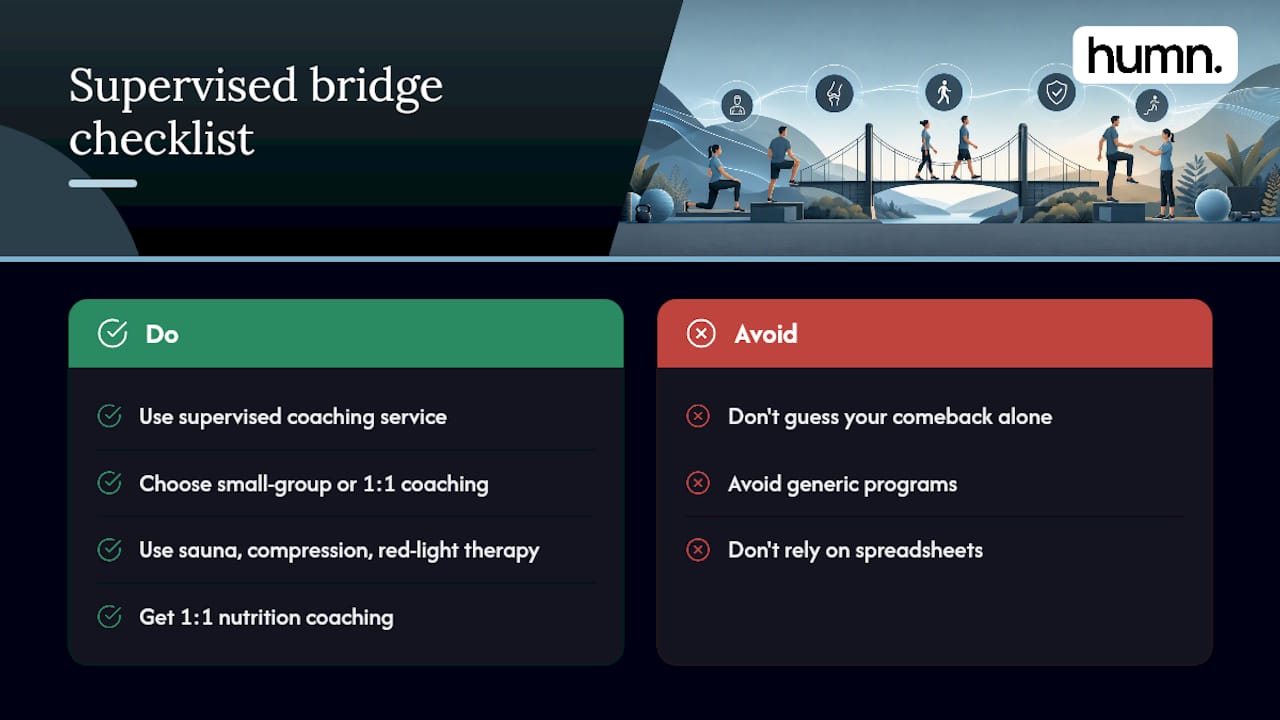
A supervised coaching service can be an effective alternative to guessing your way through a comeback alone. Instead of piecing together range-of-motion drills, load percentages, and recovery tools from scattered advice, you get a coach who adjusts your plan session by session based on how your body actually responds.

That starts with Small Group Personal Training and 1-on-1 Coaching & Guidance built around your specific limits, not a generic program. If tissue tolerance is your bottleneck, sauna, compression, and red light therapy sessions support the recovery side of the equation while you rebuild strength. And if energy or tissue repair feels slow, 1:1 nutrition coaching addresses the intake side most restart plans skip entirely.
If you’re ready for a graded return with someone tracking your progress instead of a spreadsheet, consider booking an assessment through a membership coaching service to start the conversation about where your body actually is right now.
Sources
This guide draws on physical therapy and sports medicine resources, including WebMD’s exercise-after-injury guidance, HSS’s dos and don’ts of post-injury training, and clinician-written frameworks on staged return to training and cross-education effects.
This article is general information, not a substitute for advice from a qualified doctor. Consult a qualified healthcare professional about your own circumstances before acting on anything here.
- 5 Do’s and Don’ts of Working Out After Injury
- Coming Back After Injury, Surgery, or Illness Without Breaking Yourself a Second Time
- Training the uninjured side during recovery: how cross-education helps preserve strength
FAQ
How Can I Regain My Fitness After an Injury?
Get medical clearance, then rebuild through the same three-phase order every time: restore range of motion, rebuild strength at reduced load, then reintroduce speed and impact. Progress based on how your body responds within 24 hours of a session, not a fixed schedule.
What Is the 3-3-3 Rule for Working Out?
There’s no single clinically established “3-3-3 rule” for post-injury training in the sources behind this guide. If you’ve seen it referenced elsewhere, treat it as informal advice and check any specific numbers against your clinician’s guidance rather than a general rule of thumb.
How Can I Start Exercising Again After a Long Break?
Start at a fraction of your previous volume, often around half, and increase gradually only when soreness resolves within a day. Frequent, short sessions rebuild capacity more safely than a few intense ones, especially after weeks off.
How Long Does It Take to Regain Running Fitness After an Injury?
Timelines vary too widely by injury type and severity to state a fixed number. A more reliable approach uses function-based milestones, tolerating full range of motion, then bodyweight movement, then progressive load, rather than counting weeks on a calendar.
No Comments.