

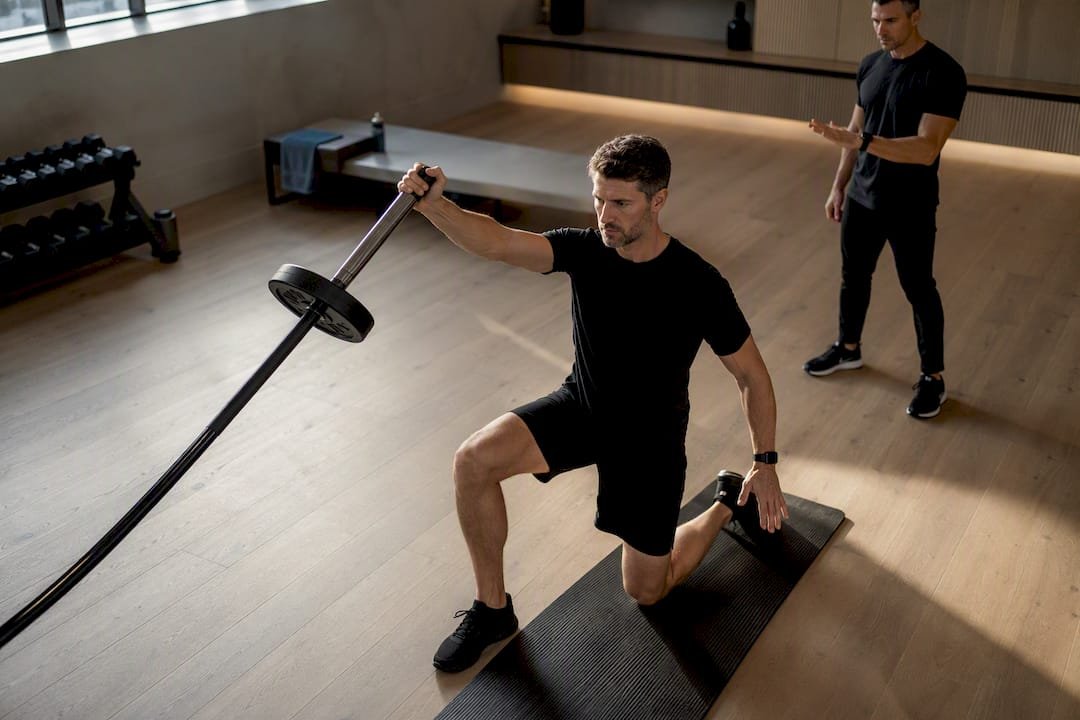
Personal training for executives works when it flips the usual model: instead of building your week around the gym, the program builds itself around your calendar. That means sessions typically lasting between 20 and 30 minutes instead of 90 minute blocks, travel-proof protocols instead of “just get back on track when you’re home,” and coaches who track energy and decision quality alongside strength and body fat. Done right, most executives feel a measurable shift in energy and focus within a few weeks, with strength and body-composition changes becoming visible over a period of several weeks.
TL;DR:
- Short, frequent sessions of 20 to 30 minutes are designed to fit unpredictable travel schedules, maintaining consistency even during busy weeks.
- Programs incorporate travel-specific nutrition and recovery protocols, such as pre-planned restaurant orders and hotel-room workouts, to ensure progress during trips.
- Systems-based coaching manages sleep, stress, nutrition, and training together, addressing the whole health system rather than just workouts.
- Flexibility in session length, timing, and location helps executives adapt training to sudden schedule changes without losing momentum.
- Technology like wearables and coaching apps provides real-time data to adjust plans proactively, reducing the need for lengthy check-ins and supporting remote management.
Table of Contents
- What Does Personal Training for Executives Actually Look Like?
- What Should You Expect From Assessment and Tracking?
- How Do You Fit Training Into an Unpredictable Schedule?
- What Does a Realistic Training Week Actually Look Like?
- What Results Should You Expect, and On What Timeline?
- Why a Systems-Based Approach Beats a Workout Plan
- What Nutrition and Recovery Strategies Actually Hold Up Under Travel?
- What Should You Look for in an Executive Personal Trainer?
- What Does Executive Personal Training Typically Cost?
- How Does Wellness Coaching Fit Alongside Fitness Training?
- How Flexible Can a Program Really Be With Your Calendar?
- What Technology and Tools Support Executive Training Programs?
- An Editorial Take on What Actually Moves the Needle
- Ready to See What a Strategy Call Looks Like?
- Sources
- FAQ
What Does Personal Training for Executives Actually Look Like?
There are multiple formats in this space, each suitable for different types of busy schedules.
1:1 in-person coaching puts a trainer in the room with you, adjusting load and technique in real time. It’s the highest-touch option and usually the most expensive, but it removes almost all the guesswork.
Boutique small-group coaching puts you alongside two or three other high-performers with similar time constraints, under one coach who still individualizes the programming. You get community and accountability without sacrificing personalization.
Hybrid coaching with app support pairs a human coach with a tracking app for the days you can’t make it in. A coach in Singapore can adjust your Tuesday session from a hotel room in Denver.
The core components tend to stay consistent across formats:
- Time-efficient resistance training built around compound lifts, not filler exercises
- Nutrition defaults for travel weeks, so decisions are pre-made before you land
- Recovery access, from mobility work to more structured modalities like compression or sauna
- Calendar-aware accountability that adjusts to your actual week, not an idealized one
The real difference is between a trainer who shows up for sessions and a coach running a system. Session-only trainers optimize the hour you’re together. Systems-based coaching manages sleep, stress, and nutrition between sessions, which is where most of an executive’s health actually gets won or lost.
What Should You Expect From Assessment and Tracking?
A serious program starts with more than a handshake and a treadmill test.
The initial assessment usually includes a body composition scan or movement screen, plus something less common: a schedule audit. A good coach wants to see your actual calendar for the next month before writing a single workout, because a program built for a normal week falls apart the first time you have three back-to-back flights.
Pro Tip: Bring your travel calendar to your first consultation, not just your fitness goals. The program that survives your actual October matters more than the one that looks good on paper in January.
Ongoing tracking typically covers:
- Strength benchmarks on a handful of key lifts, checked monthly rather than every session
- Sleep quality and duration, often pulled from a wearable
- Recovery markers like resting heart rate or subjective readiness scores
- Body composition, rechecked on a quarterly cadence rather than weekly
Premium programs increasingly use DEXA scans and biometric wearables to make progress objective instead of anecdotal. Travel protocols matter just as much: a program should hand you default restaurant orders and hotel-room workout options before you ask, not after you’ve already fallen off track for two weeks. Privacy is part of the deal too. Boutique and appointment-only settings are common for a reason: many executives simply don’t want to train in a crowded commercial gym.
How Do You Fit Training Into an Unpredictable Schedule?
Most executive coaching programs recommend a baseline of several short resistance sessions per week as a realistic target. That’s a realistic adherence target even during a bad month, and it’s what the strongest programs in this space actually prescribe rather than the five or six sessions a general fitness magazine might suggest.
Three scheduling models tend to work best:
- Early-morning blocks before the inbox opens, protected the same way you’d protect a 7 a.m. call with a board member.
- Micro-sessions of 20 to 30 minutes, slotted into gaps between meetings rather than requiring a dedicated hour.
- Calendar-integrated planning, where the coach sees your actual week in advance and builds around known travel or late nights.
Accountability holds this together. Weekly strategic reviews (short check-ins on what worked and what didn’t) beat daily nagging. Asynchronous check-ins, usually through a messaging app, let you report in from an airport lounge instead of waiting for a scheduled call. Some coaches also set specific access windows, so you know exactly when you can reach them without wondering if you’re overstepping.
What Does a Realistic Training Week Actually Look Like?
A sample week for a client who travels two or three days out of five might run like this:
- Monday: 25-minute strength session, upper body focus, before the first meeting
- Tuesday: Travel day, 20-minute hotel bodyweight circuit
- Wednesday: 30-minute strength session, lower body and core
- Thursday: Travel day, walking meeting or mobility work only
- Friday: 25-minute full-body strength session
Two sample sessions show how little space this actually requires:
- Hotel room session (20 minutes): goblet squats or split squats with a suitcase, push-ups, single-leg Romanian deadlifts, plank variations, finishing with 5 minutes of mobility work.
- Office or small-studio session (30 minutes): trap-bar deadlift or goblet squat, dumbbell bench press, one-arm row, and a loaded carry, done at moderate intensity with short rest periods.
Daily habits matter as much as the sessions: a protein anchor at each meal, and a 7 to 8 hour sleep target treated as non-negotiable as any client call. Progression doesn’t mean adding time. It means more weight, tighter tempo, or less rest between sets on the same compound movements, so a 25-minute session in month three demands more than the identical session did in month one.
What Results Should You Expect, and On What Timeline?
The first wins show up fast and they’re subjective: better energy by midafternoon, sharper focus in late meetings, and noticeably better sleep, often within the first two to three weeks.
Measurable changes take longer. Strength gains on key lifts and shifts in body composition typically show up over 6 to 12 weeks, tracked through:
- Training consistency (sessions completed versus sessions planned)
- Movement load progression on core lifts
- Simple strength tests repeated monthly
- Body-composition scans, where available, run quarterly
The connection to work performance isn’t abstract. Executives who sleep better and train consistently report more resilience under pressure and clearer decision-making late in the day, which is often the real ROI a demanding schedule is paying for.
Why a Systems-Based Approach Beats a Workout Plan
Most executive fitness advice treats training, sleep, nutrition, and stress as separate problems. They aren’t. That’s the thinking behind a four-pillar framework: Resist (strength training that builds real capacity), Recover (structured recovery access, not just rest days), Renew (nutrition and lifestyle habits that hold up under travel and stress), and Rhythm (the scheduling and accountability system that keeps all three running when the calendar gets ugly).
Each pillar maps directly to an executive constraint. Resist replaces the impulse to skip training when time is short. Recover accounts for the fact that a 60-hour work week erodes recovery faster than any workout can rebuild it. Renew handles the 200 small nutrition decisions a travel-heavy month throws at you.
A program that only addresses the workout is solving a quarter of the problem. The other three quarters, recovery, nutrition, and the schedule itself, are where most executives actually fall off track.
humn delivers this through 1-on-1 coaching, small-group training, and recovery access including sauna, compression, red light therapy, and acupuncture, all under one roof in a boutique setting.
What Nutrition and Recovery Strategies Actually Hold Up Under Travel?
Nutrition strategy for executives isn’t about a meal plan. It’s about pre-made decisions that survive a bad week. A protein anchor at every meal, whether that’s eggs at breakfast or a protein shake between back-to-back calls, removes the biggest single failure point: skipping meals until you’re starving and grabbing whatever’s closest.
Restaurant defaults matter more than most people expect. Pre-built menu choices for common travel scenarios, like a standard order at a steakhouse or airport terminal, cut decision fatigue to nearly zero. You’re not deciding what to eat under pressure. You already decided, weeks ago, with a clear head.
Recovery works the same way. Sleep is the highest-leverage lever most executives underuse, and a 7 to 8 hour target should carry the same weight as a scheduled meeting, not an aspiration that gets bumped for a late email. Beyond sleep, structured recovery modalities, compression therapy, sauna use, and for some clients, acupuncture, can meaningfully speed the recovery curve between strength sessions, which matters more when you’re only training three times a week and need each session to count.
The habit that ties both together: build the default before you need it. A traveling executive who has already decided what breakfast looks like on a Tuesday in Chicago isn’t making a nutrition decision at 6 a.m. They’re just following the plan they built on a calm Sunday.
What Should You Look for in an Executive Personal Trainer?
Credentials matter, but the wrong credentials give false confidence. A certification proves someone passed a test. It doesn’t prove they’ve ever programmed around a board meeting that ran three hours long or a trans-Atlantic flight landing at 6 a.m. before a 9 a.m. presentation.
Look for three things specifically:
Experience with executive clients. A coach who’s worked exclusively with retirees or college athletes will build a program that assumes a predictable schedule, because that’s what they know. Ask directly how many current clients travel more than one week a month.
Systems thinking, not just programming skill. Ask what happens to your plan when you cancel three sessions in a row during a busy quarter. A trainer without an answer is a session-seller. A coach with a clear answer, an asynchronous check-in, a modified home protocol, a rescheduled priority, is running a system.
Specialization in time-constrained training. Not every trainer can compress a full stimulus into 25 minutes without it turning into a rushed, sloppy version of a longer session. That’s a specific skill, built around compound movements and smart exercise selection, not just enthusiasm.
One more filter worth applying: ask what they track besides weight and reps. A coach who asks about your sleep, your travel schedule, and your stress load is thinking about the whole system. A coach who only asks about your last workout isn’t.
What Does Executive Personal Training Typically Cost?
Pricing in this category varies widely because the offer varies widely. A basic 1:1 session with an independent trainer might run in line with standard personal training rates in a given city. Boutique programs that bundle coaching with recovery access, nutrition guidance, and ongoing accountability price higher, reflecting the fact that you’re not paying for an hour of attention. You’re paying for a system running in the background all week.
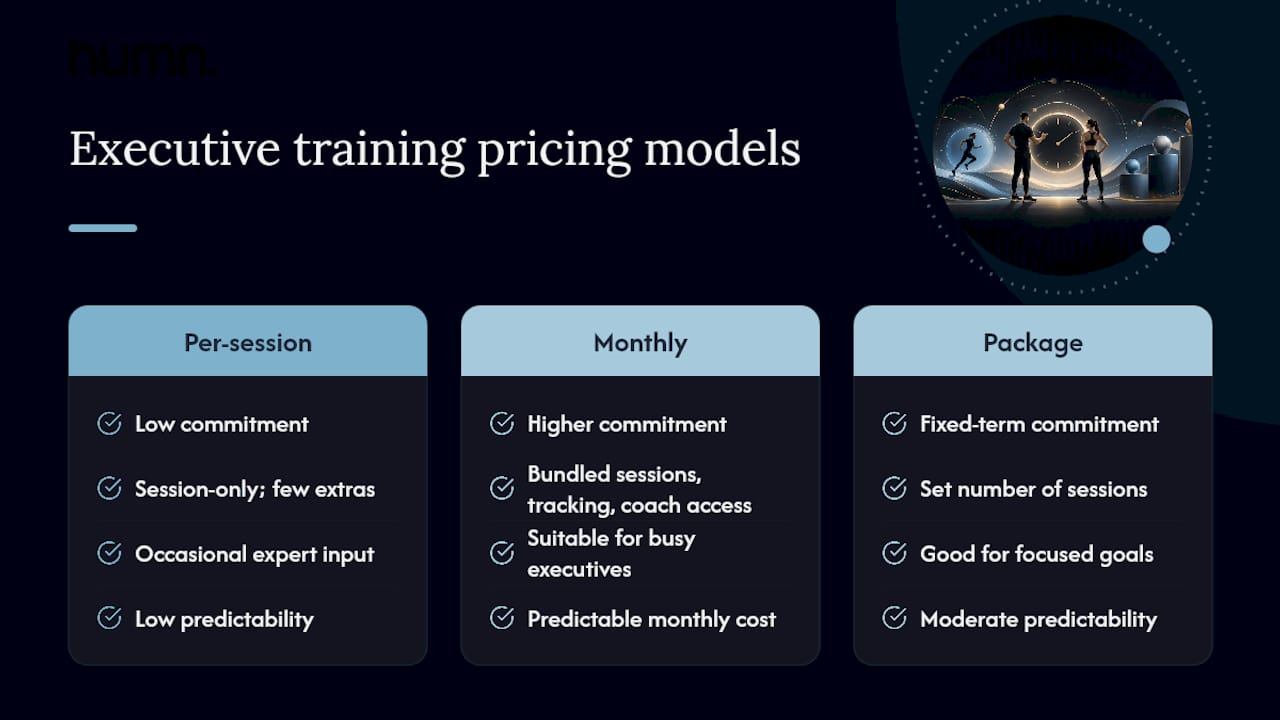
Most programs fall into one of three pricing models. Per-session pricing suits someone who wants occasional expert input without a broader commitment, but it rarely includes the accountability infrastructure that makes executive coaching work. Monthly membership pricing bundles sessions, tracking, and coach access into one predictable cost, which tends to suit executives better precisely because it removes another decision from an already overloaded week. Package pricing, a fixed number of sessions over a set period, sits in between, often used for a focused push toward a specific goal like an assessment before a major life event.
The honest way to evaluate cost isn’t the price per session. It’s the cost per outcome. A program that keeps you consistent for 12 weeks at a moderate price beats a cheaper option you abandon in week three. Ask any program directly what’s included beyond the workout itself, recovery access, nutrition guidance, coach availability between sessions, because that’s usually where the real price difference lives, and where the real value does too.
How Does Wellness Coaching Fit Alongside Fitness Training?
Stress doesn’t stay in its lane. An executive under sustained pressure sleeps worse, recovers slower from training, and makes worse food choices under fatigue, which is why the strongest programs treat stress management as part of the fitness plan, not a separate wellness initiative bolted on afterward.
This doesn’t require a therapist’s caseload of tools. It usually starts with something simple: tracking subjective stress alongside training load, so a coach can see when to pull back intensity instead of pushing through a week that was already going to be brutal. Some executives benefit from complementary approaches, including things like structured stress-reduction techniques alongside their training, particularly during high-stakes stretches like earnings season or a major deal close.
Mental health support and fitness coaching aren’t competing priorities. A coach who notices you’re short-tempered in check-ins or sleeping four hours a night for two weeks straight is doing more for your long-term performance than one more heavy squat session would. The best executive programs build this observation into the relationship itself, treating a stressed, under-recovered client differently than one riding a good month, rather than running the same program regardless of what’s actually happening in your life.
How Flexible Can a Program Really Be With Your Calendar?
Flexibility is the entire premise of this category, but it needs a specific mechanism, not just a friendly promise. The programs that actually hold up under a chaotic quarter build flexibility into three layers: session length, session timing, and session location.
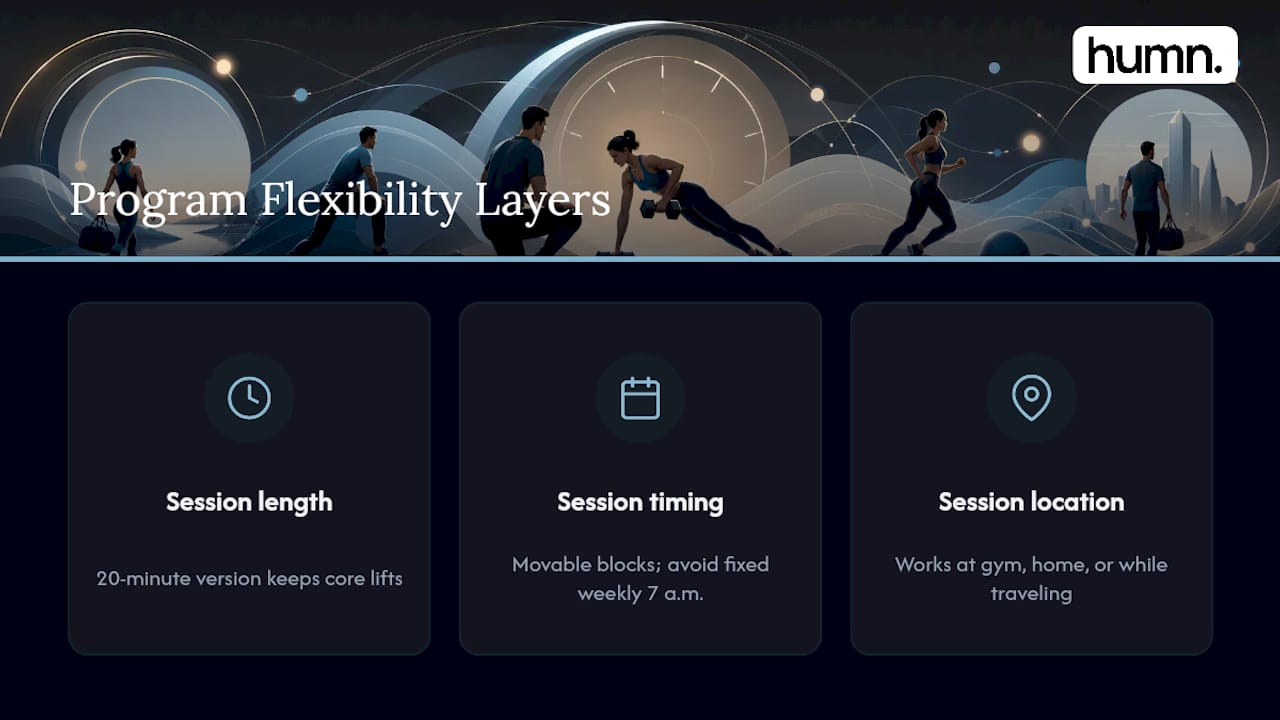
Session length flexes because a 20-minute version of a workout, built around the same core lifts with tighter rest periods, still delivers a real training stimulus. Session timing flexes because a coach who insists on a fixed 7 a.m. slot every week is optimizing for their calendar, not yours. Session location flexes because a program that only works in one physical space breaks the first time you’re on a work trip.
The unpredictable part of an executive schedule isn’t usually the meetings themselves. It’s the notice, or lack of it. A program built around rigid weekly structure collapses the first time a 6 p.m. call gets moved to 4 p.m. and eats your workout window. A program built around a floor (three sessions, whatever format fits) and a system for rescheduling without guilt tends to survive contact with an actual executive calendar.
This is also where prioritizing fitness within a genuinely busy schedule becomes less about willpower and more about design. The goal isn’t finding more time. It’s building a program with enough give in it that a bad week doesn’t turn into a bad quarter.
What Technology and Tools Support Executive Training Programs?
Most executive coaching relationships run on a combination of a coaching app and a wearable device, and the two do different jobs. The app handles programming, exercise demonstrations, and logging, letting a coach adjust Thursday’s session on Wednesday night based on how Monday and Tuesday actually went. The wearable, whether that’s a smartwatch or a dedicated recovery tracker, feeds the coach data on sleep, resting heart rate, and recovery scores that a client would otherwise have to self-report, often inaccurately.
This matters more for executives than for the average gym member, because the data replaces conversations that would otherwise require time neither person has. A coach who can see your sleep dropped to five hours for three straight nights doesn’t need a 20-minute call to figure out why you’re not hitting your usual numbers. They already adjusted Thursday’s session before you asked.
The technology isn’t the point, though. It’s a support system, not a replacement for judgment. A wearable can tell a coach your heart rate variability dropped. It can’t tell them you have a board presentation Friday that’s been keeping you up. That context still comes from a human relationship, which is why the strongest programs pair the data with a real check-in, not a dashboard alone.
An Editorial Take on What Actually Moves the Needle
Most fitness advice aimed at executives gets the emphasis backward. It leads with the workout, as if the hardest part of getting fit is knowing which exercises to do. It isn’t. The hardest part is building a system flexible enough to survive a calendar that changes without warning.
That’s the real argument for a four-pillar approach over a workout plan. Resist matters, but Recover, Renew, and Rhythm are what keep Resist alive past week three. Conventional advice treats travel and long hours as obstacles to a “real” program. A better framing treats them as the actual conditions the program has to be built for, from day one, not as exceptions to apologize for later.
If there’s one thing to prioritize first, it’s not intensity. It’s the floor: three short sessions a week, protected like any other commitment, with a coach who has already seen your travel calendar and built around it. Energy and sleep improvements usually show up before strength does, and that early win is what keeps most executives in the system long enough for the slower, more durable changes to show up too.
— Josh
Ready to See What a Strategy Call Looks Like?
If you’ve read this far, you already know what doesn’t work: another generic plan that assumes you have two free hours a day. Some coaching services build their programs around executives specifically, meaning the schedule audit happens before the workout, not after sessions are missed.

A strategy call runs 20 to 30 minutes and covers three things: a look at your actual weekly schedule and travel pattern, one concrete strategy you can use immediately regardless of whether you join, and a clear picture of what a membership would look like for your specific week. There’s no generic sales script, because there’s no generic client. humn works with clients through 1:1 coaching, small-group training, and full recovery access, all built around the Resist, Recover, Renew, and Rhythm framework covered above.
If your calendar has broken every fitness plan you’ve tried so far, that’s exactly the problem this is built to solve. Book a strategy call with humn and bring your actual schedule, not your ideal one.
Sources
Executive Health & Performance Coaching, Executive Fitness Coaching, and humn’s premium coaching overview.
- Executive Fitness Coaching (program descriptions)
- Executive Ascension — Executive Health & Performance Coaching
- Fitness Coaching for Executives | Geebs Coaching
FAQ
What Is the 3-3-3 Training Rule?
Different coaches define it differently, but one common version calls for three strength sessions weekly, three key lifts per session, and three months as a checkpoint for reassessing progress. Treat it as a loose framework rather than a fixed standard, since definitions vary by program.
Is It Worth Becoming a Certified Personal Trainer?
That depends entirely on your goals as a trainer, not as a client, and it falls outside what this article covers for executives seeking coaching. If you’re evaluating a coach’s credentials, ask about their experience with time-constrained, travel-heavy clients specifically, not just their certification.
Is 40 Too Old to Start Executive Fitness Coaching?
No. Most executive coaching clients start well past young adulthood, and programs built around body-composition tracking and progressive strength work adjust load and volume to age and recovery capacity rather than assuming a youthful baseline.
How Much Does Executive Personal Training Typically Cost?
Pricing depends on format: per-session rates suit occasional coaching, while monthly memberships that bundle training, recovery, and accountability generally run higher but remove decision fatigue from an already full schedule.
Can Executive Coaching Work if I Travel Every Other Week?
Yes, that’s the specific problem this model is built to solve. Programs use hotel-friendly workouts, restaurant defaults, and asynchronous check-ins so travel weeks don’t reset progress the way an unstructured plan typically does.
No Comments.