

Yes, alcohol can blunt the muscle repair process, and the damage scales with how much you drink and when. A small amount of alcohol on an occasional day won’t undo your training. Larger quantities right after a hard lifting session can measurably suppress the biology your muscles rely on to rebuild. The fix isn’t abstinence. It’s protein, fluids, sleep, and a buffer window before you pour anything.
TL;DR:
- Drinking alcohol close to training, especially binge levels, significantly suppresses muscle protein synthesis and disrupts signaling pathways essential for repair.
- Heavy drinking can reduce testosterone and growth hormone levels while elevating cortisol, hindering recovery and prolonging hormonal disruption up to 36 hours.
- Alcohol’s diuretic effect and priority metabolism in the liver impair rehydration and glycogen refueling efforts post-exercise.
- Consuming alcohol within six hours of intense workouts risks damaging your gains, but delaying drinking and prioritizing protein and hydration mitigates this harm.
- Moderate, well-timed alcohol consumption during recovery can be manageable, but binge drinking after intense sessions causes the most significant setbacks.
Table of Contents
- Alcohol and Muscle Recovery: What Happens Inside Your Cells
- Hormonal and Metabolic Effects That Matter for Hypertrophy
- Hydration, Glycogen, and the Refueling Problem
- How Drinking Wrecks Sleep Quality and Next-Day Training Readiness
- Timing and Dose Rules for Drinking Without Torching Your Gains
- What the Research Agrees On, and Where It Still Falls Short
- How Coaches Apply This: A Recovery-First Approach to Alcohol
- What Actually Matters Here, and What’s Overblown
- Protect Your Recovery Without Giving Up Your Social Life
- Sources
Alcohol and Muscle Recovery: What Happens Inside Your Cells
After a hard training session, your muscle fibers are full of microscopic tears. Your body responds by ramping up a signaling pathway called mTOR, which activates a downstream protein called p70S6K and ultimately drives muscle protein synthesis (MPS), the process of stitching torn fibers back into bigger, stronger tissue. Eating protein after exercise amplifies this signal. Alcohol interferes with it.
A randomized human trial published in PLOS One had participants perform a combined resistance and endurance workout, then consume either protein alone, alcohol with protein, or alcohol alone. The protein-plus-alcohol group still saw MPS drop by roughly 24% compared with protein alone. The alcohol-only group, with no protein to buffer the damage, saw an even steeper decline, in the range of 37%.
Even when researchers gave subjects enough protein to normally maximize the muscle-building response, adding alcohol on top of it cut the anabolic signal by close to a quarter. Protein didn’t cancel out alcohol’s effect. It just softened the blow.
Alcohol suppressed post-exercise MPS by a significant percentage, depending on whether protein was consumed alongside it, in a controlled human trial. That’s not a rounding error. It’s the difference between your body efficiently converting a hard session into new tissue and a chunk of that opportunity getting lost.
Mechanistically, researchers point to alcohol’s effect on mTORC1 signaling itself, likely through upstream disruptions involving REDD1 and altered phosphatidic acid pathways, according to a review in Nutrition & Metabolism. The practical upshot: alcohol doesn’t just add empty calories. It appears to interfere with the actual translation machinery your muscles used to build new protein, even when the raw material (amino acids) is sitting right there.
A few caveats matter before you panic about last weekend. The PLOS One trial used a high alcohol dose equivalent to a substantial number of standard drinks for an average male body weight. That’s binge territory, not a glass of wine with dinner. Sample sizes in this research area tend to be small, often a dozen or two participants, and most studies have leaned heavily on male subjects. A systematic review covering this body of work confirms the dose- and time-dependent pattern but flags exactly this gap: we have much better data on what happens after eight drinks than after two.
Hormonal and Metabolic Effects That Matter for Hypertrophy
Muscle growth isn’t only about protein synthesis in the muscle fiber itself. It also depends on a hormonal environment that supports repair rather than working against it, and heavy drinking tilts that environment in the wrong direction.
Acute, high-dose alcohol intake has been shown to reduce circulating testosterone and growth hormone while nudging cortisol upward, according to the same Nutrition & Metabolism review. Testosterone and growth hormone both support tissue repair and protein synthesis. Cortisol, in excess, works against it by promoting protein breakdown. Stack a hormonal profile that’s suppressing anabolic signals while elevating catabolic ones, and you’ve made your muscles’ job harder right when they need the most help.
Here’s what that looks like in practice:
- Testosterone and growth hormone suppression: most pronounced after large acute doses, not moderate drinking.
- Cortisol elevation: can persist alongside the alcohol-induced sleep disruption discussed further down, compounding the effect.
- Insulin sensitivity: alcohol can blunt how efficiently your muscles take up glucose, which slows glycogen resynthesis after a workout.
- Time course: hormonal disruption from a heavy drinking session can linger anywhere from roughly 10 to 36 hours depending on dose, meaning the damage isn’t confined to the night you drank.
That time course is the detail most people miss. Drink Saturday night after a brutal leg day, and the hormonal fallout can still be affecting your Sunday and even bleed into Monday’s training readiness. Timing your drinking relative to training, not just moderating how much, turns out to be a lever most people never think to pull.
Hydration, Glycogen, and the Refueling Problem
Alcohol is a diuretic. It suppresses antidiuretic hormone, which means your kidneys dump more water than usual, and that undercuts the rehydration you’re trying to accomplish after a sweaty session. According to guidance from University Hospitals, a single alcoholic drink can require roughly twice as much water to offset compared with a non-alcoholic beverage of the same volume. Drink a beer to “rehydrate” post-workout, and you may be digging the hole slightly deeper before you fill it back in.
There’s also a common myth worth killing: that carb-heavy drinks like beer help refuel muscle glycogen. They don’t, reliably. Once alcohol enters your bloodstream, your liver prioritizes metabolizing the ethanol over almost everything else, including converting carbohydrates into stored glycogen. The carbs in that beer are mostly along for the ride, not doing the refueling job you’re crediting them for.
Here’s a more useful sequence if you’re training hard and know you’ll be drinking later:
- Rehydrate with water or an electrolyte drink first, before any alcohol touches your system.
- Eat your post-workout protein and carbs on schedule, treating that window as non-negotiable regardless of evening plans.
- Delay alcohol by several hours rather than drinking immediately post-training.
- Pair any alcohol with food and additional water, roughly matching or exceeding the volume of what you drink.
- Rehydrate again the next morning with electrolytes, since overnight diuresis compounds the deficit from training sweat.
None of this fully cancels alcohol’s physiological effects, per the same University Hospitals guidance, but it meaningfully reduces the compounding damage to dehydration stacked on top of hormonal and MPS disruption. For a practical take on refueling and recovery nutrition, see why recovery nutrition after HYROX matters for performance.
How Drinking Wrecks Sleep Quality and Next-Day Training Readiness
Alcohol makes you fall asleep faster, which fools a lot of people into thinking it improves sleep. It doesn’t. It fragments the second half of the night and specifically cuts into REM sleep, the stage most tied to recovery and cognitive restoration. You can log eight hours in bed and still wake up undercooked because the architecture of that sleep was compromised.
This matters for training readiness in a few concrete ways:
- Growth hormone release, which happens predominantly during deep sleep in the first half of the night, can be disrupted when alcohol alters normal sleep architecture.
- Subjective recovery tends to feel worse the next day even when total sleep time looks adequate on paper.
- Heart rate variability and resting heart rate, if you track them, often show a stress signature the morning after drinking, similar to what you’d see after a poorly recovered night.
- Soreness perception frequently spikes, partly because poor sleep lowers pain tolerance independent of actual tissue damage.
Pro Tip: If you track morning HRV or a readiness score, treat a night of drinking like a mini deload signal. Don’t schedule your heaviest lift or highest-intensity conditioning session for the next morning. Push it a day, or swap in something lighter.
The mismatch between how you feel and how recovered you actually are is the trap here. You might feel “fine” by mid-morning, but the biology underneath, hormone timing, glycogen status, sleep debt, doesn’t always match that feeling. That gap is exactly why relying on gut instinct instead of a couple of objective markers leads people to overtrain without realizing it.

Timing and Dose Rules for Drinking Without Torching Your Gains
The research points to a fairly workable set of rules rather than an all-or-nothing mandate.
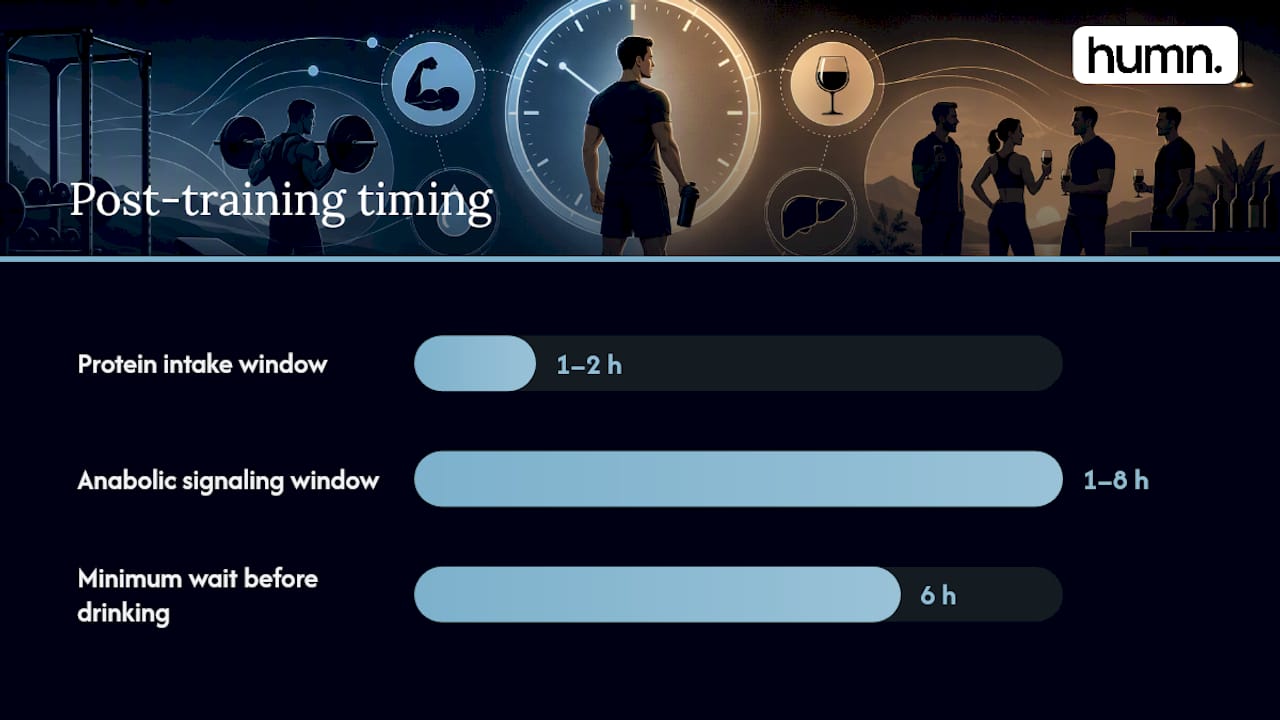
On timing: practitioner guidance built around the early recovery window suggests waiting at least six hours after a hard training session before drinking, longer if the session involved unfamiliar movements or maximal effort that caused unusual muscle damage. The first one to eight hours post-exercise is when anabolic signaling is most active, and that’s the window worth protecting.
On dose: the clearest evidence for measurable harm shows up at binge levels, generally five or more standard drinks in a session. A single light drink, occasionally, sits in much murkier territory where the research simply hasn’t demonstrated the same degree of disruption.
If you know you’re training hard and drinking later the same day, this sequence protects the most ground:
- Finish your workout and get 20 to 30 grams of protein in within the first hour or two.
- Add carbohydrates if the session was long or glycogen-depleting, especially endurance work.
- Rehydrate with water or an electrolyte drink before anything alcoholic.
- Wait several hours, ideally past the six-hour mark, before your first drink.
- Keep the session moderate, food-paired, and matched with extra water.
- Prioritize a full night’s sleep and treat the next morning’s hard training as optional, not mandatory.
| Scenario | Recommended action |
|---|---|
| Light training day, one drink planned | Minimal special precaution needed; hydrate normally |
| Hard lifting session, drinking same evening | Wait 6+ hours, front-load protein and carbs first |
| Endurance session, drinking same evening | Prioritize carb refueling before alcohol; extra rehydration |
| Planned binge-level drinking (5+ drinks) | Expect measurable MPS and hormonal impact; consider a lighter training day to follow |
| Social event with unavoidable drinking | Pre-commit to a drink limit, eat beforehand, hydrate aggressively after |
What the Research Agrees On, and Where It Still Falls Short
Systematic reviews converge on one point: alcohol’s effect on recovery is dose- and time-dependent, not a flat, universal penalty. Heavy, close-to-training drinking causes the clearest biochemical disruption; light, well-timed drinking shows a much fuzzier picture.
That said, the evidence has real gaps worth knowing about before you treat any of this as settled science:
- Some performance trials found no immediate drop in short-term strength or power recovery after alcohol in certain conditions. That doesn’t contradict the MPS findings. It just means functional output can hold up in the short term even while the underlying cellular repair signal is measurably suppressed. The muscle you can lift with today isn’t the same as the muscle being rebuilt for tomorrow.
- Female participants are underrepresented across most of this research, so dose thresholds derived from male-dominated trials may not translate cleanly.
- There’s little data comparing habitual moderate drinking to occasional binge-level intake over months or years, which is the pattern most real-world exercisers actually live.
- Long-term hypertrophy outcomes, as opposed to single-session MPS snapshots, remain largely unstudied.
How Coaches Apply This: A Recovery-First Approach to Alcohol
At humn, coaches don’t hand clients a blanket rule about drinking. They look at individual recovery data, sleep quality, morning readiness, and training goals, then help each person decide where alcohol fits without quietly sabotaging progress.
That often means pre-committing to limits before a social event rather than deciding in the moment, scheduling recovery sessions like sauna or compression work around heavier drinking occasions, and using small-group accountability to keep habits consistent. It’s the same behavior-first logic that runs through humn’s lifestyle coaching, treating alcohol as one variable in a bigger system of sleep, stress, and training load rather than an isolated moral failing or a strict prohibition.
What Actually Matters Here, and What’s Overblown
The evidence supports a narrower conclusion than most fitness content suggests. Occasional, moderate drinking probably isn’t the muscle-growth killer that some corners of the internet claim. Binge drinking after intense training, especially in that first eight-hour window, is where the real damage happens.
The conventional advice usually swings to one extreme or the other: total abstinence, or “don’t overthink it.” Both miss the actual lever, which is timing. A six-hour buffer after hard training and a protein-first sequence do more to protect your gains than agonizing over whether you’re “allowed” a drink at all.
If you take one thing from the research, prioritize the immediate post-training window over the drinking decision itself. Get protein and fluids in early, protect your sleep that night, and let the buffer period do the heavy lifting. Everything else is fine-tuning.
— Josh
Protect Your Recovery Without Giving Up Your Social Life
You don’t need to choose between training hard and having a life. humn is built around exactly this kind of real-world tradeoff, coaching that accounts for sleep, stress, and social drinking instead of pretending they don’t exist.
Members work with dedicated coaches who track readiness and recovery metrics, then adjust programming around what’s actually happening in your life, not a generic template. humn’s recovery services, including sauna, compression, and red light therapy, help offset the nights that don’t go perfectly, while 1:1 coaching builds the habits that make those nights the exception instead of the norm. If you’re training seriously in the Gaithersburg area and want a coach who plans around your actual schedule, start with a conversation about what personal training at humn looks like.
This article is general information, not a substitute for advice from a qualified doctor. Consult a qualified healthcare professional about your own circumstances before acting on anything here.
Sources
- Alcohol Ingestion Impairs Maximal Post-Exercise Rates of Myofibrillar Protein Synthesis following a Single Bout of Concurrent Training | PLOS One
- The Effects of Alcohol Consumption on Recovery Following Resistance Exercise: A Systematic Review
- Alcohol consumption and hormonal alterations related to muscle hypertrophy: a review | Nutrition & Metabolism | Springer Nature Link
- Alcohol After Exercise: Not a Good Mix | University Hospitals
No Comments.