

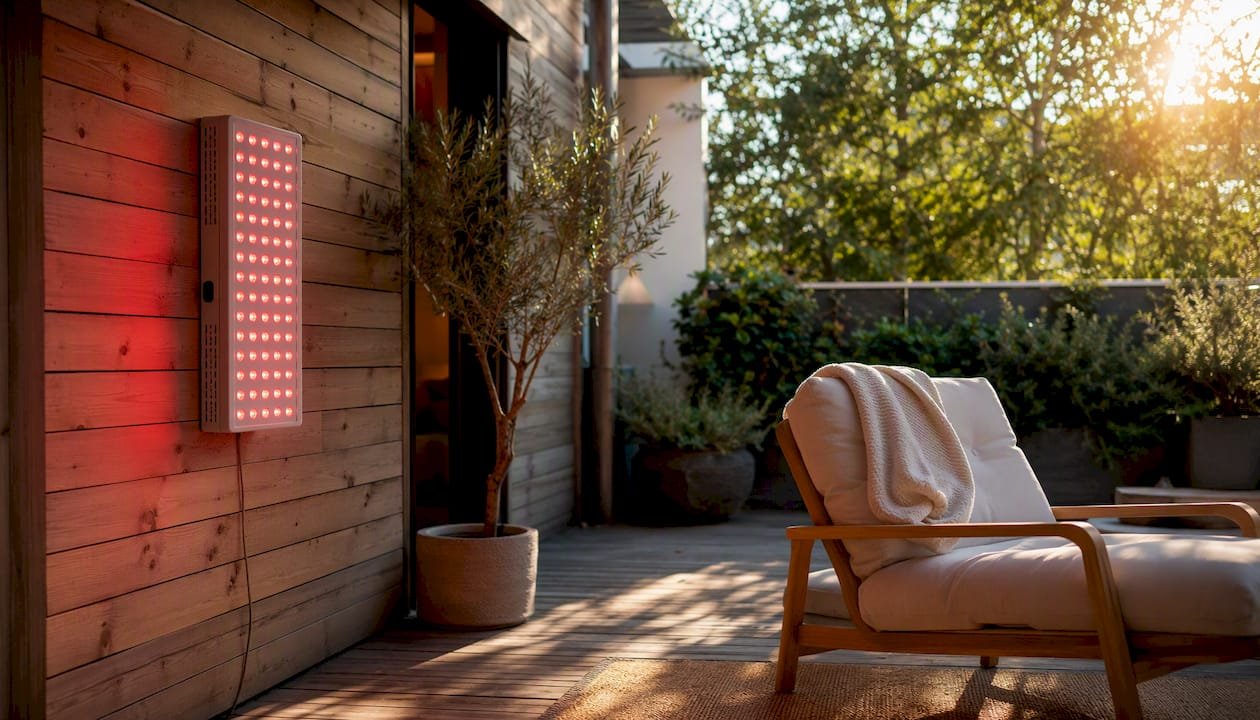
For most home devices, the working dose per treatment area falls within a moderate range, with sessions typically administered multiple times per week, and session length depending entirely on your panel’s actual irradiance at the distance you sit from it. Skin and surface goals require doses at the lower end of that range. Muscle, joint, and deeper tissue targets need more energy and usually benefit from near-infrared wavelengths layered on top of red light.
That’s the whole answer in one sentence. The rest of this comes down to arithmetic, and it’s simpler than it looks once you know the formula: Dose (J/cm²) = Irradiance (mW/cm²) × Time (seconds) ÷ 1,000. Get comfortable with that equation and every panel, every claim about “10,000 lux” or “200 watts,” and every conflicting protocol you’ve read online starts to make sense.
A few numbers to anchor you before we go further:
- Skin rejuvenation and collagen support: 3 to 10 J/cm², typically 5 to 15 minutes depending on irradiance.
- Hair growth (scalp): roughly 4 to 10 J/cm², several times weekly, for months before real change shows.
- Muscle recovery: 10 to 30 J/cm², often needing near-infrared for depth.
- Joint pain and arthritis: 20 to 60 J/cm² at the joint surface, since bone and cartilage sit deeper than skin.
- Wound healing: 5 to 20 J/cm², frequently dosed more conservatively at first.
The World Association for Laser Therapy and photobiomodulation researchers have converged on a key warning worth internalizing early: dosing follows a biphasic response, meaning too little light does nothing and too much can actually inhibit the cellular activity you’re trying to stimulate. More is not better here. Eye protection matters for any panel with meaningful near-infrared output, and anyone on photosensitizing medication or managing an active medical condition should check with a clinician before starting.
Pro Tip: Before you calculate anything, find your device’s irradiance in mW/cm² at the actual distance you’ll sit or stand from it, not the peak number stamped on the box. That single correction fixes most dosing mistakes before they happen.
Key Takeaways
Red light therapy dosage depends on measured irradiance at your real treatment distance, a target J/cm² matched to your goal, and consistent frequency of 3 to 5 sessions weekly.
| Point | Details |
|---|---|
| Use the dose formula | Dose (J/cm²) = Irradiance (mW/cm²) × Time (s) ÷ 1,000; solve for time once you know irradiance and target dose. |
| Match dose to depth | Skin needs 3 to 10 J/cm²; muscle and joints need 10 to 60 J/cm² plus near-infrared wavelengths. |
| Measure, don’t guess | Get irradiance at your actual sitting distance since manufacturer peak numbers overstate real-world dose by 25 to 50%. |
| Respect the biphasic curve | More light isn’t always better; overdosing can blunt the same cellular response you’re trying to stimulate. |
| Recovery-focused coaching integrates dosing precision | humn. builds red light therapy into its Recover pillar alongside sauna and compression, dosed as part of an individualized coaching plan rather than a generic protocol. |
Table of Contents
- What Is a Good Red Light Therapy Dosage for Home Use?
- Why Dosage Matters More Than Wattage Claims
- How Do You Calculate Red Light Therapy Dosage?
- How Do You Measure Your Device’s True Irradiance?
- How Often Should You Do Red Light Therapy?
- What Are the Best Red Light Therapy Protocols by Condition?
- Is Red Light Therapy Safe? Contraindications to Know
- Do You Need a Different Dose for Different Skin Tones?
- How Do You Set Up an Effective Session?
- How Long Until You See Results From Red Light Therapy?
- Can Medications or Supplements Affect Your Red Light Dosage?
- A Coach’s View on Dosing Precision in Recovery Programming
- How humn. Builds Red Light Therapy Into Your Recovery Plan
- Frequently Asked Questions
- Sources
What Is a Good Red Light Therapy Dosage for Home Use?
Translating a goal into a session time requires knowing two things: your target J/cm² and your panel’s irradiance at your treatment distance. Once you have both, the math takes seconds.
Here’s a quick-reference table using common consumer-panel irradiance values at a typical 6 to 12 inch distance:
Notice the pattern: at low irradiance, hitting a therapeutic dose for deep tissue can take twenty-plus minutes, while a high-output panel gets you there in under seven. Neither is wrong. It is just math that tells you how long to sit there.
A few practical notes on using this table:
- These figures assume treating one body area per session; whole-body panels covering multiple zones simultaneously don’t require you to multiply time, since the light hits everything at once.
- Small handheld devices concentrate more irradiance into a smaller area, often shortening session time but requiring you to move the device between body parts.
- Frequency for most goals typically starts at a few sessions per week, then decreases as maintenance is reached.
Why Dosage Matters More Than Wattage Claims
A 300-watt panel and a 60-watt panel can deliver nearly identical doses to your skin, because what matters is irradiance at your actual sitting distance, not the total power the LEDs consume. Wattage tells you what the device draws from the wall. It tells you almost nothing about what reaches your skin six inches away.
This is where the biphasic dose response becomes practical rather than theoretical. Research on photobiomodulation consistently shows a dose window where cellular response peaks, flanked by underdosing (no effect) and overdosing (a blunted or even counterproductive effect) on either side. Chasing bigger, brighter, more powerful marketing claims can push you past that window rather than toward better results.
What actually predicts outcomes:
- Measured irradiance at your real treatment distance, not the spec sheet’s best-case number.
- Consistent moderate dosing across weeks, not occasional maximum-intensity sessions.
- Matching wavelength to tissue depth rather than assuming more red light equals more benefit everywhere.
Pro Tip: Start at the low end of a condition’s dose range for your first two weeks. It’s far easier to add a few minutes than to walk back irritation or a plateau from overdosing.
How Do You Calculate Red Light Therapy Dosage?
The formula again, because it’s the single most useful thing in this article: Dose (J/cm²) = Irradiance (mW/cm²) × Time (s) ÷ 1,000. Everything else is unit conversion.
Here’s the step-by-step process:
- Find your irradiance in mW/cm² at your treatment distance (covered in detail in the next section).
- Decide your target dose in J/cm² based on your goal (see the condition tables further down).
- Rearrange the formula to solve for time: Time (s) = Dose (J/cm²) × 1,000 ÷ Irradiance (mW/cm²).
- Convert seconds to minutes by dividing by 60.
Let’s run three real examples.
Example 1: You want a 10 J/cm² skin dose, and your panel delivers 50 mW/cm² at your usual 8 inch distance. Time = 10 × 1,000 ÷ 50 = 200 seconds, or 3.3 minutes.
Example 2: You’re targeting 20 J/cm² for muscle recovery with a lower-output travel panel at 30 mW/cm². Time = 20 × 1,000 ÷ 30 = 667 seconds, or 11.1 minutes.
Example 3: You have a high-irradiance professional-grade panel at 130 mW/cm² and want 30 J/cm² for a joint. Time = 30 × 1,000 ÷ 130 = 231 seconds, or 3.8 minutes.
A few edge cases worth flagging:
- Low-irradiance panels (under 30 mW/cm²) can push session times past 20 minutes for deep-tissue doses, which gets impractical fast. If you’re regularly calculating sessions longer than 25 to 30 minutes for one area, your panel probably isn’t the right tool for that particular target.
- High-irradiance panels (over 100 mW/cm²) can hit therapeutic doses in under two minutes, which raises real risk of accidental overdosing if you’re not tracking time carefully. Set a timer. Don’t eyeball it.
- Multi-area treatment doesn’t require recalculating from scratch for each spot; just repeat the same time calculation for each body region if you’re moving a smaller device around, and treat total daily light exposure as cumulative, not per-area unlimited.
How Do You Measure Your Device’s True Irradiance?
Spec sheets lie by omission more than by outright falsehood. A panel advertised at “100 mW/cm²” is usually measured at 6 inches, sometimes less, and that number can drop by 40% or more at 12 inches. Light intensity follows an inverse-square relationship with distance, meaning irradiance falls off fast as you move away from the panel, not gradually.
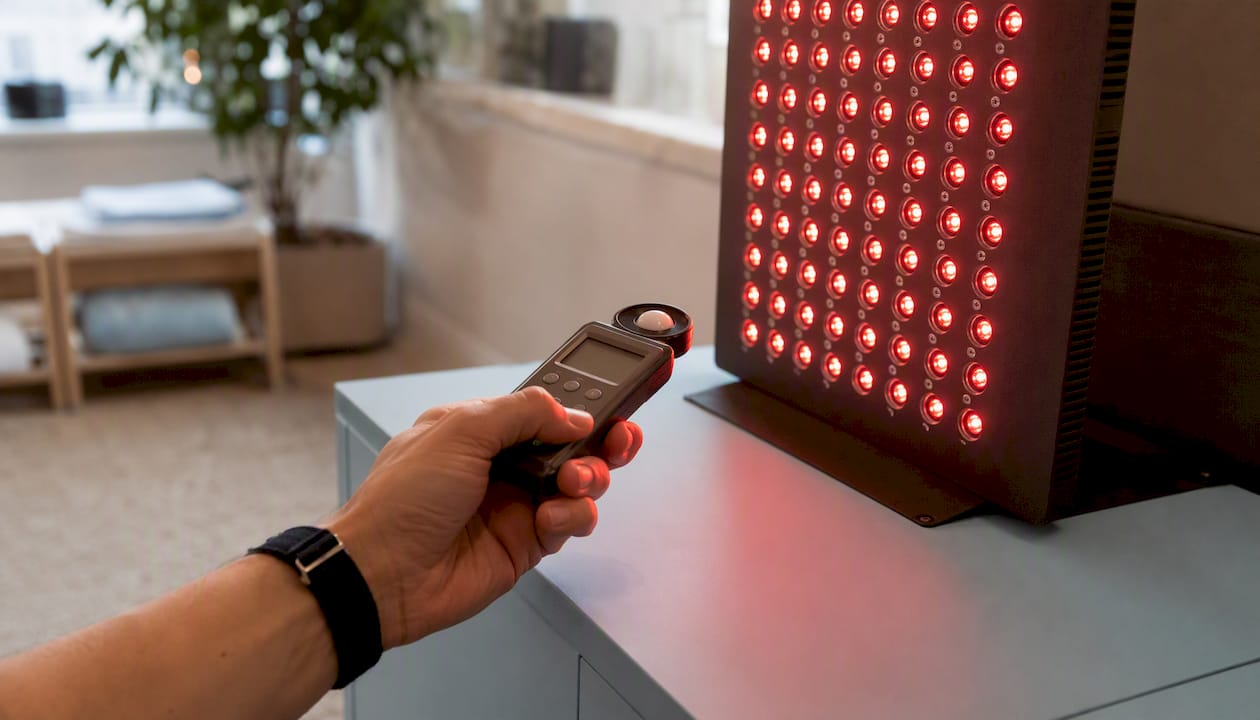
What to actually trust on a spec sheet: the test distance the manufacturer used, and whether that distance matches where you’ll actually sit. What to question: any irradiance figure listed without a corresponding distance, since that number is functionally meaningless on its own.
Your options for getting a real number:
- Ask the manufacturer directly for irradiance at multiple distances (6, 12, 18 inches), since reputable brands publish this or will provide it on request.
- Buy or borrow a handheld irradiance meter, which runs affordably and gives you a direct reading at your exact sitting position.
- Use published third-party testing where available, cross-referenced against the manufacturer’s own claims.
Rule of thumb: for most consumer panels, expect roughly a 25 to 50% irradiance drop between the manufacturer’s test distance and a more realistic 12 to 18 inch home-use distance. That drop is the single biggest reason people underdose without realizing it.
Pro Tip: Measure once at your actual sitting distance, write the number down, and reuse it for every future calculation. You only need to do this measurement once per device setup.
How Often Should You Do Red Light Therapy?
Most published protocols land on 3 to 5 sessions per week, and that range shows up consistently across clinical trials on photobiomodulation. Daily use appears in some studies too, particularly for acute conditions like wound healing, but daily sessions demand more attention to cumulative dose so you don’t drift into the inhibitory side of the biphasic curve.
If you’re treating twice in one day, which some acute-pain protocols call for, space the sessions at least 6 hours apart. Back-to-back dosing without that gap is one of the more common ways people accidentally overdose a treatment area.
Two phases worth distinguishing:
- Acute phase: higher frequency (4 to 5 times weekly), tighter dosing, used when actively addressing a new issue like a strained muscle or a fresh wound.
- Maintenance phase: 2 to 3 times weekly once you’ve reached your goal, mainly to sustain results rather than drive new change.
Watch for diminishing returns or new irritation as your signal to taper. If four weeks of consistent 4x weekly sessions haven’t moved the needle at all, the fix usually isn’t more frequency. It’s revisiting your dose calculation, since an under measured irradiance number is the most common culprit.
What Are the Best Red Light Therapy Protocols by Condition?
Dosing needs differ enormously depending on what you’re treating, mostly because of how deep the target tissue sits and how much energy has to survive the trip through skin to get there.
Skin rejuvenation and anti-aging
Skin is a surface target, so it needs the lowest doses on this list, generally 3 to 10 J/cm². At 50 mW/cm², a 6 J/cm² dose takes 2 minutes. First texture changes tend to show up in four to eight weeks of consistent 3 to 5x weekly use, with fuller collagen-related changes taking longer.
Hair growth
Scalp protocols sit close to skin dosing, 4 to 10 J/cm², but the timeline runs much longer. Hair follicles operate on multi-month growth cycles, so meaningful regrowth typically takes three to six months of consistent sessions, not weeks. At 40 mW/cm² across a scalp panel, a 6 J/cm² dose runs about 2.5 minutes.
Muscle recovery
This is where near-infrared earns its place. Muscle tissue sits deeper than skin, and red light alone often can’t penetrate far enough to meaningfully affect it. A combined red and near-infrared panel targeting 20 J/cm² at 70 mW/cm² needs roughly 4.8 minutes. Soreness relief often shows up within days; deeper recovery benefits build over a few weeks of consistent post-workout use.
Joint pain and arthritis
Joints need the highest doses here, 20 to 60 J/cm², because you’re trying to influence tissue under bone and cartilage, not just skin. Near-infrared wavelengths in the 800 to 880 nm range do the heavy lifting. At 100 mW/cm², a 40 J/cm² dose takes about 6.7 minutes. Most people report noticeable pain reduction within two to six weeks, though joint protocols often need ongoing maintenance rather than a defined endpoint.
Wound healing and post-surgical recovery
Wound protocols use moderate doses, 5 to 20 J/cm², but frequency runs higher, sometimes daily, especially in early healing stages. This is one context where clinical caution matters most; post-surgical use should generally involve a conversation with whoever is managing your recovery, since red light therapy carries no universal dosing guideline and individual healing conditions vary widely.
Is Red Light Therapy Safe? Contraindications to Know
Red light therapy carries a solid short-term safety profile when used as directed, but “as directed” is doing real work in that sentence, since there’s no single universal dosing standard across devices and conditions.
A few groups should check with a clinician before starting:
- Anyone pregnant, out of general caution around unstudied populations rather than documented harm.
- Anyone on photosensitizing medications (certain antibiotics, retinoids, some acne treatments) since these can amplify skin reactions to light exposure.
- Anyone with active cancer under treatment, where light-based interventions need to be coordinated with the treating oncology team.
Common side effects are mild and typically resolve on their own: temporary redness, occasional headache from bright light exposure, or short-term changes in shedding patterns during early hair treatment (often mistaken for hair loss, when it’s frequently a normal cycling response). Stop and consult a clinician if redness persists beyond a few hours, if you notice blistering, or if any existing condition seems to worsen rather than improve.
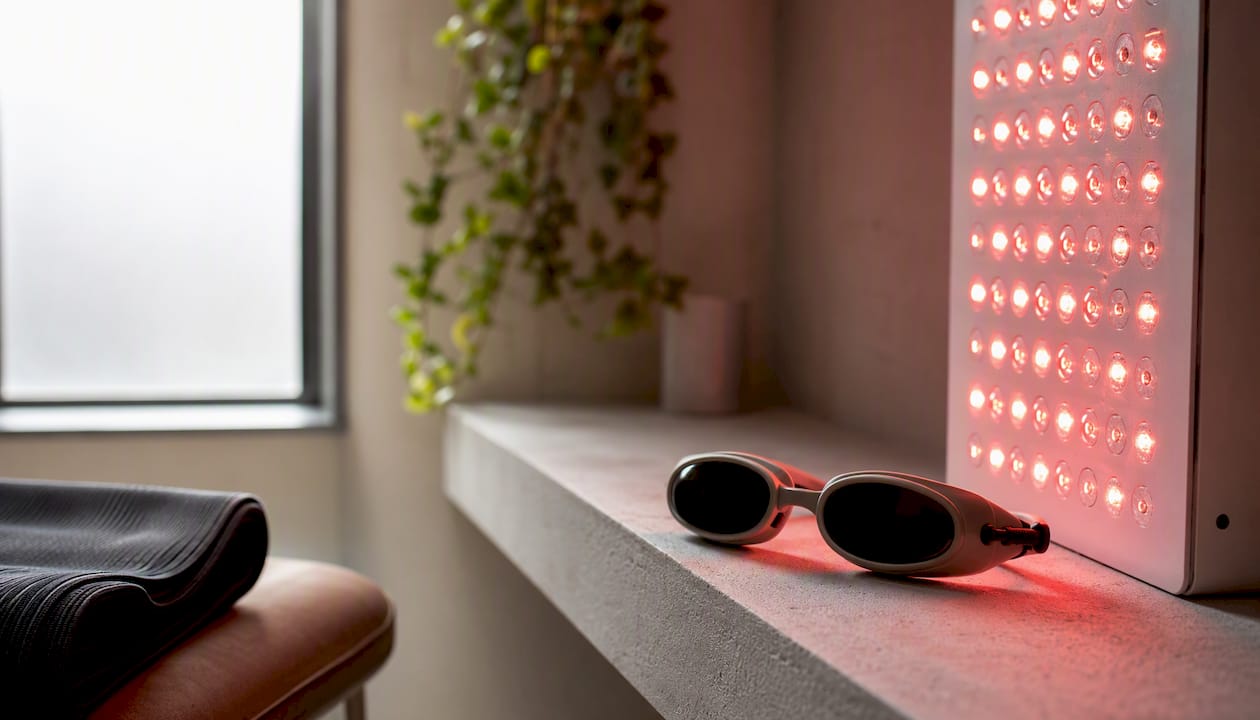
Eye protection matters most with high-irradiance panels and anything with substantial near-infrared output, since near-infrared can penetrate the eye without triggering the blink reflex that visible light does. Facial and nasal treatments call for particular care around the eyes specifically.
Do You Need a Different Dose for Different Skin Tones?
Tissue depth and skin pigmentation both change how much light actually reaches your target, which means the same panel and the same sitting time can produce different real-world doses in different people. Stanford Medicine’s overview of red light therapy points out that individual variation in response often comes down to exactly this: how much light gets absorbed or scattered before it reaches the target tissue.
Higher melanin content absorbs more light at the surface, meaning less energy makes it to deeper structures. For deeper targets like muscle or joints, and for higher pigmentation, a modest increase in surface dose (commonly cited stepwise increases in the 10 to 20% range in practitioner guidance) can help compensate, applied gradually rather than all at once.
Wavelength selection matters just as much as dose here. Red light (630 to 660 nm) works well for skin and surface targets. Near-infrared (800 to 880 nm) penetrates further and is generally what’s needed for muscle, joint, and other deeper structures. This is exactly why combined red and near-infrared panels show up so often in serious protocols: one wavelength range for surface work, another for depth.
Pro Tip: If you’re increasing dose to compensate for depth or pigmentation, add no more than 10 to 20% at a time and hold that new dose for at least a week before adjusting again. Stepwise increases let you catch overdosing before it becomes a pattern.
How Do You Set Up an Effective Session?
A few basics separate an accurate session from a wasted one:
- Treat clean, bare skin. Lotions, sunscreen, and makeup can block or scatter light before it reaches tissue.
- Remove topical retinoids or other photosensitizing products beforehand if you’re using them elsewhere on your routine.
- Measure and maintain your treatment distance consistently. Six inches one day and eighteen the next means two completely different doses despite identical session time.
- Apply moisturizer or a recovery serum after, not before, since post-treatment skin tends to absorb topicals more readily.
If you’re treating multiple areas in one sitting, split your total session time across them rather than giving each area the full calculated dose on top of the others; think of it as budgeting minutes across body parts, not stacking full doses everywhere.
Timing matters more than people expect. Evening sessions tend to pair well with sleep-related goals, while pairing recovery sessions with post-workout nutrition tends to compound recovery benefits rather than working against them.
How Long Until You See Results From Red Light Therapy?
Timelines vary by goal, and knowing what to expect keeps you from quitting right before results would have shown up.
- Skin texture: early smoothing often visible in 2 to 4 weeks, fuller collagen effects by 8 to 12 weeks.
- Pain relief: frequently the fastest response, sometimes within days for acute soreness.
- Muscle recovery: noticeable within the first week or two of consistent post-workout use.
- Hair regrowth: the slowest category, often three to six months before visible density change.
- Wound healing: early signs (reduced redness, faster closure) sometimes within one to two weeks.
Consult a clinician if you see no improvement after a full evidence-based trial period for your specific goal, generally 8 to 12 weeks for most conditions, or if you notice worsening symptoms rather than a plateau.
Can Medications or Supplements Affect Your Red Light Dosage?
Certain medications and supplements change how your skin and body respond to light exposure, which means your usual dose calculation might not apply cleanly if you’re taking one of them. Photosensitizing drugs are the main concern: certain antibiotics (tetracyclines, fluoroquinolones), retinoid-based acne medications, and some diuretics can all increase skin sensitivity to light, including the wavelengths used in red light therapy.
St. John’s Wort, a common over-the-counter supplement, has documented photosensitizing effects as well, and it’s easy to overlook since it doesn’t read as a “medication” the way a prescription does. If you’re taking anything in these categories, the safer path is starting at the lowest end of the dose range for your goal and watching closely for unusual redness or irritation before working up.
This isn’t about avoiding red light therapy altogether if you’re on one of these medications. It’s about recognizing that your effective dose might behave differently than someone with no photosensitizing factors, and adjusting your starting point accordingly rather than following a generic protocol blindly. When in doubt, a quick conversation with your prescribing doctor or pharmacist about light sensitivity takes a few minutes and removes the guesswork entirely.
A Coach’s View on Dosing Precision in Recovery Programming
Recovery only works when it’s dosed with the same discipline as a training program, and red light therapy is no exception. Inside humn.'s four-pillar framework, Resist, Recover, Renew, Rhythm, red and near-infrared light aren’t an add-on you use whenever you remember to. They’re scheduled around training load, sleep patterns, and how a client’s body is actually responding week to week.
Recovery earns its place as a fitness pillar precisely because it’s treated with the same precision as strength work, not as an afterthought bolted onto the end of a session. Getting dosing right, matching intensity and duration to what someone’s tissue actually needs, is what separates a recovery tool that moves the needle from one that just feels good in the moment.
How humn. Builds Red Light Therapy Into Your Recovery Plan
Guesswork is the enemy of good dosing, and that’s exactly why humn. doesn’t hand clients a red light panel and a generic instruction sheet. Recovery services, including red light therapy, sauna, and compression, get built into your coaching plan the same way a training load gets adjusted week to week: based on what your body is actually doing, not a one-size protocol pulled from a box.
If you’re in Gaithersburg and want recovery tools dosed as part of an actual plan rather than trial and error at home, premium coaching built around busy adults folds red light therapy into your broader strength and lifestyle programming from day one. Book a consult to see how humn. structures recovery, training, and habit coaching around your specific goals.
Frequently Asked Questions
How long should a red light therapy session last?
Session length depends entirely on your device’s irradiance and your target dose, but most home sessions run 2 to 15 minutes per area. Low-output panels need longer sessions; high-output panels reach the same dose in a fraction of the time.
How many times a week should you use red light therapy?
Most evidence-backed protocols use 3 to 5 sessions per week during an active treatment phase, dropping to 2 to 3 times weekly once you shift into maintenance.
Can you overdose on red light therapy?
Yes. The biphasic dose response means doses well above the therapeutic range can blunt or reverse the cellular benefits you’re aiming for, which is why starting conservative and increasing gradually matters more than maximizing intensity.
What’s the difference between red light and near-infrared for dosing?
Red light (630 to 660 nm) works well for surface targets like skin. Near-infrared (800 to 880 nm) penetrates deeper and is generally necessary for muscle, joint, and other subsurface targets, often at higher J/cm² doses than skin protocols require.
Do you need to wear eye protection during red light therapy?
For high-irradiance panels or anything with meaningful near-infrared output, yes, particularly during facial treatments, since near-infrared can affect the eye without triggering a natural blink response.
This article is general information, not a substitute for advice from a qualified doctor. Consult a qualified healthcare professional about your own circumstances before acting on anything here.
Sources
- Red Light Therapy Dosing Guide: How to Calculate J/cm² | LightTherapyIQ
- Red light therapy - Cleveland Clinic
- PMC3926176 (photobiomodulation review)
- Red light therapy insights - Stanford Medicine
No Comments.