

Buying a residential infrared sauna runs roughly $1,500 on the low end and well past $8,000 for a premium full-spectrum cabin, according to Jacuzzi’s consumer pricing guidance. Add delivery, electrical work, and installation, and the all-in number can be substantially higher than the initial purchase price. Studio drop-in sessions typically run $25–$75 per visit, while boutique membership packages can bring that down to roughly $15–$40 per session depending on tier.
For most recovery-focused adults who want consistent results, membership at a facility like humn. is the smarter starting point. Ownership makes sense if you need daily private access and plan to use it for a decade. For everyone else, the math and the habit science both favor a well-structured membership.

Table of Contents
- How much do infrared saunas cost across every price tier?
- What actually drives the price difference?
- Membership vs. buying: what does the breakeven actually look like?
- What does it actually cost to run a home infrared sauna?
- How often do you need to use infrared sauna to actually benefit?
- What to ask before signing a boutique membership with sauna access
- How humn. structures sauna access inside its membership
- The verdict: should you buy or join?
- Key Takeaways
- Why consistency beats ownership for most clients
- humn. membership: recovery built into your coaching plan
How much do infrared saunas cost across every price tier?
Sauna Dekor’s pricing breakdown organizes the market into four practical tiers, and each one involves real trade-offs beyond the sticker price.
Purchase price bands:
- Portable and entry-level units: Fabric pop-up tents and compact single-person cabins. Materials are basic, heater quality varies, and lifespan is shorter. These are the most accessible entry point.
- Mid-range residential cabins ($3,000–$8,000): Two- to three-person cedar or hemlock cabins with improved far-infrared heaters, better controls, and longer warranties. This is where most home buyers land.
- Premium full-spectrum systems: Full-spectrum heaters (near, mid, and far infrared), smartphone controls, chromotherapy lighting, and premium timber. Jacuzzi notes that higher material quality and manufacturer reputation drive meaningful value differences at this tier.
- Custom and commercial builds: Architect-integrated or commercial-grade installations. Price reflects custom cabinetry, ventilation systems, and durability for high-volume use.
**Membership pricing models at boutique studios:
**
| Model | Typical range | Best for |
|---|---|---|
| Drop-in single session | $25–$75 | Occasional users |
| Session bundle (5–10 pack) | $15–$40/session | Moderate users |
| Capped monthly membership | $80–$150/month | 2–4x/week users |
| Unlimited monthly tier | $150/month | Daily or near-daily users |
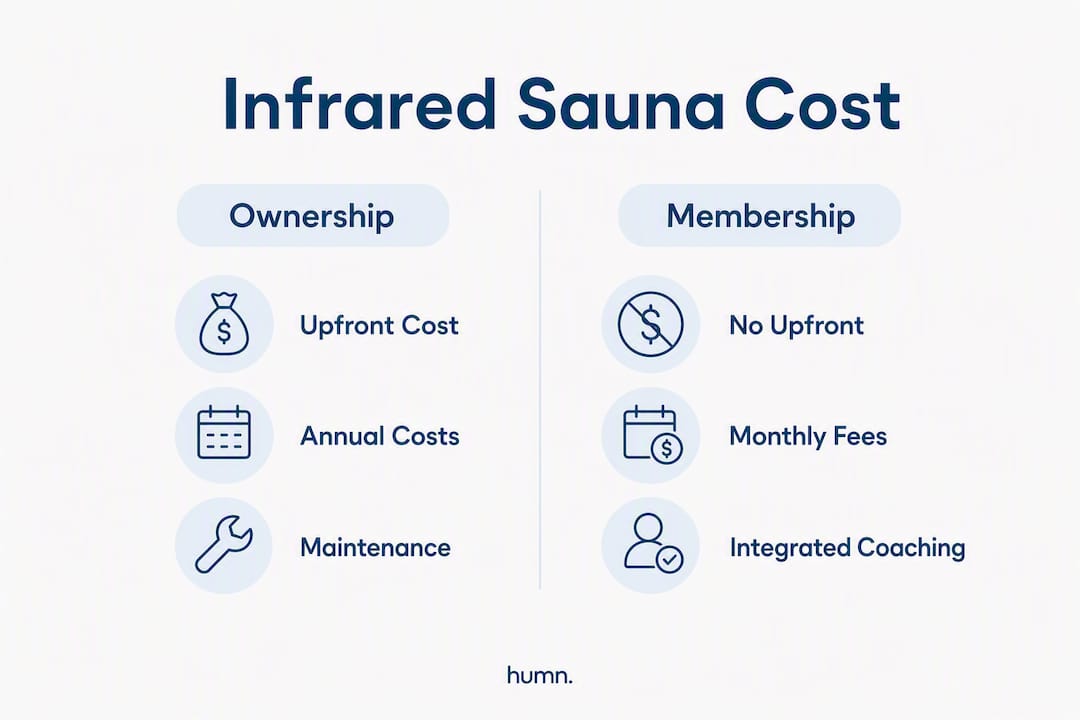
What “all-in” actually means for ownership: Industry analyses consistently show that electrical work, ventilation, delivery, and assembly add 15–25% to the headline unit price. A $5,000 cabin can realistically cost $6,000–$6,250 before your first session.
What actually drives the price difference?
Six factors explain most of the gap between a $2,000 entry cabin and a $10,000 custom build.
- Heater type: Far-infrared heaters are standard and effective for recovery. Full-spectrum systems add near and mid-infrared wavelengths at a higher cost. Jacuzzi’s guidance notes that premium controls and full-spectrum capability raise upfront cost without necessarily changing core therapeutic outcomes for general cardiovascular and recovery goals.
- Timber quality: Canadian hemlock and Western red cedar resist moisture and last longer. Lower-cost units often use poplar or engineered wood, which degrades faster in humid conditions.
- Size and electrical requirements: Many infrared cabins plug into a standard 120V outlet, which keeps installation simple. Larger cabins and premium systems typically require a dedicated 240V circuit, adding $500–$1,500 in electrical work before installation.
- Controls and accessories: Chromotherapy, Bluetooth audio, and app integration are comfort features. They add cost but don’t change the heat output or recovery benefit.
- Membership value drivers: For studio memberships, what you’re really paying for is scheduling flexibility, session caps, included recovery services, and whether a coach integrates sauna into your programming.
Pro Tip: Below roughly $4,000–$5,000, price tracks closely with component quality and lifespan. Above that threshold, you’re increasingly paying for aesthetics and customization rather than better therapeutic performance.
Membership vs. buying: what does the breakeven actually look like?
Here’s a worked example with clear assumptions so you can adjust it to your situation.
Assumptions:
- Mid-range residential cabin: $5,000 purchase price
- Installation and electrical (15%): $750
- Total upfront cost: $5,750
- Estimated lifespan: 10 years
- Sessions per week: 3x (156 sessions/year)
- Annual operating costs (electricity, maintenance): qualitatively low but recurring
- Boutique membership: $150/month ($1,800/year), includes sauna plus coaching and recovery services
| Metric | Ownership | Boutique membership |
|---|---|---|
| Upfront cost | $5,750 | $0 |
| Annual cost (year 1) | $5,750+ operating | $1,800 |
| Annual cost (years 2–10) | Operating costs only | $1,800/year |
| Years to breakeven vs. membership | roughly three years at 3x/week | N/A |
At 3x/week, ownership breaks even against a $150/month membership in roughly three years, assuming consistent use. At 4x/week, that timeline shortens. At 1–2x/week, it stretches well past five years.
The studio session economics shift further toward membership when you factor in that a boutique membership typically bundles sauna access with coaching, red light therapy, and compression — services that would each carry a separate cost as a standalone owner.
What does it actually cost to run a home infrared sauna?
Per-session electricity costs are low but real. UseSauna’s pricing guide notes that plug-and-play 120V infrared cabins minimize installation friction, while 240V hardwired builds introduce the largest installation variable. On the operating side:
- Electricity per session: A typical two-person infrared cabin uses 1.6–3.0 kWh per session. At the U.S. average residential rate, that’s roughly $0.20–$0.50 per session.
- Routine maintenance: Cleaning, replacing heater pads, and checking seals are low-cost but require attention. Budget a modest annual amount for consumables.
- Large-ticket repairs: Heater element replacements and control panel failures are the most common expensive repairs. Manufacturer warranties typically cover 1–5 years depending on the brand and tier.
- Warranty extensions: Premium brands offer extended coverage; budget for this if you’re buying at the mid-range tier without a long standard warranty.
Over a 10-year ownership period, ongoing operating and maintenance expenses can add meaningfully to the headline purchase price. That recurring cost is invisible in the sticker price but real in the total-cost-of-ownership calculation.
How often do you need to use infrared sauna to actually benefit?
Clinical and health-education sources link consistent sauna use to measurable cardiovascular and recovery outcomes at frequencies around 3–4 sessions per week. Sporadic use produces far weaker results.
- 3–4x/week is the threshold where repeatable recovery and cardiovascular signals appear in the research.
- Session length matters too: 20–45 minutes per session is the typical effective range, with benefits building over 4–12 weeks of consistent use.
- Adherence is the real variable. For busy professionals, location friction and scheduling complexity are bigger barriers than price.
Pro Tip: Build sauna sessions into an existing habit window — right after a training session, for example. Facilities that integrate sauna scheduling with your coaching calendar remove the friction that kills consistency.
What to ask before signing a boutique membership with sauna access
Not all memberships are equal. Before committing, run through this checklist.
- Session caps: Does the membership limit sauna sessions per week or month? Some tiers cap at 8–12 sessions/month, which matters at 3–4x/week.
- Peak-hour restrictions: Can you book during the hours you actually train?
- Included recovery services: Does sauna access come bundled with red light therapy, compression, or other modalities, or are those add-ons?
- Coach integration: Does a coach incorporate recovery sessions into your programming, or is sauna access just a perk you manage yourself?
- Hygiene and turnaround: Ask about cleaning protocols between sessions and whether private suite access is available.
- Hidden fees: Initiation fees, cancellation terms (30-day vs. 90-day notice), guest pass costs, and package expiration dates all affect real cost.
- Booking flexibility: What happens if you cancel a session last-minute? Is there a penalty?
Pro Tip: The membership that integrates recovery into your coaching plan is worth more than one that just gives you a key to the sauna room. Ask specifically how coaches use recovery data in your programming.
How humn. structures sauna access inside its membership
humn. in Gaithersburg, MD, bundles infrared sauna access with its full recovery suite — including red light therapy and compression — inside a single membership. That’s not a bolt-on perk; it’s built into the programming framework.
Members work with coaches who incorporate recovery sessions into habit-based plans alongside strength training and lifestyle coaching. The four-pillar framework (Resist, Recover, Renew, and Rhythm) means sauna use is scheduled, tracked, and connected to sleep, stress, and performance goals rather than treated as a standalone service.
What that means practically:
- Recovery sessions are scheduled alongside training, not as a separate booking task.
- Coaches use recovery data to adjust programming, so a hard training week triggers more deliberate recovery scheduling.
- The Nordic-inspired facility design reduces the friction of showing up — environment matters for habit formation.
- Sauna, red light, and compression are available in one location, which removes the multi-stop recovery routine that most home setups can’t replicate.
For recovery-focused members, this model shifts the value equation. The coaching-driven adherence that humn. provides is what closes the gap between owning a sauna and actually using it consistently enough to benefit.
The verdict: should you buy or join?
Three clear profiles emerge from the cost and habit evidence.
Buy if: You need daily private access, have the space and electrical infrastructure, and plan to use it consistently for 7–10 years. Factor in the full all-in cost including installation and operating expenses before comparing to membership pricing.
Join a boutique membership if: You use sauna 3–4x/week for recovery, want coaching integrated into your programming, and value the accountability and scheduling support that makes consistency realistic.
Try studio sessions first if: You’re new to infrared sauna and want to confirm the habit before committing to either ownership or a long-term membership.
Key Takeaways
Membership-first is the stronger financial and behavioral choice for recovery-focused adults using infrared sauna 3–4 times per week, especially when coaching and scheduling support are included.
| Point | Details |
|---|---|
| Purchase price range | Residential infrared cabins run from entry-level to $8,000+; all-in costs add 15–25% for installation. |
| Membership per-session cost | Boutique memberships typically reduce per-session cost to $15–$40, well below drop-in rates of $25–$75. |
| Breakeven at 3x/week | A mid-range cabin purchase breaks even against a $150/month membership in roughly three years of consistent use. |
| Frequency threshold for benefits | Clinical evidence supports 3–4 sessions per week as the threshold for measurable cardiovascular and recovery outcomes. |
| humn. membership model | humn. bundles sauna, red light, and compression with coach-led programming, making consistent recovery use practical for busy professionals. |
Why consistency beats ownership for most clients
The cost math on infrared sauna ownership is straightforward. The behavior math is harder. What I see repeatedly in coaching contexts is that people buy equipment with the best intentions and then use it sporadically — not because they don’t value it, but because life competes with a solo habit that has no external structure.
The clients who get the most from infrared sauna are the ones who treat it like a scheduled appointment, not a spontaneous choice. That’s exactly what an integrated membership model supports. When your coach builds recovery into your weekly plan and the facility is five minutes from where you already train, the friction that kills consistency disappears.
Ownership still makes sense for the right person. But for a busy professional who wants real recovery outcomes, not just access to a piece of equipment, the membership model wins on both cost-per-benefit and long-term adherence. The sauna you actually use three times a week is worth more than the one sitting in your basement.
*— Josh
humn. membership: recovery built into your coaching plan
If the membership case resonates, humn. is built around exactly this model. Recovery services including infrared sauna, red light therapy, and compression are integrated into every membership alongside personalized coaching for busy professionals — not offered as a separate add-on you have to remember to book.

The difference from a standalone studio session is the coaching layer. At humn., your recovery schedule is part of your programming, adjusted week to week based on training load and lifestyle factors. You’re not managing sauna access on your own; your coach is managing it with you. View membership options at humn. or reach out to discuss whether the integrated recovery model fits your schedule and goals.
No Comments.