

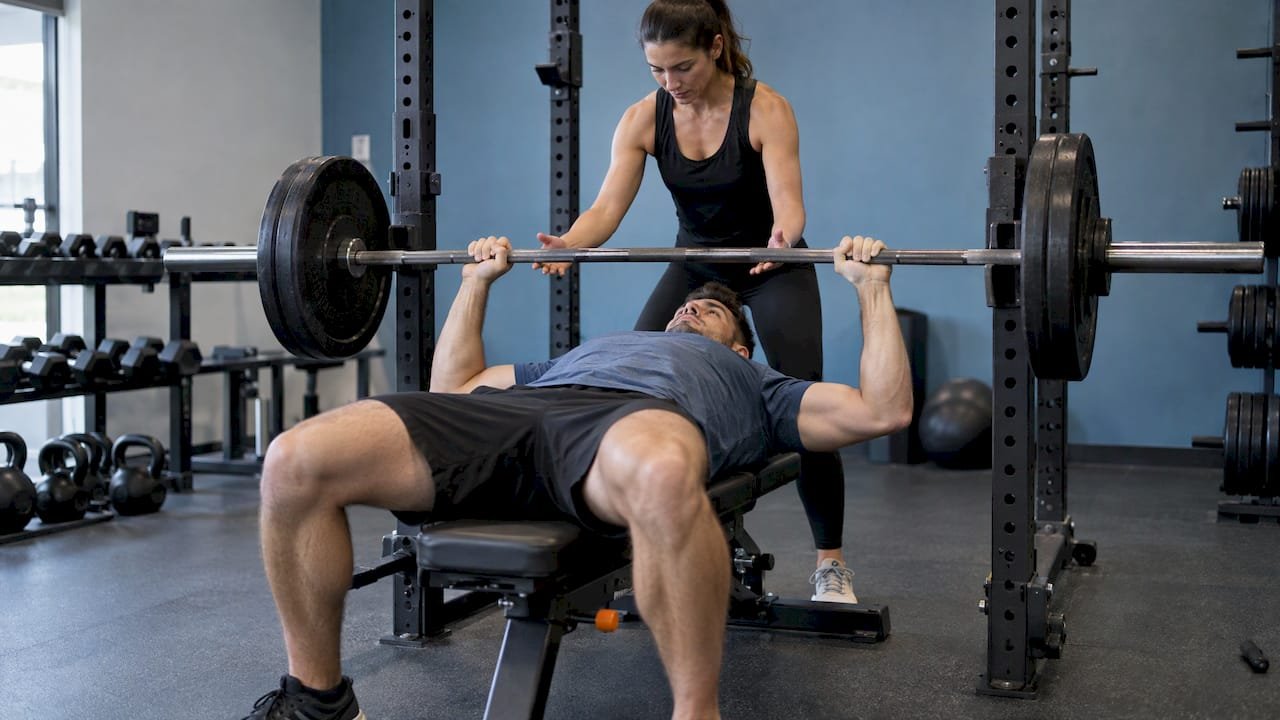
A shoulder-friendly bench press comes down to five things: a stable upper back, a moderate grip, elbows tucked at roughly 45° from your torso, a controlled descent that stops before your shoulders stretch back too far, and a warm-up that wakes up the muscles around the joint. If pressing hurts, you also need to know when to stop and get checked, because technique tweaks only help a shoulder that is fit to train.
This guide walks through each adjustment, the variations that tend to feel better, a warm-up you can run in a few minutes, and the signs that mean a doctor should look at your shoulder before you touch a barbell again.
TL;DR
- If you have a history of shoulder pain, get medical clearance before returning to upper-body pressing, per the American College of Sports Medicine.
- Keep your grip no wider than 1.5 times your bi-acromial width (roughly the distance between the bony points of your shoulders), and keep your upper arms near 45° from your torso instead of flared out.
- Squeeze your shoulder blades back and down, lower the bar under control, and limit how far your upper arms travel behind your torso at the bottom. A towel roll on the chest can set that limit.
- Floor presses, decline presses, narrow reverse-grip presses and restricted-depth machine or cable presses are common alternatives when a flat barbell press bothers you.
- Sudden, severe pain, a pop followed by weakness, numbness, or a misshapen shoulder means stop and get medical care.
Table of Contents
- Why the bench press bothers some shoulders
- Get cleared first if you have a history of shoulder pain
- The shoulder-friendly setup, step by step
- Setup checklist
- A warm-up that prepares the shoulder
- Variations that tend to feel better
- Build the muscles that support the press
- How to adjust the load when it hurts
- When to stop and see a doctor
- Perspective: why shoulder-friendly pressing is a coaching problem
- Get coaching on your pressing in Gaithersburg
- A sample bench session for a cranky shoulder
- FAQ
- Sources
Why the bench press bothers some shoulders
The bench press asks your shoulder joint to do two jobs at once: move heavy load and stay centered in a shallow socket. When your shoulder blades are loose on the bench and your elbows flare wide, the upper arm can drift too far behind the body at the bottom of the rep. That is the position most associated with irritation at the front of the shoulder.
NSCA guidance on shoulder performance points to a grip between 1 and 1.5 bi-acromial widths and a retracted scapula as ways to reduce compression and shear forces at the shoulder joint. In plain terms: a stable base under the joint and a moderate hand position protect it.
None of this means the bench press is off limits for you. It means the details of your setup matter more than the number on the bar.
Get cleared first if you have a history of shoulder pain
The ACSM Health & Fitness Journal’s guidance on the bench press is direct: lifters with a history of shoulder pain should be medically cleared before resuming upper-body resistance training. A sports medicine physician, orthopedist or physical therapist can tell you what is going on and what range of motion is safe for you.
There is also good news in the sports medicine literature. For a condition known as weightlifter’s shoulder (distal clavicular osteolysis), an ACSM sports medicine review identifies activity modification and rehabilitation as the main initial treatments, with injections or surgery considered for stubborn cases. Modifying how you press, rather than abandoning it, is a normal part of the plan, and your clinician should set the boundaries.

The shoulder-friendly setup, step by step
The ACSM article lays out a set of technique changes for lifters with shoulder pain. Here is how to apply them on the bench.
1. Set your upper back before you unrack
Lie down, pull your shoulder blades together and down toward your back pockets, and keep them there for the whole set. The ACSM guidance says to squeeze the shoulder blades together during the lift. Lying on a bench without doing this leaves the shoulder blade free to slide, which means the ball of the joint has to move more.
A cue many coaches use: think of pulling your shoulders away from your ears and into the bench, as if tucking them into a back pocket. Muscle & Fitness describes the same idea in its shoulder-prep circuit, where “back pockets” means pulling the shoulders back and down rather than only pinching the blades.
2. Choose a moderate grip
Find your bi-acromial width: the distance between the two bony points at the top of your shoulders. The ACSM guidance advises a grip no wider than 1.5 bi-acromial widths, and NSCA guidance gives a range of 1 to 1.5. If your hands currently sit out near the rings on the bar, move them in.
A quick check: at the bottom of the rep, your forearms should look close to vertical when viewed from the front or the foot of the bench. If your hands are far outside your elbows, the grip is too wide.
3. Keep your elbows near 45°
The ACSM recommendation is to keep the humerus, your upper arm bone, around 45° from the torso. That sits between a flared “T” position (90°) and elbows pinned against your ribs (0°). Picture an arrow shape from above rather than a T.
The same source tells lifters with shoulder pain to avoid the “high-five” position, where the upper arms are straight out to the sides at the bottom of the press.
4. Control the descent and limit depth
Lower the bar slowly and avoid bouncing it off your chest. The ACSM guidance also advises limiting shoulder extension at the bottom, meaning how far the upper arm travels behind the torso, to no more than 15°. In practice that means touching or stopping just short of the chest instead of sinking the bar as deep as possible.
A simple tool for this is a towel roll. The same article suggests placing a 4 to 6 inch towel roll on the chest so the bar stops when it meets it. Have a spotter or coach set it up the first time so the height is right and the bar is safe.
5. Press with intent, not momentum
Bouncing the bar uses the stretch at the bottom, which is exactly where you are trying to limit stress. Pause briefly, press smoothly, and lock out without shrugging your shoulders toward your ears.
Setup checklist
| Setup variable | Shoulder-friendly target | Common mistake |
|---|---|---|
| Shoulder blades | Pulled back and down, held all set | Loose on the bench, shoulders rolling forward |
| Grip width | 1 to 1.5 bi-acromial widths | Hands near the outer rings |
| Upper-arm angle | About 45° from the torso | Elbows flared to 90° (“high-five”) |
| Bar path | Controlled, no bounce | Dropping or bouncing off the chest |
| Bottom position | Stops before the shoulder stretches far behind the torso | Sinking as deep as possible |
A warm-up that prepares the shoulder
TrainHeroic’s bench warm-up guidance says a shoulder-friendly warm-up should combine thoracic spine mobility, scapular activation, reduced internal-rotation tightness and external-rotation work for the rotator cuff, done for 2 to 3 sets, followed by an empty-bar bench press set. That is a useful template.
A simple version you can run in about ten minutes:
- Upper-back mobility. A few slow reps of a thoracic extension or rotation drill.
- Scapular activation. Options named in the TrainHeroic guidance include band pull-aparts, face pulls, scapular push-ups and Y-T-W raises.
- External rotation. Light cable, band or dumbbell work to switch on the rotator cuff.
- “Back pockets.” Muscle & Fitness lists this drill at 2 sets of 10 repetitions with 30 seconds of rest.
- Empty-bar sets. Rehearse your grip, elbow angle and shoulder-blade position before adding load.
Keep the loads light. The purpose is to rehearse the position you will bench in, not to fatigue the shoulder before the work sets. If you want more drills, our mobility routine for lifters fits in 10 to 15 minutes.
Variations that tend to feel better
The ACSM article describes several alternatives when a standard flat barbell press is uncomfortable:
- Floor dumbbell press. Your upper arms stop when they reach the floor, which builds in a range-of-motion limit and makes the 15° extension limit easy to respect.
- Narrow reverse-grip press. Palms face you and hands sit closer together.
- Decline press. A decline angle shortens the range and changes the shoulder position. Physical therapist and coach Tony Gentilcore has described it as a shoulder-friendly pressing variation for lifters bothered by flat or incline work, though your clinician should confirm it suits your shoulder.
- Seated machine or cable press with restricted depth. The seat and a depth stop do some of the positioning work for you.
The ACSM source covers all of these options, including the towel roll described above. Rotate through them rather than hunting for a single perfect lift. A dumbbell variation also lets each arm find its own path, which many lifters find easier on the joint.
Build the muscles that support the press
Pressing is only half of shoulder health. NSCA guidance describes side-lying abduction to 45°, side-lying external rotation and side-lying horizontal extension as supporting exercises for the shoulder. Rows and pulldowns can be added once rotator cuff strength and stability are adequate.

That last phrase matters. If you are coming back from pain, ask your physical therapist when it is time to add heavier pulling, and do the rehab work they assign first.
How to adjust the load when it hurts
Use pain as information. Our 0 to 3 pain rule for training around joint pain gives a practical way to decide whether to continue, reduce or swap an exercise. The short version: if a set pushes pain above your comfortable limit, or the pain lingers or builds from set to set, lower the weight, shorten the range or switch to a different variation.
If you are working with a clinician, their guidance replaces any rule of thumb from an article.
When to stop and see a doctor
Some signals mean you stop pressing today.
- Call 911 for sudden pressure or crushing pain, especially if it spreads from the chest toward the left jaw, arm or neck, or comes with shortness of breath, dizziness or sweating. MedlinePlus lists these as emergency signs, since shoulder pain can sometimes come from the heart.
- Seek emergency care after a severe injury that leaves the shoulder very painful, swollen, bruised or bleeding, according to the same page.
- Book a medical evaluation for ongoing intense pain, weakness, numbness, reduced motion, a misshapen or swollen shoulder, a loose feeling, or a pop or tearing sensation followed by loss of function. Duke Health gives this list, and its orthopaedic surgeon Christopher Klifto, MD, separates ordinary post-workout soreness from those red flags.
For ongoing aches without those red flags, a sports medicine physician or physical therapist is the right first call. Some people also explore acupuncture alongside their rehab; our guide to testing acupuncture for shoulder pain safely explains how we approach it.
Perspective: why shoulder-friendly pressing is a coaching problem
Most shoulder complaints we hear about at humn. do not start with the bench press itself. They start with a bench press done on top of a desk-bound week, short sleep, high stress and no time to warm up. The bar gets blamed, but the system around it deserves a look.
That is why we coach the whole person. Our approach rests on four pillars: Resist, Recover, Renew and Rhythm. Resist is the lifting. Recover and Renew cover sleep, stress and the recovery work that lets you keep training. Rhythm is the habit layer that makes it sustainable.
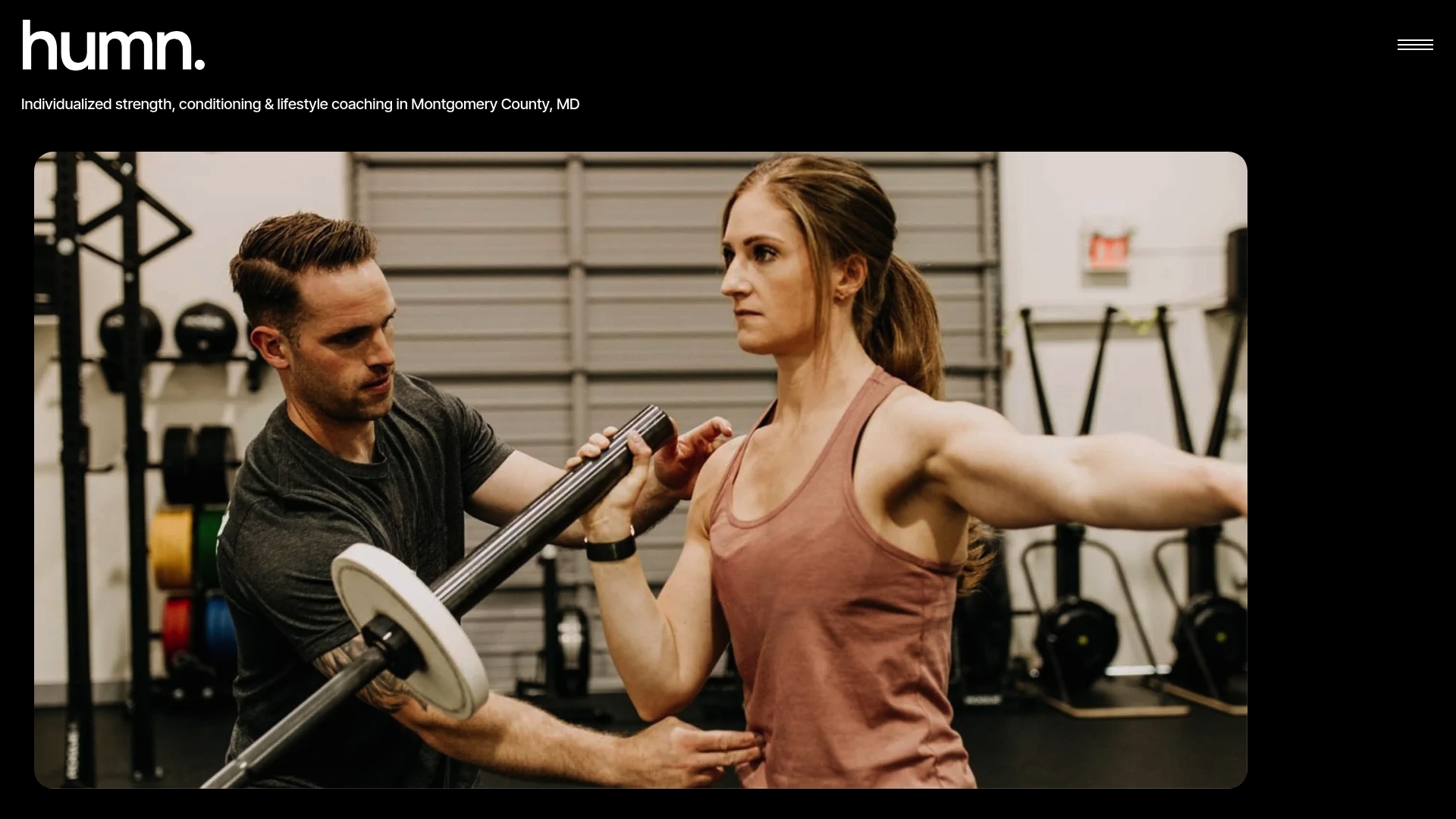
In a small-group setting, a coach can watch your grip, your elbow angle and your bar path, and adjust them set by set. In 1-on-1 coaching, we can go further and build a pressing plan around your history, your clearance from your clinician and the way your week actually looks.
A shoulder-friendly bench is not a lesser bench. It is a repeatable one, and repeatable is what builds strength over years.
Josh
Get coaching on your pressing in Gaithersburg
If you want someone to check your setup in person, we coach strength training in small groups and one-on-one at humn. in Gaithersburg, MD. Coaches can help you apply the grip, elbow angle and depth changes above and choose pressing variations that fit your training. We also build in sleep, stress, nutrition and recovery habits, because shoulders respond to all of it.
See how membership at humn. works, or read how small group training builds habits for busy adults. If your shoulder needs more individual attention, 1-on-1 coaching is the closer fit. Our coaching supports your training alongside your clinician’s guidance. It does not replace it.
A sample bench session for a cranky shoulder
Here is how the pieces fit together on a training day, assuming you have been cleared to press.
- Warm-up (8 to 10 minutes): thoracic mobility, band pull-aparts, light external rotation, “back pockets,” then an empty-bar set.
- Main press (3 to 4 sets): a floor dumbbell press or a barbell press with a towel roll, using a grip inside 1.5 bi-acromial widths and elbows near 45°. Stop each set while your form is still clean.
- Secondary press: a decline press or a seated machine press with restricted depth.
- Support work: side-lying external rotation, and rows or pulldowns once your rotator cuff strength and stability are adequate.
- Cool-down: a few easy breaths, light movement and a note on how the shoulder felt that day.
Writing down that note is the habit that pays off. Over weeks you will see which variation and which load your shoulder tolerates, and you can progress from there.
FAQ
Is the bench press bad for your shoulders?
Not by default. Problems usually come from setup and range of motion: a wide grip, flared elbows, loose shoulder blades or too much depth. The ACSM guidance gives specific fixes for each, and lifters with a history of shoulder pain should be medically cleared before returning to pressing.
What grip width is best for bench press with sore shoulders?
The ACSM guidance says no wider than 1.5 bi-acromial widths, and NSCA guidance suggests 1 to 1.5. Start near the narrower end of that range and adjust until your forearms look close to vertical at the bottom.
Is dumbbell bench press easier on the shoulders than a barbell?
Many lifters find it more comfortable because each arm can follow its own path. The floor dumbbell press goes further by stopping your upper arms at the floor, which limits how far the shoulder extends. Keep your elbows near 45° and your shoulder blades set, as you would with a barbell.
Should I keep benching if it hurts?
Not through sharp or worsening pain. Reduce the load, shorten the range or switch variations, and get evaluated if pain persists. A sports medicine review identifies activity modification and rehabilitation as the main first-line approach for weightlifter’s shoulder, so adjusting your training is a normal step.
What are the signs I should see a doctor?
Ongoing intense pain, weakness, numbness, reduced motion, a swollen or misshapen shoulder, a loose feeling, or a pop or tear followed by loss of function all call for medical evaluation. Crushing chest or shoulder pain with shortness of breath, dizziness or sweating is a reason to call 911.
Sources
- The Bench Press Exercise, ACSM Health & Fitness Journal
- TSAC Report Issue 80, NSCA
- A Sports Medicine Clinician’s Guide to Distal Clavicular Osteolysis, Current Sports Medicine Reports
- Shoulder pain, MedlinePlus Medical Encyclopedia
- Know When to See a Doctor for Shoulder Pain, Duke Health
- 10 Exercises to Improve Your Shoulder Mobility, Muscle & Fitness
- The Best Bench Press Warm Up Strategy, TrainHeroic
- Tony Gentilcore on the decline press, T Nation
No Comments.