


For post-workout recovery, controlled trials typically use 3 to 4 sauna sessions per week, at 15 to 20 minutes each, done after training. That dose is common across performance studies focusing on plasma volume and endurance capacity, and aligns with common recovery protocols. Individual tolerance still matters, so treat this as a starting point, not a rigid rule.
TL;DR:
- Sauna sessions should be consistently scheduled 3 to 4 times per week after training to optimize plasma volume expansion and cellular heat shock protein signaling.
- Traditional sauna use at 80 to 90°C for 15 to 20 minutes aligns with research findings, while infrared sessions may be longer but offer limited long-term benefits.
- A gradual build-up over three weeks—starting with two 10-minute sessions, then progressing to 15-minute sessions—helps establish safe, effective recovery routines.
- Timing sauna sessions 10 to 15 minutes post-exercise and pairing with lighter training days maximizes recovery without impairing performance.
- Monitoring sleep quality, heart rate, and performance indicators helps adjust frequency to avoid dehydration, fatigue, and overtraining risks.
Table of Contents
- What Does the Research Actually Show on Sauna Frequency for Recovery?
- What’s the Best Weekly Sauna Schedule for Recovery?
- How Long Should a Sauna Session Last, and Does Type Matter?
- When Should You Sauna Relative to Your Workout?
- How Do You Stay Safe With Frequent Sauna Use?
- A Coach’s Take on Starting Slow With Sauna Recovery
- Build Sauna Recovery Into a Real Recovery System
- Sources
- FAQ
What Does the Research Actually Show on Sauna Frequency for Recovery?
Two separate bodies of evidence point at sauna frequency, and they don’t quite agree, which is exactly why the confusion exists.
The first comes from controlled performance trials. Research modeled on protocols from researchers like Scoon and Kirby had endurance athletes sauna four times a week for roughly three weeks immediately after running sessions. The results: measurable increases in time-to-exhaustion and expanded plasma volume, the fluid component of blood that improves oxygen delivery and cardiovascular efficiency during exercise. These trials weren’t testing general health outcomes. They were testing whether heat exposure, timed right after training, could push adaptation further than training alone.
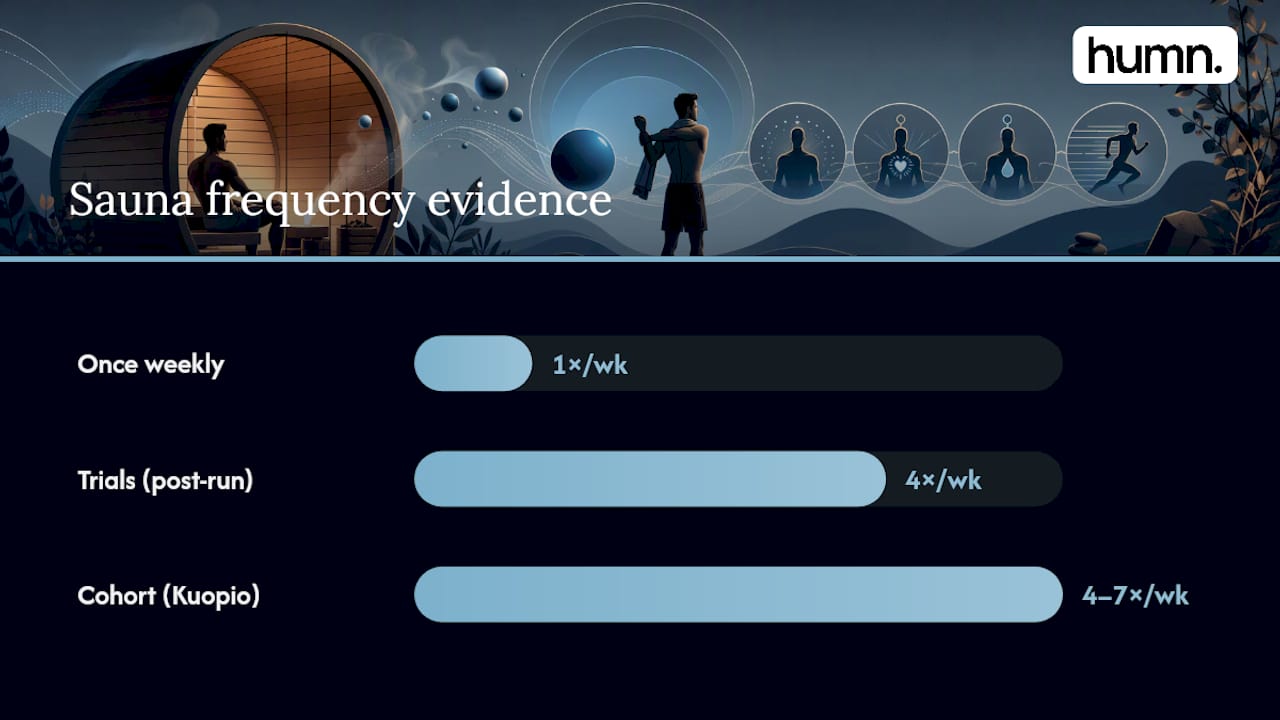
The second comes from the Finnish Kuopio cohort, a long-running observational study that tracked thousands of men over years rather than weeks. That data found people who used a sauna 4 to 7 times weekly had substantially lower cardiovascular mortality than those who went once a week. It’s a different kind of evidence: population patterns over decades, not a controlled dose-response test. That distinction explains why cohort numbers skew higher than trial numbers. General cardiovascular longevity and targeted post-workout recovery aren’t the same goal, and they don’t require the same frequency.
Underneath both data sets, two mechanisms seem to be doing the work:
- Plasma volume expansion, which improves how efficiently the heart delivers oxygen during exercise.
- Heat shock protein signaling, a cellular stress response linked to tissue repair and adaptation.
Both processes ramp up within the first several sauna exposures, with meaningful change typically appearing across 3 to 4 weeks of consistent use. That’s the practical takeaway: this isn’t a one-and-done intervention. It’s a dose you build over a month, not a session you drop in before a big event and expect results.
What’s the Best Weekly Sauna Schedule for Recovery?
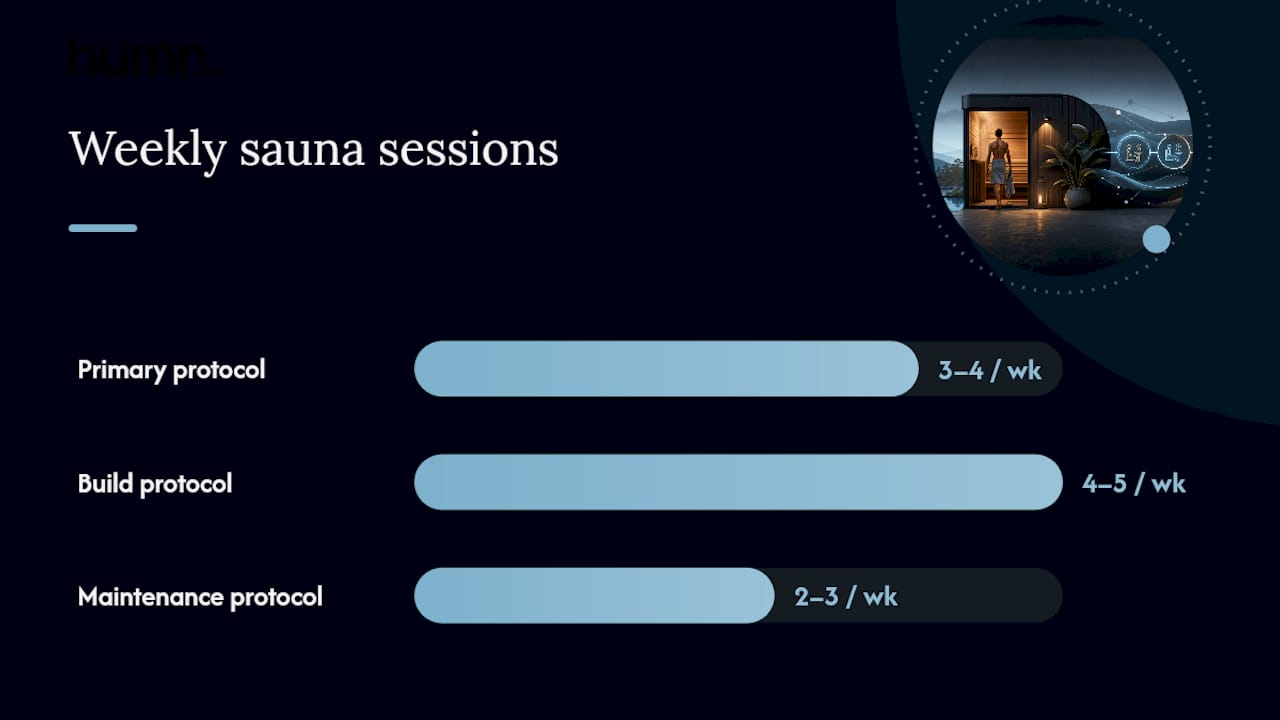
Once you know the target dose, the question becomes how to fit it into an actual week. Three protocols cover most training situations.
- Primary protocol (most people, most of the year): 3 to 4 sessions per week, taken after training days. This matches the evidence-based dose from controlled trials and works as a default for anyone lifting or running consistently.
- Build protocol (short training blocks, 3 to 6 weeks): 4 to 5 sessions per week. Reserve this for a focused push, like a race prep phase or a strength cycle, and watch sleep and resting fatigue closely since you’re stacking heat stress on top of harder training.
- Maintenance protocol (lighter training or off-season): 2 to 3 sessions per week. This keeps the habit and some of the adaptation without asking much of your recovery capacity.
A sample week on the primary protocol might look like this: sauna after Monday’s lower-body session, after Wednesday’s upper-body or conditioning work, and after Friday’s full-body or endurance session. That’s three sessions, each tied to a workout, each separated by at least a day.
Pro Tip: Consistency beats intensity here. Four sessions a week for two weeks then nothing for a month will not replicate the trial results. Pick a frequency you can actually sustain across a full month before judging whether it’s working.
How Long Should a Sauna Session Last, and Does Type Matter?
Traditional Finnish saunas run hot, typically 80 to 90 degrees Celsius, and most research uses 15 to 20 minute sessions at that range as the standard dose. Infrared units heat the body more directly at a lower air temperature, usually around 40 to 60 degrees Celsius, so sessions often run longer, but you have to adjust for the specific device rather than assume a blanket number.
- Traditional sauna: 15 to 20 minutes at 80 to 90°C is the benchmark used in most recovery research.
- Infrared sauna: Evidence is mixed. Some trials show favorable effects on neuromuscular recovery from short 10-minute post-exercise sessions, while a 2025 Frontiers trial using that same 10-minute, 3x-weekly dose found modest acute recovery benefits but limited long-term hypertrophy gains.
- Beginners: Start with 5 to 10 minutes and build up over 2 to 4 weeks as heat tolerance improves.
- The 30-minute ceiling: Pushing past 30 minutes raises dehydration risk without clear evidence of added recovery benefit, so there’s little reason to chase longer sessions once you’re in the effective range.
Infrared works well as a comfortable, lower-intensity option, but treat it as complementary to high-heat traditional sessions rather than a straight swap when plasma volume expansion is the goal. For a deeper breakdown of duration by device and body type, our sauna duration guide covers the specifics.
When Should You Sauna Relative to Your Workout?
Timing matters almost as much as frequency. A buffer of about 10 to 15 minutes after finishing exercise, before stepping into the heat, gives your heart rate a chance to come down and lets you rehydrate slightly before adding thermal stress on top of exercise stress.
Pair sauna sessions with the right kind of training day:
- Good pairings: Easy runs, low-intensity conditioning, accessory lifting days, or any session where you’re not chasing a personal best.
- Avoid pairing with: Heavy strength days or max-effort sprint work, where the added cardiovascular load from heat can blunt same-day recovery rather than support it.
Periodization rules apply here too. During a taper before competition, cut frequency back rather than adding more heat exposure. During a genuine deload week, light daily sessions are generally fine since training load itself is low. The Kuopio cohort’s 4 to 7 sessions per week associated with lower cardiovascular mortality reflects long-term health patterns, not a targeted recovery dose stacked on top of hard training blocks. Practitioners generally treat sauna as an added load: 3 to 4 sessions per week during high-intensity training, more only on lighter weeks.
Watch three signals to know if frequency needs adjusting: worsening sleep quality, rising resting heart rate or reduced heart rate variability, and unexplained performance drops in your main lifts or runs. Any of those, even while following a “correct” schedule on paper, is a cue to pull back.
How Do You Stay Safe With Frequent Sauna Use?
Dehydration is the primary acute risk, with typical fluid losses running 0.5 to 1.0 kg per session. A simple rule of thumb: weigh yourself before and after a session, and rehydrate to match what you lost, plus a bit more if you’re planning another session that day.
- Drink water before and after every session; add electrolytes if you’re sauna-ing more than three times a week or sweating heavily.
- Avoid alcohol within several hours of a sauna, since the combination sharply raises the risk of low blood pressure and irregular heartbeat.
- Anyone with cardiovascular disease, uncontrolled blood pressure, or who is pregnant should talk to a doctor before starting a frequent sauna routine.
- Reduce frequency if you notice worse sleep, dizziness when standing up, or fatigue that doesn’t resolve within a day.
- Cool down gradually after a session rather than jumping straight into a cold plunge if you feel light-headed.
Pro Tip: If a session leaves you feeling drained rather than loose and calm the next morning, that’s your body telling you to drop back a session or two that week, not push through. Our hydration guide for sauna users walks through the weigh-in method in more detail.
A Coach’s Take on Starting Slow With Sauna Recovery
Most people overcomplicate this. You don’t need a perfect protocol on day one. You need three weeks of consistent, unremarkable sessions to see whether it’s actually helping.
Week one: two sessions, 10 minutes each, after your two easiest training days. Week two: three sessions, 15 minutes, still tied to lighter workouts. Week three: move to the full 3 to 4 sessions at 15 to 20 minutes, always with that 10 to 15 minute buffer after training before you sit down. Track sleep and how you feel in the mornings, not just how the session felt in the moment.
This is why sauna sits inside our Recover pillar rather than as a standalone perk. Recovery only works when it’s paired with the right training load and watched over time, which is the whole point of coaching rather than guessing. A structured approach to recovery tends to outperform sporadic effort, whether that’s sauna, sleep, or programming.
— Josh
Build Sauna Recovery Into a Real Recovery System
A sauna alone won’t fix a training plan that’s already asking too much of you. That’s the gap most people hit: they add heat exposure without ever adjusting the training load, hydration, or sleep habits underneath it. Sauna access can be integrated into a bigger system, so your recovery protocol better matches what you’re doing in training instead of running on a separate track.

Members get recovery access alongside coaching that adjusts frequency and duration to your actual training block, not a generic weekly number pulled from a study. A guide on 1-on-1 coaching for busy professionals explains how an individualized approach to coaching works. Book a visit to see how the Recover pillar fits into your specific schedule.
Sources
- Stanford Lifestyle Medicine — Sauna and cardiovascular health
- Laukkanen et al. — Sauna bathing and cardiovascular outcomes (Kuopio cohort)
- Frontiers in Sports and Active Living — IRS post-exercise trial (2025)
FAQ
What happens after 20 minutes in a sauna?
Past the 15 to 20 minute range typically used in research, additional recovery benefit levels off while dehydration risk climbs, especially past 30 minutes.
What is the “200 rule” for sauna use?
There’s no established clinical standard called the 200 rule in sauna research; the recommended session duration based on controlled trials is 15 to 20 minutes at 80 to 90°C, which is the guideline to follow.
Is sauna two times a day too much?
For most people, two sessions in one day exceeds what’s needed for recovery and raises dehydration and cardiovascular strain without added benefit; the evidence-based range is 3 to 4 sessions spread across a full week, not stacked in a single day.
What is 30 minutes in the sauna equivalent to?
A 30-minute session sits at the upper edge of the researched range and delivers a comparable heat-adaptation stimulus to a 15 to 20 minute session, just with more fluid loss and no clear extra recovery gain to justify the added time.
How many sauna sessions per week are best for muscle recovery?
Controlled trials support 3 to 4 sessions per week, each 15 to 20 minutes, taken after training with a short buffer to let heart rate settle first.
No Comments.