


Most people get the best results seeing a trainer 2 to 3 times a week as a beginner, dropping to 1 to 2 times a week once the basics stick, and down to a check-in every few weeks once they’re advanced. Intensive phases like rehab or event prep can justify 3 sessions a week short term. If budget is the sticking point, a hybrid model, one coached session plus trainer-written solo workouts, gets you most of the benefit for a fraction of the cost.
TL;DR:
- Beginners should aim for 2 to 3 supervised sessions weekly during the first 4 to 12 weeks to build proper form and establish habits.
- Intermediate trainees typically need 1 to 2 coached sessions and 1 to 3 solo sessions weekly to focus on progression and program adjustments.
- Advanced athletes usually meet with a trainer every 2 to 4 weeks for fine-tuning, relying mostly on self-programming and fewer check-ins.
- The ideal training frequency depends on goals, schedule, budget, recovery, and technique, with higher frequency recommended for weight loss and muscle gain.
- Tapering frequency over time from multiple weekly sessions to monthly check-ins supports long-term progression and sustainability.
Table of Contents
- How Often to See a Personal Trainer by Experience Level
- How Do You Choose the Right Personal Training Frequency?
- How Training Frequency Changes Through Foundation, Transition, and Maintenance
- Budget-Friendly Ways to Stay Consistent With a Trainer
- Common Mistakes and Signs You Need to Change Your Frequency
- How humn.'s Four-Pillar Framework Shapes Session Frequency
- What I’ve Learned About Sustainable Trainer Frequency
- Where humn. Fits If You Want More Than a Gym Membership
- Sources
How Often to See a Personal Trainer by Experience Level
Frequency isn’t a fixed number. It shifts with how long you’ve been training, what you’re chasing, and how much of the work you can safely do on your own between sessions.
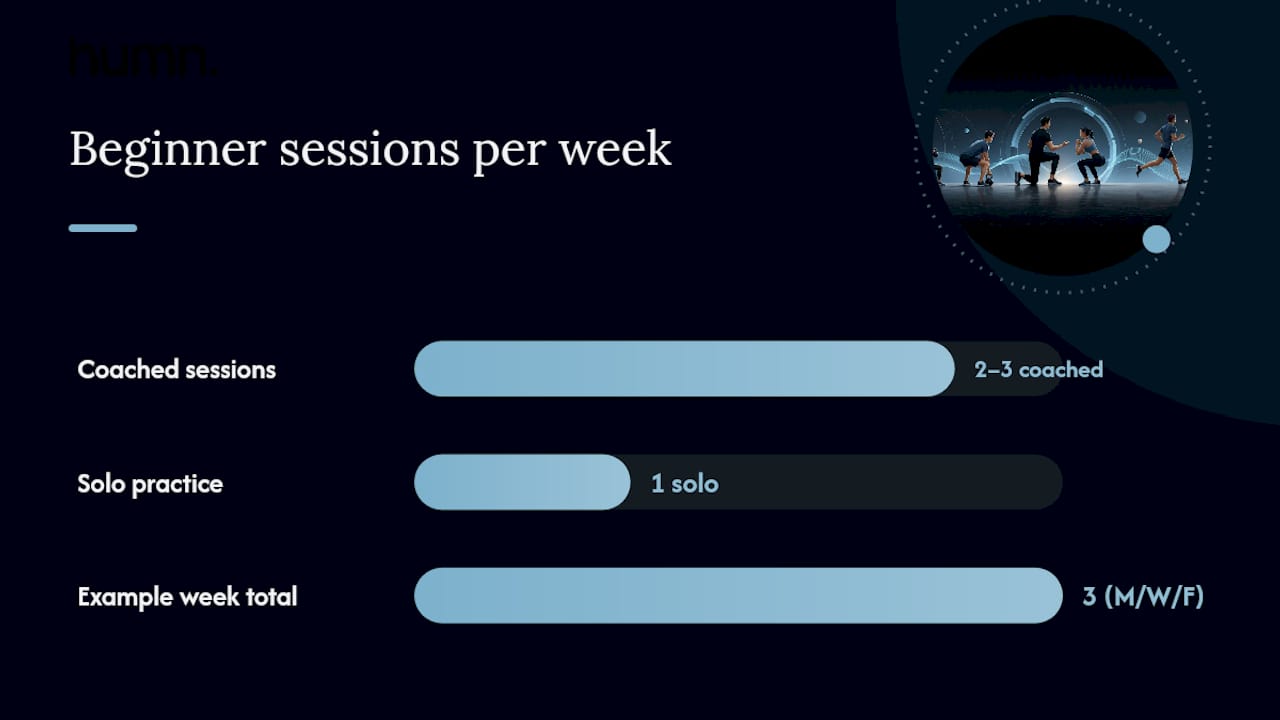
Beginners benefit from 2 to 3 supervised sessions per week for the first 4 to 12 weeks. That density matters early on because bad habits form fast, and a trainer catching a rounded back on rep three beats catching it after six months of wear on your spine. A realistic beginner week looks like this: Monday with your trainer learning the big lifts (squat, hinge, push, pull), Wednesday solo practicing the same movements at lighter loads, Friday back with your trainer for progression and load adjustments.
Intermediate clients typically need 1 to 2 coached sessions a week paired with 1 to 3 solo sessions. By this stage you can run a warmup and hit prescribed sets without someone standing over you. The trainer’s job shifts from teaching to programming, adjusting volume, managing plateaus, and keeping you honest on the lifts you’d otherwise skip.
Advanced trainees often do fine with a check-in every 2 to 4 weeks, mostly to fine-tune technique or troubleshoot a stall. At this point you’re largely self-programming, and the trainer functions more like a coach reviewing film than someone teaching from scratch.
| Experience level | Coached sessions/week | Solo sessions/week | Primary focus |
|---|---|---|---|
| Beginner | 2–3 | 1 | Technique, habit, baseline testing |
| Intermediate | 1–2 | 1–3 | Progression, programming adjustments |
| Advanced | Check-in every 2–4 weeks | 3–4 | Fine-tuning, troubleshooting plateaus |
Goals reshape these numbers, too:
- Weight loss tends to respond best to 2 or more weekly sessions combined with separate conditioning work, since the scale moves on total weekly effort, not just what happens in the session.
- Muscle gain usually needs at least 2 coached sessions a week to keep progressive overload honest and technique clean under heavier loads.
- Rehab or sport prep can call for 3 sessions a week for a defined block, then a fast taper once the movement pattern is solid.
How Do You Choose the Right Personal Training Frequency?
The right number isn’t the one that sounds most disciplined. It’s the one you’ll actually keep doing for months, not weeks.
Run through this before booking anything:
- What’s the specific goal, and by when?
- How many days a week can you realistically train, accounting for work and family?
- What’s the monthly budget, not just for the first month but the fourth?
- What’s your current recovery capacity, sleep, stress, old injuries?
- How solid is your technique on the core lifts already?
- Do you need someone checking in weekly to stay accountable, or do you self-motivate fine?
The trade-offs are real. More frequency means faster skill acquisition and tighter accountability, but it costs more and can crowd out other parts of your life. Fewer sessions save money and build independence, but only if you actually have the technique and discipline to fill the gaps.
A workable rule: front-load higher frequency for 6 to 12 weeks, then taper as you get consistent. If budget is tight, choose hybrid from the start rather than starting at 3x/week and quitting cold when the bill adds up.
When you book, walk through these steps:
- State your goal plainly (fat loss, strength, return from injury, general fitness).
- Share your actual weekly schedule, not your aspirational one.
- Ask for a written 8 to 12 week plan, including what to do on solo days.
- Set 2 or 3 measurable check-in metrics (load on key lifts, body measurements, a fitness test) so progress isn’t a feeling.
Pro Tip: Ask your trainer for a solo-day plan on day one, not after month three. A trainer worth paying will hand it over without being asked twice.
How Training Frequency Changes Through Foundation, Transition, and Maintenance
Frequency isn’t static across a training relationship. It follows a phase-based model: front-load contact when you’re learning, and taper it as you build independence.
- Foundation (weeks 1 to 8, sometimes to 12): 2 to 3 sessions a week focused on technique, habit-building, and baseline testing. This is where most of the injury-prevention value gets locked in.
- Transition (weeks 8 to 20): Frequency drops to 1 to 2 sessions a week as your solo work gets more reliable and your form holds under fatigue without a coach watching.
- Maintenance (ongoing): Once technique and consistency are proven, 1 session a week or a biweekly check-in, backed by solo or small-group work, keeps you progressing without paying for constant supervision.
You’re ready to taper when your training log shows consistent completion, your form holds steady on video or in the mirror, and your core lifts are climbing without a coach cueing every rep.
Budget-Friendly Ways to Stay Consistent With a Trainer
You don’t need three sessions a week to make real progress, and pretending otherwise is how people quit after month two.
The hybrid model, one coached session a week plus a written plan for 2 to 3 solo sessions, is widely regarded as a cost-effective and sustainable structure because it keeps the coaching value (programming, form checks, accountability) without the price tag of daily supervision. A short, higher-frequency block, 6 to 12 weeks at 2 to 3 times a week, followed by a taper down to weekly or biweekly, works well for people prepping for something specific: a wedding, a race, a return from injury.
Other ways to cut cost without cutting progress:
- Small-group training splits the coach’s attention and the bill across several people.
- Mixed packages pairing occasional 1-on-1 sessions with group classes lower the per-session cost while keeping expert eyes on your form.
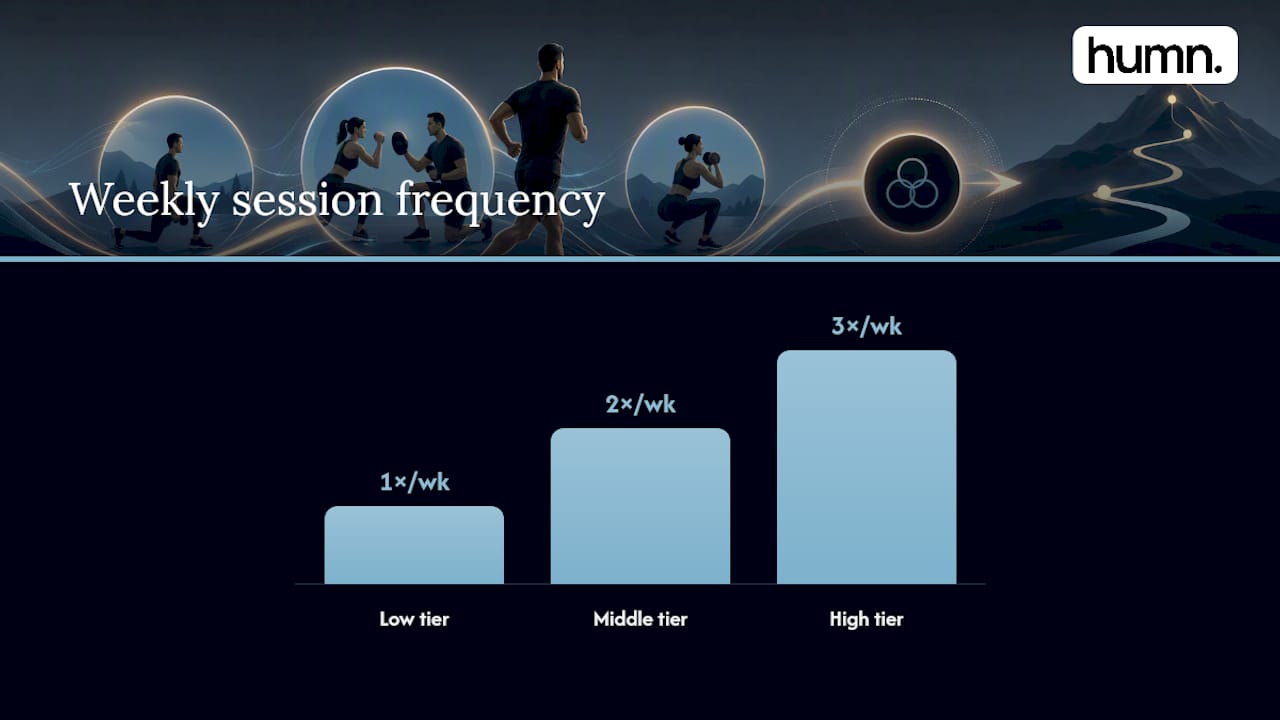
- Rough monthly ranges scale with frequency: 1x/week sits at the low end, 2x/week in the middle, 3x/week at the top. Ask any trainer for their actual pricing tiers before assuming you can’t afford more contact.
A well-run 1-on-1 hybrid setup often costs less over a year than a full-frequency package abandoned after eight weeks.
Common Mistakes and Signs You Need to Change Your Frequency
The biggest mistake isn’t picking the wrong number, it’s treating personal training as your only training. One good session a week does nothing if the other six days are unstructured.
Watch for:
- Ramping frequency up fast without giving your body time to adapt, a fast track to overtraining.
- Skipping the solo sessions your trainer programmed, which quietly erases most of the value of a hybrid plan.
- Ignoring persistent fatigue, stalled lifts, poor sleep, or a nagging ache that won’t resolve. These usually mean it’s time to pull back frequency, not push through it.
On the flip side, bump frequency up when you hit a real plateau, you’re learning a complex new skill, you’re returning from injury, or you’re prepping for a specific event with a deadline.
Structured, progressive training volume with adequate recovery consistently outperforms short bursts of intensity followed by drop-off, which is the whole argument for picking a sustainable frequency over an aggressive one you’ll abandon by March.
Pro Tip: If you’ve missed more solo sessions than you’ve completed for two weeks straight, that’s your sign to simplify the plan, not add more coached sessions on top of it.
How humn.'s Four-Pillar Framework Shapes Session Frequency
humn. builds frequency decisions around four pillars: Resist (strength training), Recover (structured deloads and recovery access), Renew (nutrition and lifestyle habits), and Rhythm (weekly accountability). A client rebuilding strength after injury might start with small-group or 1-on-1 coaching at higher frequency, then shift to weekly Rhythm check-ins backed by recovery add-ons as independence grows. New clients typically start with beginner-focused personal training before tapering toward a sustainable long-term rhythm.
What I’ve Learned About Sustainable Trainer Frequency
Phase-based frequency beats a fixed number every time I’ve seen it applied well. One client front-loaded three sessions a week for ten weeks to fix a shoulder issue, then settled into a weekly check-in for the following year, and that steady rhythm did more for her than the intense block ever could alone. Pick a frequency you can actually sustain for 3 to 6 months. Everything else is negotiable.
— Josh
Where humn. Fits If You Want More Than a Gym Membership
humn. is built for busy professionals who want a long-term coaching relationship, not just a workout slot. That means small-group training, 1-on-1 coaching, and recovery services (sauna, compression, red light therapy, acupuncture) integrated under one roof, so your training frequency and your recovery plan are designed together instead of fighting each other.

If you’re new to structured training, the beginner program walks you through a foundation phase built around technique and habit before frequency ever tapers. If you’re weighing whether 1-on-1 coaching fits your schedule and budget, read how humn. structures individualized coaching for professionals and book a consultation to map out a frequency that actually fits your week.
Sources
- Why hybrid personal training is taking over the fitness industry
- PMC article relevant to exercise prescription and recovery
No Comments.