


Zone 2 cardio builds endurance, sharpens mitochondrial and metabolic function, and strengthens the heart, all while keeping injury risk and recovery costs low. It benefits nearly everyone: busy adults chasing longevity, endurance athletes building a base, and anyone recovering from harder training. Clinical researchers and exercise physiologists both point to it as one of the most efficient, sustainable tools in fitness.
TL;DR:
- Most people can stay in Zone 2 with modest effort, supporting mitochondrial growth, increased capillary density, and improved heart efficiency over time.
- Zone 2 training primarily relies on the talk test, with heart rates around 60 to 70% of maximum, and is best maintained through steady, rhythmic activities.
- It rapidly improves fat burning, metabolic flexibility, and cardiovascular health while minimizing injury risk and enabling easier recovery.
- Weekly recommendations range from 150 minutes for beginners to several hundred minutes for elite athletes, spread across multiple sessions for best results.
- Zone 2 cannot replace high-intensity or anaerobic training for maximum speed, power, or rapid fat loss, and overdoing volume without balancing recovery can cause fatigue.
Table of Contents
- What Is Zone 2 Cardio, and Why Does It Matter?
- What Counts as a Zone 2 Workout?
- What Are the Real Benefits of Zone 2 Training?
- How Do You Know You’re Actually in Zone 2?
- How Much Zone 2 Cardio Should You Do Each Week?
- What Won’t Zone 2 Training Fix?
- What Does a Practical Zone 2 Week Actually Look Like?
- How We Build Zone 2 Into Coaching at humn.
- Ready for a Personalized Zone 2 and Strength Plan?
- Sources
What Is Zone 2 Cardio, and Why Does It Matter?
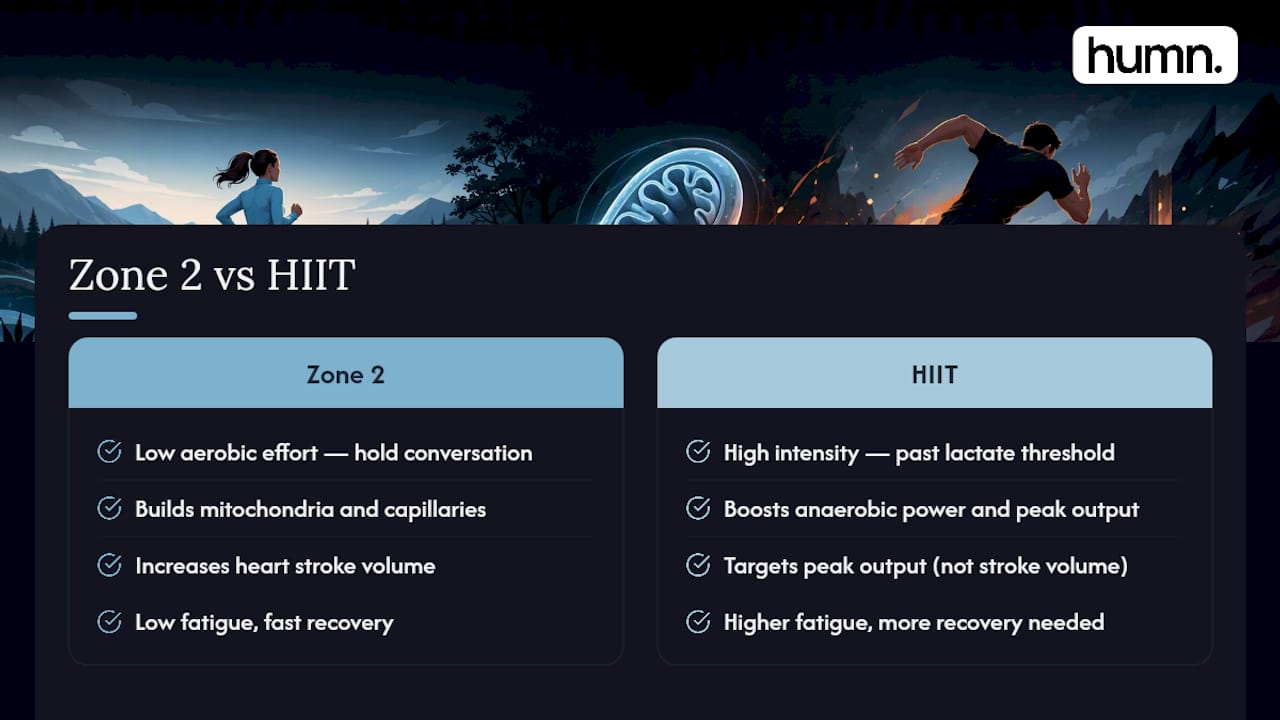
Zone 2 sits at the low end of aerobic effort, the pace where you could hold a conversation but not sing through it. Two people running side by side at the same heart rate percentage can be working at very different relative intensities, so the talk test still matters more than any chart.
What happens inside your body at this pace is the real story. Sustained time at low intensity drives your muscles to grow new mitochondria, the cellular structures that convert fat and oxygen into usable energy. It also increases capillary density around muscle fibers, which means more blood vessels delivering oxygen where it’s needed. Over months, your heart adapts too, with a stronger stroke volume that lets it pump more blood per beat instead of just beating faster. Together these changes improve endurance and are tied to lower cardiovascular disease and diabetes risk.
Compare that to high-intensity interval training, or HIIT, which pushes you past your lactate threshold and forces different adaptations, mostly around anaerobic power and peak output. Both have a place. HIIT sharpens your ceiling; Zone 2 raises your floor and lets you recover fast enough to do more work overall. Exercise physiologists describe Zone 2’s appeal as a “low-stress, high-benefit” profile, meaning you get real physiological payoff without racking up the fatigue and joint stress that comes with constant high-intensity work.
What Counts as a Zone 2 Workout?
You don’t need a treadmill or a cycling studio to train in Zone 2. Almost any steady, rhythmic movement works as long as you keep the effort controlled.
- Brisk walking or incline hiking
- Easy-paced cycling, indoors or outdoors
- Rowing at a conversational pace
- Swimming at a relaxed, sustainable stroke rate
- Elliptical or stair machine work at low resistance
For most people, sessions often extend for moderate durations to support endurance. Beginners often feel Zone 2 as “surprisingly easy,” almost frustratingly so, while trained athletes hit the same heart-rate zone at a noticeably faster pace since their aerobic engine is bigger. Mixing modes, say, cycling one day and rowing the next, keeps the training mentally fresh and reduces repetitive strain on any single joint or muscle group. Podcasts, audiobooks, or a walking route with actual scenery make the time pass without tempting you to speed up.
What Are the Real Benefits of Zone 2 Training?
This is where Zone 2 earns its reputation, and the benefits go well beyond “easy cardio.”
Fat oxidation and metabolic flexibility. Training at this intensity teaches your body to rely more efficiently on fat as fuel, a trait known as metabolic flexibility. That matters for endurance because sparing glycogen means you can go longer before hitting the wall. It matters less as a standalone weight-loss tool than marketing suggests. Clinical explainers are consistent on this point: Zone 2 supports fat-burning efficiency and heart and lung function, but body composition still comes down mostly to total energy balance and diet.
Cardiovascular gains. Regular Zone 2 work increases stroke volume and capillary density, so your heart moves more blood with less effort and your muscles pull oxygen from the blood more efficiently. This kind of moderate aerobic stress also encourages healthy cardiac remodeling rather than the more extreme structural changes sometimes associated with heavy endurance overload.
Mitochondrial density and endurance capacity. Peer-reviewed research on aerobic training documents measurable mitochondrial and cellular adaptations that support better endurance and more efficient energy production. More mitochondria means more capacity to produce energy aerobically, which translates directly into repeated output. You can hold pace longer, recover between hard efforts faster, and bounce back quicker the next day.
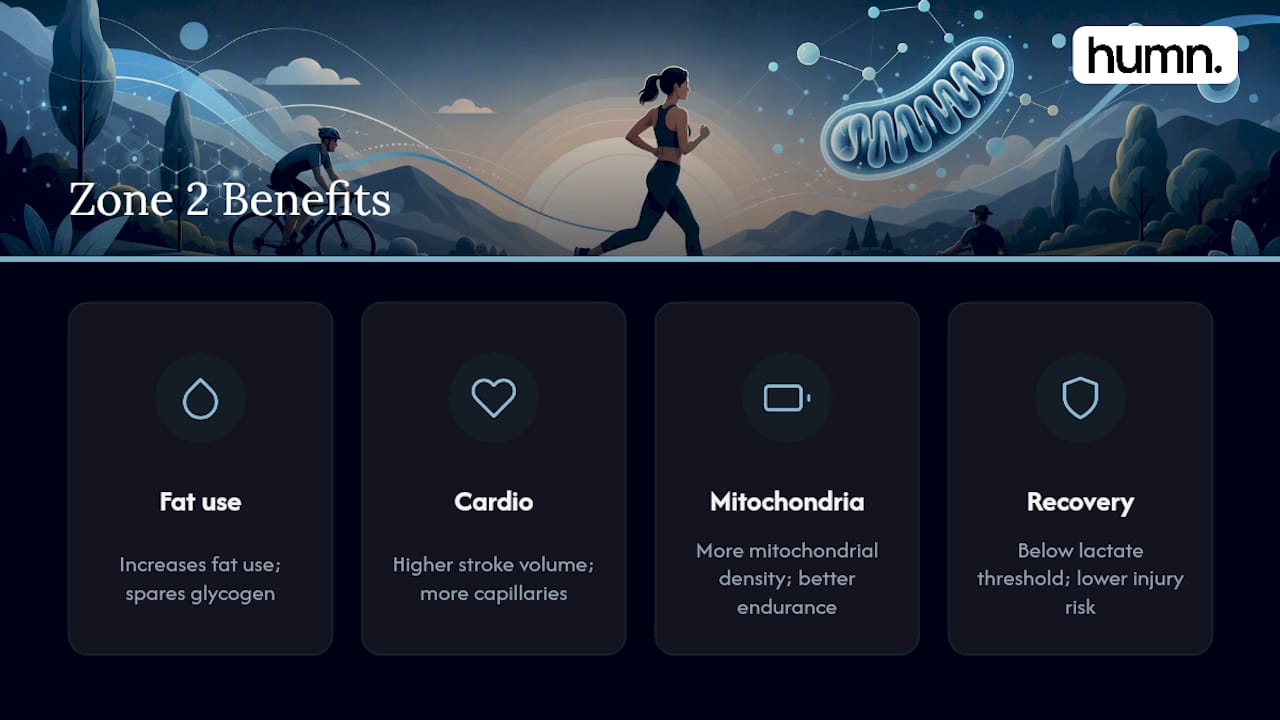
Lower injury risk and easier recovery. Because Zone 2 stays below your lactate threshold, your body can clear metabolic byproducts almost as fast as they’re produced. That keeps musculoskeletal and systemic stress low, which is why it’s considered one of the more sustainable training habits available, with lower injury and overtraining risk compared to frequent high-intensity sessions.
Cognitive and anti-inflammatory signals. Emerging evidence links regular aerobic activity to improved blood flow to the brain and modest reductions in systemic inflammation, both of which are associated with better long-term cognitive function. The research here is promising but still developing, so treat it as a meaningful side benefit rather than a headline claim.
Quick fact: Zone 2 training remains below the lactate threshold, which is precisely why sessions can run longer with less recovery debt than high-intensity work demands, according to Vail Health’s review of Zone 2 physiology.
How Do You Know You’re Actually in Zone 2?
The talk test is still the simplest, most reliable tool most people need. If you can speak in full sentences but couldn’t comfortably sing, you’re likely in range. If you’re gasping between words, you’ve drifted into Zone 3 or beyond.
For a heart-rate-based check, most people land somewhere around a moderate percentage of estimated max heart rate, adjusted to individual perception, though that formula (220 minus age) is a rough starting point, not gospel. Genetics, fitness level, medications, and even sleep quality shift your actual numbers. A chest-strap monitor tends to read more accurately during steady efforts than a wrist-based sensor, which can lag or misread during arm movement.
- Talk test: full sentences, no gasping
- RPE (rate of perceived exertion): roughly 3 to 4 out of 10
- Heart rate: about 60 to 70% of estimated max, adjusted to how you actually feel
If you want more precision, especially for structured endurance training, a lactate threshold test at a sports performance lab gives you your actual numbers instead of an estimate. It’s not necessary for general health goals, but it’s useful if you’re chasing race performance or training for a specific event.
Pro Tip: If your heart rate consistently sits higher than expected for a pace that used to feel easy, that’s often an early sign of accumulated fatigue or inadequate recovery, not just “a bad day.”
How Much Zone 2 Cardio Should You Do Each Week?
Public health guidance generally recommends at least 150 minutes of moderate aerobic activity weekly, and Zone 2 fits that recommendation almost perfectly since it’s moderate by definition.
Beginners can start with a moderate amount of weekly exercise spread across sessions, and still see meaningful adaptation. General fitness goals benefit from regular weekly exercise maintained consistently. Endurance athletes often train at a much higher volume; some elite competitors log several hundred minutes a week in Zone 2 alone, since it forms the bulk of their training load. That elite-volume figure isn’t a target for recreational exercisers, just a reminder of how much room there is between “enough” and “maximum.”
The practical move is spreading sessions across three to five days rather than cramming everything into one long weekend workout, and layering in strength training and occasional higher-intensity intervals rather than treating Zone 2 as your only training input.
What Won’t Zone 2 Training Fix?
Zone 2 has real limits, and pretending otherwise sets people up for disappointment. It doesn’t build maximal speed, power, or the anaerobic capacity you need for sprinting or heavy lifting; that requires targeted higher-intensity work. It’s also not a magic fat-loss switch on its own. Diet and total energy balance still drive body composition more than any single training zone.
For athletes with specific performance goals, an all-Zone 2 diet can become monotonous and under-stimulating, leaving key energy systems undertrained. And while rare, piling on excessive low-intensity volume without enough recovery or strength work can still lead to overuse issues. If you notice persistent fatigue or declining performance, that’s a signal to check in with a coach or physician rather than just adding more miles.
What Does a Practical Zone 2 Week Actually Look Like?
Two simple templates cover most fitness levels without overcomplicating things.
- Beginner (3 days): 30 minutes brisk walking or cycling on Monday, Wednesday, and Friday, keeping each session at a conversational pace.
- Intermediate (5 days): 40 to 60 minute sessions on Monday, Tuesday, Thursday, Friday, and Saturday, rotating between cycling, rowing, and incline walking, with one strength session layered in on a non-consecutive day.
- Progress check: Track whether your heart rate at the same pace trends downward over four to six weeks, or whether the same heart rate lets you sustain a faster pace. Either shift signals real aerobic improvement.
Sequence Zone 2 sessions apart from heavy lifting days when possible, and use morning readiness cues like HRV to decide whether to push the pace or keep it easy. Consistency over months beats intensity on any single day, and following a structured training plan phase helps prevent the common mistake of drifting too hard, too often.
How We Build Zone 2 Into Coaching at humn.
At humn., Zone 2 lives inside our Resist and Recover pillars, the strength and regeneration sides of our four-pillar framework alongside Renew and Rhythm. We typically program it as a base layer beneath a client’s strength work, using simple heart-rate and RPE checks during onboarding to find each person’s real Zone 2 range rather than relying on a generic formula. If you want that kind of precision instead of guessing at numbers from a chart, a coached assessment is worth considering.
— Josh
Ready for a Personalized Zone 2 and Strength Plan?
Reading about heart-rate zones only gets you so far. The real gap for most busy adults isn’t information, it’s knowing your own numbers and having a plan that adjusts as your fitness changes. That’s the core of personal training at humn., where coaches assess your aerobic base directly, build a Zone 2 target around your actual physiology, and pair it with strength work and recovery access, including sauna, compression, and red light therapy, so training and recovery work together instead of competing for your limited time.

Every program starts with a real conversation about your goals and current fitness, not a generic template. If you’re in Gaithersburg, MD and want a plan built around your own heart-rate data instead of an online calculator, reach out to humn. and schedule an assessment.
Sources
- The power of zone 2 training: unlocking endurance, metabolic health and longevity — Vail Health
- HSS expert shares why Zone 2 cardio is great for your heart health — Hospital for Special Surgery News
- PMC article on aerobic training and mitochondrial adaptations — NCBI PMC
- What Is Zone 2 Cardio? — Cleveland Clinic
No Comments.