

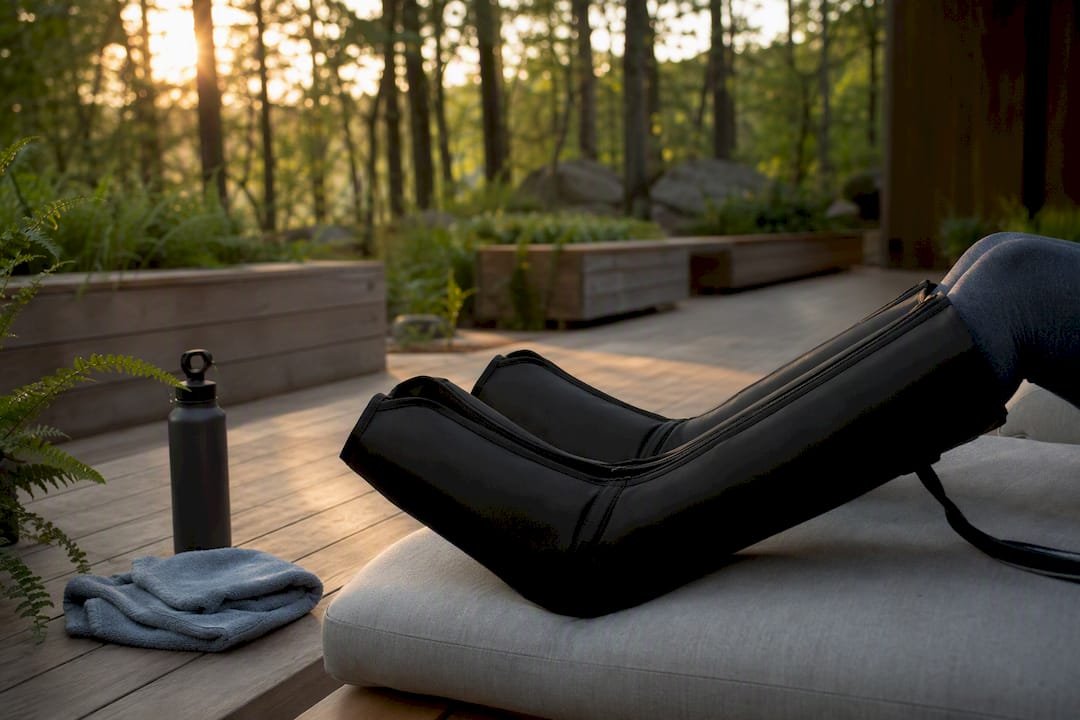
Yes, for screened, healthy adults, pneumatic compression boots are generally safe when used at moderate pressure (moderate pressure around the range commonly used in studies) for a session duration typically recommended post workout in a supervised setting. The exceptions matter as much as the rule: active or suspected blood clots, severe peripheral artery disease, and decompensated heart failure are key contraindications that should keep someone out of the boots entirely.
TL;DR:
- Compression boots are safe for healthy adults when used at recommended pressures and session durations, but should be avoided by those with active DVT, severe artery disease, or unstable heart failure.
- The primary benefits of compression boots include improved venous return, lymphatic drainage, and metabolite clearance, with evidence supporting their use mainly for quick recovery rather than performance enhancement.
- Proper screening and supervision are essential, especially for new users, to prevent risks and ensure correct fit, pressure, and hygiene protocols.
- Use of compression boots is most effective during tight training schedules, such as race week or back-to-back sessions, and should never replace medical consultation in case of symptoms like swelling or pain.
- Sessions should be tailored with moderate pressure (60–80 mmHg), short durations (15–30 minutes), and immediate cessation if symptoms like pain or swelling occur, always under professional guidance.
Table of Contents
- How Do Compression Boots Actually Work?
- What Does the Research Actually Show?
- Who Should Not Use Compression Boots?
- What’s a Safe Compression Protocol?
- Why Supervised Use Beats Going It Alone
- When Should You Stop a Session or Call a Doctor?
- A Coach’s View on Making Compression Count
- How to Try Supervised Compression Recovery at humn
- Sources
How Do Compression Boots Actually Work?
Pneumatic compression boots use sequentially inflating air chambers moving from foot to thigh, applying a wave-like compression pattern. That sequencing pushes fluid back toward the torso, mimicking what leg muscles do naturally when you walk or pedal.
The mechanical effect touches three systems at once:
- Venous return: the wave pattern helps move blood back toward the heart, especially useful after standing or sitting still through a hard session.
- Lymphatic drainage: compression reduces the interstitial fluid that pools around fatigued muscle, which is part of why legs feel less puffy afterward.
- Metabolite clearance: boots are thought to help clear byproducts like lactate, though the effect on soreness is more consistent than the effect on measurable output.
None of that makes compression automatically safe for everyone. It’s mechanical force applied to blood vessels and tissue, which is exactly why screening comes before the session, not after.
What Does the Research Actually Show?
The honest answer: modest, real, and inconsistent. A meta-analysis on recovery techniques found massage delivered the biggest reduction in delayed-onset muscle soreness among common recovery methods, with compression garments producing a smaller, but still measurable, drop in soreness and perceived fatigue. Compression is a solid tool. It’s not the strongest one in the toolbox.
The numbers that matter: an RCT on compression tights and post-exercise recovery found garments improved markers of venous return and perceptual recovery compared with a placebo condition, though not every outcome reached significance. That’s the pattern across this research: real signal, but it doesn’t show up on every measure every time.
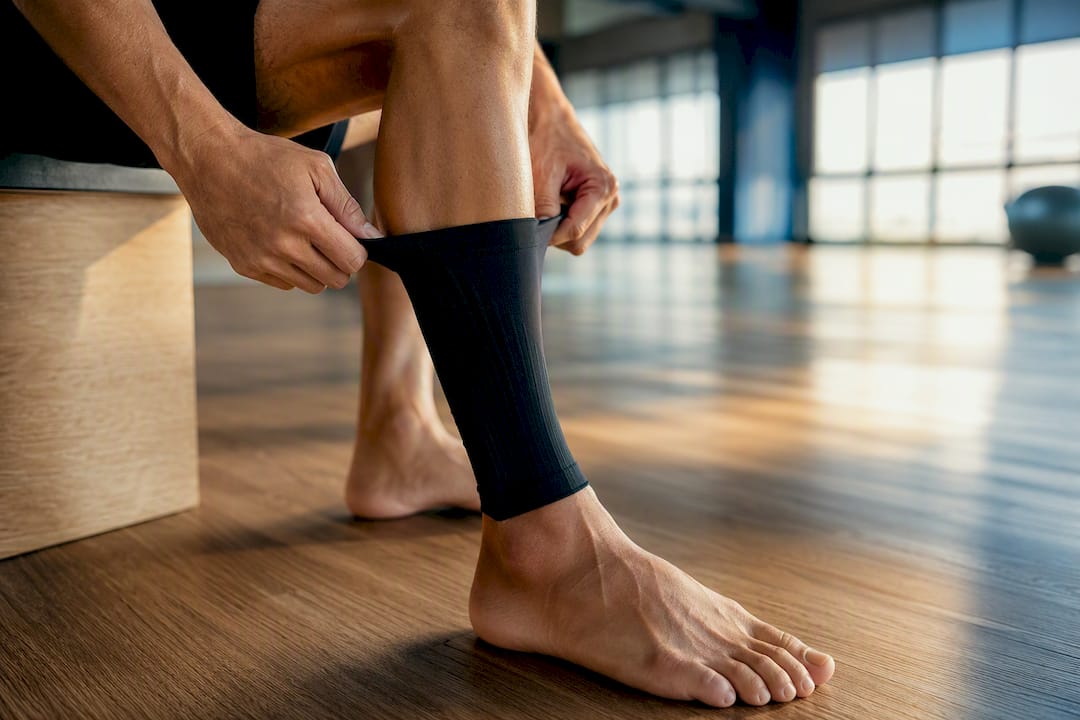
Where compression earns its keep most clearly is in tight turnaround windows, think two-a-day training blocks, a heavy race week, or back-to-back sessions where there’s no time for a full night’s sleep between bouts. Where it gets murkier is pure performance output. One small trial in trained cyclists found intermittent pneumatic compression actually elevated blood lactate during subsequent exercise, with no meaningful change in heart rate. That’s not a red flag for safety. It’s a reminder that “recovery tool” doesn’t mean “performance enhancer,” and the two get conflated constantly.
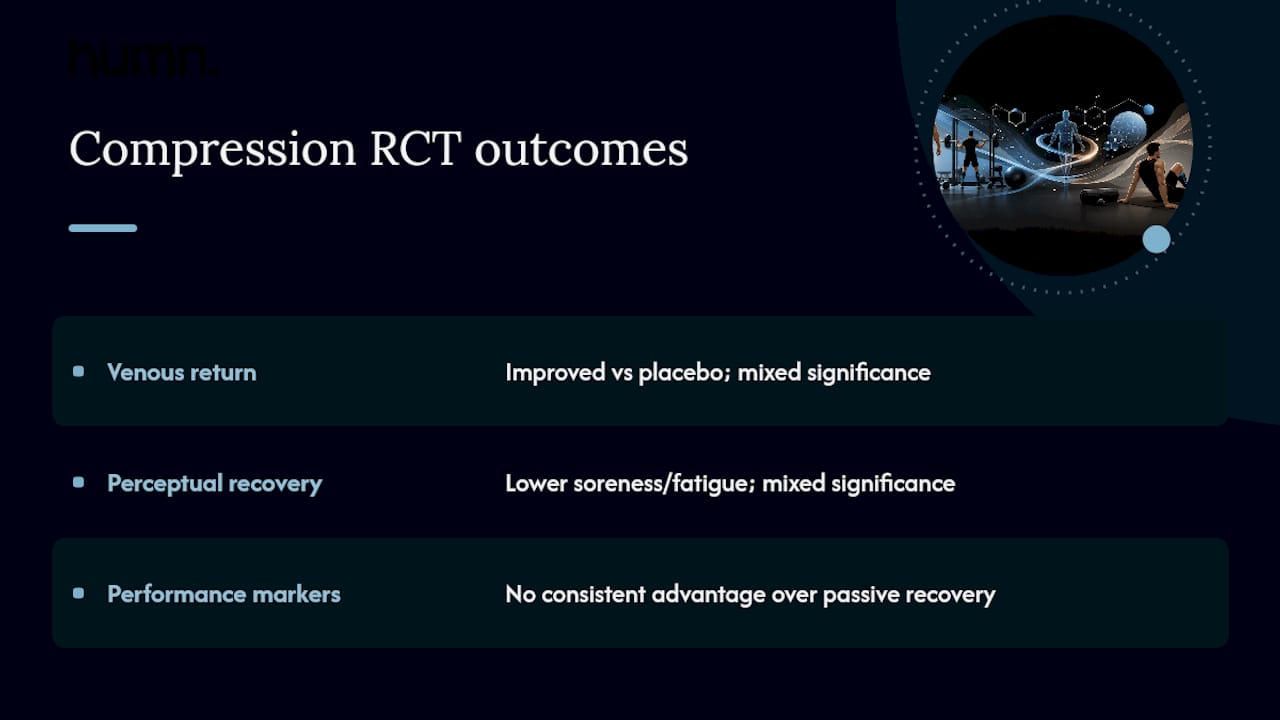
Other controlled trials on sequential compression found no consistent performance advantage over passive recovery for several markers. Small samples and wildly different protocols across studies make it hard to draw one clean conclusion, so treat compression as a comfort and recovery-perception tool first, not a guaranteed performance lever.
Who Should Not Use Compression Boots?
Screening takes two minutes and it’s the single biggest safety lever a facility controls. A clinical consensus statement on compression therapy risks lays out the conditions that should stop a session before it starts.
Absolute contraindications (do not proceed, no exceptions):
- Active or suspected deep vein thrombosis (DVT) — any recent unexplained unilateral leg swelling, warmth, or pain
- Severe peripheral arterial disease, defined by clinical consensus with low ankle pressure or ankle-brachial pressure index
- Decompensated or unstable heart failure
- Active skin infection, cellulitis, or open wounds on the legs
Relative cautions that need a doctor’s clearance before use, not an automatic pass or an automatic no:
- Surgery on the legs or pelvis within the past few weeks
- Advanced diabetic neuropathy, where numbness could hide a pressure injury
- A complicated personal or family vascular history
- Pregnancy, which should be discussed with an OB rather than assumed safe or unsafe
A short intake conversation before every new member’s first session, covering recent surgeries, known clotting history, diabetes status, and any leg swelling or pain, catches the overwhelming majority of risk before a boot ever goes on.
Pro Tip: Keep the intake questions on a physical card at the recovery station, not buried in an app. Staff scan it in ten seconds while helping a member get fitted, and that habit alone prevents most avoidable incidents.
What’s a Safe Compression Protocol?
The research and manufacturer guidance converge on a fairly narrow band, which makes the practical rules simple to follow. Most step-by-step protocols recommend removing restrictive clothing, sitting or lying still with legs elevated slightly, and starting with bare legs or a thin liner instead of thick clothing that bunch under the cuffs.
- Pressure: 60 to 80 mmHg for most healthy adults; a first-time session should run lower and shorter until the member knows what moderate pressure actually feels like.
- Session length: 20 to 30 minutes post workout is standard; cap a brand-new member’s first try at around 15 minutes.
- Fit: correct cuff sizing matters more than people assume, since a boot that’s too small concentrates pressure right at the knee instead of spreading it evenly. Chamber count and gradient smoothness affect this directly. Devices with more chambers and a smoother pressure gradient reduce painful pressure spikes near the thigh and knee.
- Hygiene: wipeable liners between every member, a disinfecting wipe-down of the boots themselves, and a logged maintenance check on the pump unit.
- Frequency: several sessions per week is typical for training, with daily use warranting caution and monitoring.
Pro Tip: If a member’s legs still feel tight or tingly an hour after a session at their usual pressure, drop the setting by 10 to 15 mmHg next time rather than assuming they need to “push through it.”
Why Supervised Use Beats Going It Alone
Screening only works if someone actually does it, which is the gap between a facility session and a boot sitting unsupervised in someone’s living room. Practitioner commentary on pneumatic compression points to supervised application as the difference between catching a red flag early and finding out about it after the fact.
At humn, compression sits inside the Recover pillar, not off in a corner as an afterthought. That distinction shows up in three ways:
- Staff run the same intake questions every time, not just at sign-up, so a new leg injury or medication change gets caught before pressure gets applied.
- A compression session becomes built-in downtime. Members who’d otherwise skip hydration or a post-workout meal get twenty guided minutes to actually do both.
- Recovery gets treated as connected work, not an isolated gadget. Compression pairs naturally with tools like acupuncture for muscle recovery inside one coached plan, instead of members guessing at combinations on their own.
That’s the practical case for why recovery functions as its own fitness pillar: the tool matters less than the person watching how you respond to it.
When Should You Stop a Session or Call a Doctor?
Most compression sessions are uneventful. Knowing the short list of exceptions is what keeps it that way.
- Stop immediately for sharp or worsening pain, numbness or tingling that doesn’t ease when pressure drops, swelling in only one leg, chest pain, or trouble breathing.
- Treat as a possible DVT emergency if a member reports sudden one-sided swelling, unusual warmth, or redness in the calf, even outside of a session. That calls for urgent medical evaluation, not a wait-and-see approach.
- Document and follow up every time something is stopped early: note the symptom, remove the device, and point the member toward their primary care provider or emergency services depending on severity.
None of this requires a medical degree on staff. It requires a written protocol, a habit of asking, and the willingness to end a session early rather than push through a red flag.
A Coach’s View on Making Compression Count
We schedule compression heaviest during race week and double-session blocks, when legs are carrying more fatigue than usual and the recovery window is short. We decline it just as readily. A member with unexplained calf swelling gets a conversation about seeing a doctor first, not a slot on the recovery calendar.
Every session starts the same way regardless of how busy the floor is: intake questions, a quick fit check, pressure dialed to what that person’s legs actually need that day, and a timer. Skipping any one of those steps to save five minutes is the fastest way to turn a recovery tool into a liability.
— Josh
How to Try Supervised Compression Recovery at humn
Compression access at humn comes built into the Recover pillar, alongside sauna, red light therapy, and acupuncture, all run by staff trained to screen before anyone sits down in the boots. That’s the real difference between a facility session and a boot ordered online: someone is actually checking for the conditions that make compression a bad idea before pressure ever gets applied.
If you’re already training with us, ask your coach about adding recovery sessions to your current plan. If you’re new, a trial visit is the easiest way to see how compression fits alongside strength work, sleep coaching, and the rest of what a membership includes. Book a visit and ask about recovery access to find out what a supervised session actually feels like, and whether your training block calls for it this week or not at all.
Sources
- Meta-analysis on recovery techniques and DOMS - PMC
- Consensus statement on medical compression therapy risks and contraindications
This article is general information, not a substitute for advice from a qualified doctor. Consult a qualified healthcare professional about your own circumstances before acting on anything here.
No Comments.