


Most people should build 1 to 2 rest days into every training week, and some training styles call for up to 3. The number comes down to biology: muscle tissue needs roughly 48 to 72 hours to repair and rebuild after resistance work before you hit that same muscle group again. Intensity, sleep, age, and how long you’ve been training all shift that number up or down.
TL;DR:
- Most people should schedule 1 to 2 rest days per week, with some training styles requiring up to 3, depending on intensity and volume.
- Rest placement matters; midweek breaks prevent fatigue buildup and help optimize recovery between heavy sessions.
- Sleep, stress, age, and protein intake influence how much recovery time your body needs beyond the standard guidelines.
- Active recovery days with light movement generally promote better muscle repair than complete rest, especially when recovering from intense sessions.
- Customized rest schedules built around individual training loads and life factors outperform rigid, universal plans for sustained progress.
Table of Contents
- How Many Rest Days You Need by Training Goal
- What Changes Your Rest Day Needs
- A Step-by-Step Way to Set Your Rest Days
- Active Recovery vs. Full Rest: What to Actually Do
- Signs Your Body Needs More Rest Than You’re Giving It
- How humn. Programs Rest Into Real Client Plans
- Why Simple Rest Schedules Beat Perfect Ones
- Get a Rest Schedule Built Around Your Actual Life, Not a Generic Template
- Sources
How Many Rest Days You Need by Training Goal
The right number of rest days depends less on willpower and more on what you’re training for. A beginner recovers differently than someone chasing a deadlift PR, and a runner’s recovery needs differ from those of a lifter.
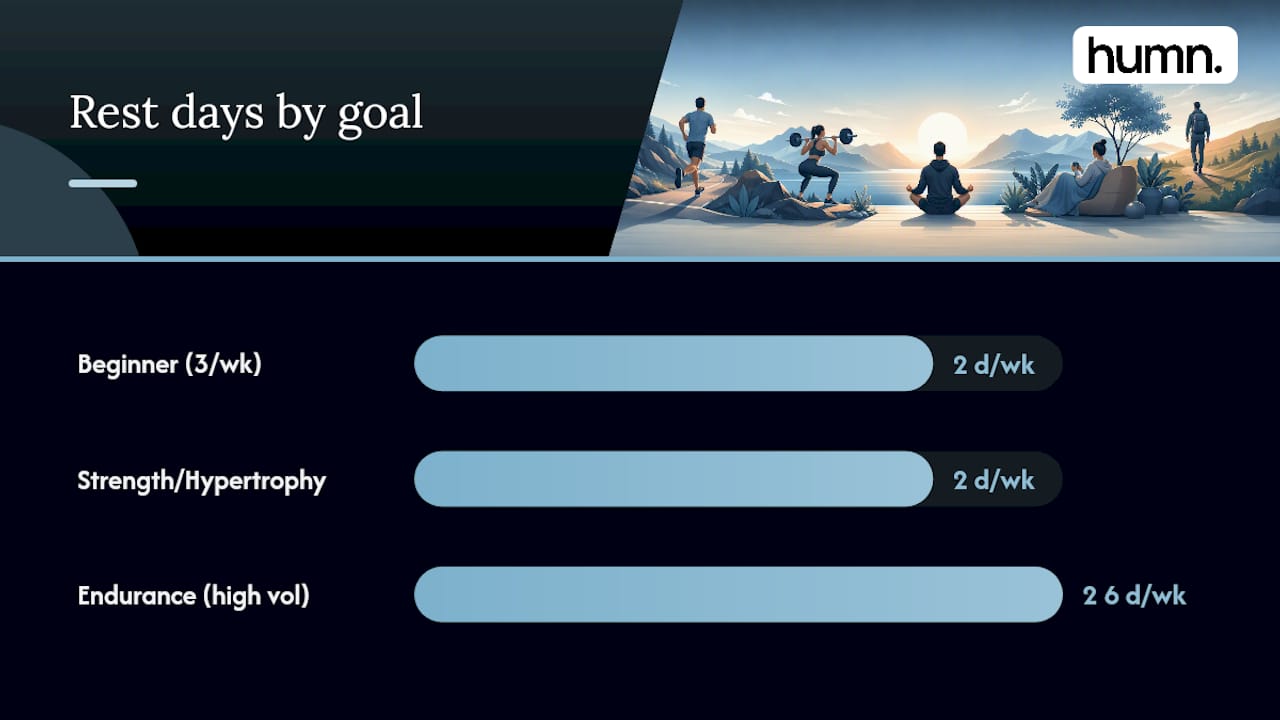
- Beginner, 3 sessions a week: Take 2 rest days, one completely off and one active (a walk, light stretching, an easy bike ride). New lifters generate more muscle damage from unfamiliar movements, so the extra buffer matters more here than most people expect.
- Strength or hypertrophy, 4 sessions a week: Plan 2 rest or active-recovery days, spaced so the same muscle group gets 48 to 72 hours before its next session. A common split hits upper body Monday and Thursday, lower body Tuesday and Friday, with rest or light cardio on the remaining days.
- Endurance or high-volume cardio: Build in 2 to 3 rest or active-recovery days depending on session intensity. Moderate aerobic work often only needs a rest day every 3 to 5 days, while back-to-back hard efforts (intervals, tempo runs, long rides) need recovery sooner.
Where you place these days matters as much as how many you take. Midweek rest breaks up accumulated fatigue before it compounds, while a rest day right after your longest or hardest session lets you absorb that specific stress instead of layering more on top of it.
Pro Tip: Stack your two hardest sessions of the week 48 hours apart, not back to back. It gives you a natural rest window without having to add an extra day off.
What Changes Your Rest Day Needs
The 1 to 2 day guideline is a starting point, not a fixed rule. Training intensity and total weekly volume are the biggest levers. Heavy compound lifts near your max, or five straight days of high-intensity cardio, demand more recovery than moderate, steady sessions.
Sleep and life stress matter almost as much as the workout itself. Poor sleep or a stretch of high work stress raises cortisol and slows tissue repair, which means your body needs more downtime to do the same job. Protein intake plays a role too. Adequate, evenly spaced protein throughout the day supports the muscle repair that happens on your days off.
- Older adults generally need more recovery time between hard sessions, since tissue repair slows with age.
- Beginners often need more rest early on despite lighter loads, because their bodies haven’t adapted to the new stress yet.
- Advanced athletes can sometimes train more frequently but usually manage volume through periodized deload weeks instead of extra days off.
Rule of thumb: if you’re sleeping poorly, under real stress, or coming off illness, add a rest day. If sessions feel easy and you’re recovering fast, you can often train through what used to be a rest day.
A Step-by-Step Way to Set Your Rest Days
Guessing your way through a training week wastes effort. Here’s a simple method to lock in a number that fits your actual life.
- Audit your current week. Note the intensity, duration, and muscle groups hit in each session. Two heavy leg days back to back is a different problem than four easy 30-minute sessions.
- Set your baseline rest count. Start with 1 to 2 days for most goals, then place them so the same muscle group gets 48 to 72 hours before its next hard session.
- Use a deload instead of stacking on extra rest days. If you train 5 or 6 days a week consistently, a planned deload week every 4 to 8 weeks often solves fatigue better than adding a third rest day every single week.
- Test it for 4 to 8 weeks, then adjust. Track how you feel and perform, and shift your rest count based on what shows up.
Pro Tip: Write your rest days into your calendar before you schedule anything else that week. Rest that isn’t planned is the first thing that gets skipped.
Active Recovery vs. Full Rest: What to Actually Do
Not every rest day should look the same. Active recovery keeps blood flowing to sore muscles without adding real training stress, and it usually beats sitting completely still.
- Active recovery examples: a 20 to 30 minute walk, gentle mobility work, an easy 15 minute spin on a bike, or light swimming.
- Full rest is the better call when: you’re sick, nursing an acute injury, or dealing with the kind of deep fatigue that makes even light movement feel like a chore.
- Nutrition and sleep still count on rest days: keep protein intake steady and prioritize a full night’s sleep, since most of the physical repair work happens during sleep, not during the workout itself.
The 48 to 72 hour recovery window for trained muscle groups isn’t arbitrary. It’s roughly how long tissue repair and protein synthesis take to run their course after resistance training, which is why hitting the same muscles again too soon undercuts the work you already put in.
For more ideas on filling that time productively, check out active recovery ideas that keep you moving without digging a deeper fatigue hole.
Signs Your Body Needs More Rest Than You’re Giving It
Your body usually tells you before a bad training block turns into a real setback. Watch for persistent soreness that doesn’t fade, a resting heart rate that’s creeping higher than normal, restless sleep, or strength and endurance numbers that quietly slide backward. Mood shifts, like unusual irritability or dreading workouts you normally enjoy, count too.
- Short-term fix: add one extra active rest day and prioritize sleep for a few nights.
- Program-level fix: cut volume for a week or run a full deload if the pattern sticks around.
- When to get help: if fatigue, mood changes, or performance drops persist past two or three weeks despite more rest, it’s worth flagging the overtraining signs with a coach or medical professional rather than pushing through.
How humn. Programs Rest Into Real Client Plans
Rest isn’t an afterthought in humn.'s four-pillar framework. Resist covers the training stimulus, Recover handles the physical downtime, Renew addresses sleep and nutrition, and Rhythm ties it all into a schedule a client can actually sustain. Coaches build rest days around each client’s specific training load, not a generic template.
A typical client lifting three days a week with a physically demanding job might get one full rest day and one active recovery day built around recovery services like compression or red light therapy. Someone in a higher-frequency strength block might see a scheduled deload every fifth or sixth week instead of a fourth rest day added to the regular rotation.
Rest programmed with intention, tied to how someone actually trains and lives, holds up better over months than a fixed number applied the same way to everyone.
Why Simple Rest Schedules Beat Perfect Ones
Coaches see the same pattern constantly: people overthink the exact number of rest days and underthink whether they’re actually taking them. A basic 1 to 2 day schedule, followed consistently, beats an elaborate periodization plan that gets abandoned after two weeks. Try a simple version for a month, then adjust based on how your body responds.
— Josh
Get a Rest Schedule Built Around Your Actual Life, Not a Generic Template
A blog post can hand you a starting range, but it can’t see your sleep quality, your job stress, or how your knees felt after last week’s squats. That’s the gap humn. closes. Working with a coach through 1-on-1 coaching means your rest days get built around your actual training load and recovery signals, not a one-size-fits-all number pulled from an article.

A first conversation at humn. usually covers your current training pattern, sleep habits, and stress load, then maps out where rest and active recovery days should sit in your week. Small-group and individualized programming both fold in access to recovery services like sauna, compression, and red light therapy on the days you’re not lifting. If you’re tired of guessing at your own recovery, reach out to humn. and get a schedule built around your actual week, not an average one.
Sources
HHS Physical Activity Guidelines, CDC activity basics, ACSM’s muscle recovery road map, and UCHealth on rest and recovery.
- Skeletal muscle hypertrophy — PMC review
No Comments.