


Mindset is the single most powerful predictor of long-term fitness success, outweighing workout programming, equipment access, and even nutrition planning. Research confirms that self-efficacy explains 46.7% of the variance in fitness persistence. That number tells you something critical: nearly half of whether you stick with training comes down to what you believe about yourself, not what you do in the gym. The role of mindset in fitness success operates through motivation, behavioral consistency, and the ability to adapt when plans fall apart. Coaches at humn see this play out daily with real clients in Gaithersburg, MD.
How does mindset shape motivation and consistency in fitness?
Mindset determines whether you show up on the hard days, not just the easy ones. A growth mindset, the belief that ability develops through effort, keeps you focused on progress rather than perfection. A fixed mindset, by contrast, treats setbacks as proof of permanent limitation. That distinction changes everything about how you respond to a missed workout or a plateau.

The brain’s reward system reinforces this pattern. Setting small, achievable goals floods the brain with dopamine, which strengthens self-belief and makes the next workout feel more attainable. This is why breaking a 12-week program into weekly targets works better than fixating on the end result. Each small win builds the neurological foundation for the next one.
Mental attitude in exercise also shapes how you interpret effort. People who frame discomfort as a sign of progress push through harder sessions. People who frame it as failure tend to cut sessions short or skip them entirely. The difference is not physical capacity. It is interpretation.
- A growth mindset reframes a missed session as a scheduling problem, not a character flaw.
- Weekly goal-setting creates consistent dopamine feedback loops that reinforce habit.
- Positive self-talk during training reduces perceived exertion and extends effort duration.
- Tracking small wins, like adding one rep or showing up three days in a row, builds compounding confidence.
Pro Tip: If you catch yourself thinking “I might as well quit since I missed Monday,” that is all-or-nothing thinking in action. Replace it with “What is the smallest thing I can do today?” Any movement counts.
What mental attitudes protect against burnout in training?
Burnout is not just physical exhaustion. It is a psychological state where training stops feeling meaningful and starts feeling like punishment. Research shows that a positive mental attitude mediates the relationship between mental toughness and reduced burnout, particularly protecting against emotional and physical exhaustion. That means attitude is not just a soft skill. It is a physiological buffer.
Mental toughness without a positive attitude is brittle. Athletes who grind through training with a negative internal narrative often hit a wall faster than those who approach hard sessions with curiosity and self-compassion. The mindset strategies that protect long-term fitness persistence share a common thread: they treat setbacks as data, not verdicts.
“Self-efficacy, body image, and motivation combined explain 54.1% of fitness persistence. The strongest single mediator is self-efficacy. Build that, and the rest follows.”
Adaptability is the practical expression of a resilient mindset. When a training block gets disrupted by travel, illness, or stress, the athlete who adapts their plan stays in the game. The athlete who insists on the original plan or nothing at all drops out. Reframing strain as a signal rather than a stop sign is a skill that can be practiced deliberately.
- Self-efficacy is the strongest behavioral mediator of long-term exercise adherence.
- Mental toughness alone does not prevent burnout. It requires a positive attitude to work.
- Reframing a hard week as “my body is adapting” reduces emotional exhaustion.
- Scheduling recovery as part of training, not a break from it, protects against physical burnout.
The mind-body connection in recovery is something humn builds directly into its programming. Recovery is not passive. It is where the mindset work of the week gets consolidated into physical adaptation.
How does mindset impact physical performance and training adaptation?
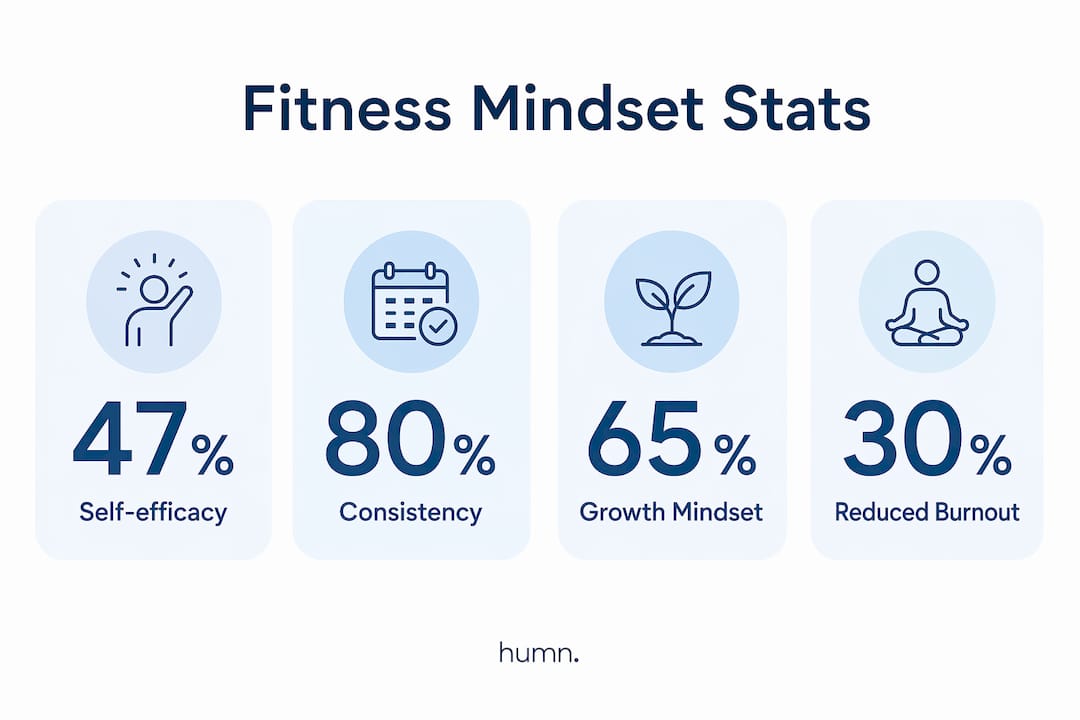
Mindset does not just influence how you feel about training. It changes what your body actually does. Mindsets positively impact physiological training adaptation, motivation, focus, decision-making, and technical skill execution under pressure. This is not motivational language. It is documented physiology.
The mechanism runs through the nervous system. Negative self-talk during exercise activates the fight-or-flight stress response, which diverts resources away from muscle performance and toward threat management. Reframing discomfort with growth mindset language reduces that stress response and keeps the body in a state where adaptation can occur.
Elite athletes and mission-critical teams treat mental framing as a trainable performance skill, not a personality trait. They build it progressively, the same way they build strength. That approach is now filtering into mainstream fitness coaching.
Here is how mindset maps to specific performance outcomes:
| Mindset behavior | Performance impact |
|---|---|
| Growth framing of effort | Increased physiological adaptation to training load |
| Positive self-talk | Reduced fight-or-flight response during hard sets |
| Focus on process goals | Better technical skill execution under pressure |
| Stress-is-enhancing belief | Improved decision-making in high-pressure moments |
| Flexible goal adjustment | Higher session completion rates over time |
- Identify your default self-talk pattern during hard sets. Write it down after a session.
- Replace threat-based language (“I can’t do this”) with challenge-based language (“This is hard and I am getting stronger”).
- Practice mindset switching before training, not just during it. A two-minute pre-session intention sets the neurological tone.
- Review your process goals weekly, not just your outcome goals. Process focus keeps performance consistent.
What mindset pitfalls block fitness progress?
All-or-nothing thinking is the most common and most damaging mindset trap in fitness. Rigid, inflexible exercise criteria cause people to abandon workouts entirely when plans are disrupted. If the standard is “a full 60-minute session or nothing,” then any deviation becomes a reason to quit. That pattern compounds over time into complete exercise abandonment.
The psychology behind this is well documented. High-anxiety individuals show 2.3-fold lower exercise adherence compared to low-anxiety groups. Anxiety and rigid thinking often travel together. When the mental standard for a “good workout” is impossibly high, anxiety about falling short becomes a reason to avoid the gym altogether.
The “perfect workout trap” is a specific version of this pattern. It describes the tendency to skip sessions when ideal conditions, the right time, the right energy level, the right equipment, are not available. Flexible standards increase sustainability because they keep the behavior alive even when conditions are imperfect.
- All-or-nothing thinking treats a 20-minute walk as a failure if you planned an hour of lifting.
- Rigid self-talk (“I have no discipline”) generalizes one missed session into a character judgment.
- Comparing your current fitness to a past peak creates a moving goalpost that is never reachable.
- Ignoring non-scale victories, like better sleep or reduced stress, narrows the definition of success too far.
Pro Tip: Redefine “a good workout” as any movement that moves you forward. A 15-minute walk on a chaotic day is not a compromise. It is a win that keeps the habit alive.
Overcoming mental barriers in fitness requires building flexible, realistic mental models. Long-term weight loss and performance depend more on gradual lifestyle change than on extreme routines. The mindset that supports that change is patient, adaptive, and grounded in self-compassion rather than self-criticism.
Key Takeaways
Mindset is the primary driver of fitness persistence, with self-efficacy, positive attitude, and flexible thinking accounting for the majority of long-term exercise adherence.
| Point | Details |
|---|---|
| Self-efficacy drives persistence | Self-efficacy explains 46.7% of fitness behavior variance. Build it through small, consistent wins. |
| Positive attitude prevents burnout | A positive mental attitude mediates mental toughness and reduces emotional and physical exhaustion. |
| Mindset changes physiology | Growth framing reduces the fight-or-flight stress response and improves training adaptation. |
| All-or-nothing thinking kills habits | Rigid exercise standards lead to full abandonment when plans are disrupted. Flexible standards sustain behavior. |
| Mindset is a trainable skill | Mental framing can be built progressively through daily habits, just like physical strength. |
What I have learned coaching real people through mindset work
The most common mistake I see is treating mindset as something you either have or you do not. Clients come in convinced they lack discipline or willpower, as if those are fixed quantities. They are not. Mindset is a skill, and like any skill, it responds to practice.
What actually changes people is not a single breakthrough moment. It is the accumulation of small mental habits: the pre-session intention, the post-session reflection, the choice to reframe a hard week as adaptation rather than failure. These habits compound the same way physical training does. You do not get strong from one workout. You do not build a resilient mindset from one good day.
The clients who make the most lasting progress at humn are not the ones who train the hardest in the first month. They are the ones who stay curious about their own patterns, who treat setbacks as information, and who give themselves enough patience to let change happen at a realistic pace. Self-compassion is not softness. It is the mechanism that keeps people in the game long enough to see real results.
The work I find most meaningful is helping someone shift from “I failed again” to “I am learning what works for me.” That shift does not happen overnight. But when it does, the physical results follow almost automatically. The body responds to a mind that believes the effort is worth it.
— Josh
How humn integrates mindset into your fitness program

At humn in Gaithersburg, MD, coaching goes beyond sets and reps. The four-pillar framework, Resist, Recover, Renew, and Rhythm, is built on the understanding that physical results require mental foundations. Every coaching relationship at humn addresses the behavioral and psychological patterns that determine whether training sticks long term.
Small-group and 1-on-1 coaching sessions include habits-based programming that targets sleep, stress, and self-talk alongside strength and conditioning. If you are ready to build fitness that lasts, explore humn’s membership options and find the program that fits where you are right now.
FAQ
What is the role of mindset in fitness success?
Mindset determines motivation, consistency, and the ability to adapt when training plans are disrupted. Research shows self-efficacy alone explains 46.7% of fitness persistence variance.
How does a growth mindset improve workout results?
A growth mindset frames effort and discomfort as signs of progress rather than failure. This reduces the fight-or-flight stress response during training and supports better physiological adaptation.
What is all-or-nothing thinking in fitness?
All-or-nothing thinking is the belief that a workout only counts if it meets a rigid, high standard. It leads to skipping sessions entirely when ideal conditions are not met, which compounds into long-term exercise abandonment.
Can mindset prevent athlete burnout?
A positive mental attitude mediates the relationship between mental toughness and reduced burnout, protecting against both emotional and physical exhaustion in ongoing training.
Is mindset something you can train?
Mindset is a trainable skill, not a fixed trait. Daily habits like pre-session intention setting, growth-based self-talk, and flexible goal adjustment progressively rebuild mental framing over time.
No Comments.