


Combining cardio and strength training is the most complete approach to building a body that is both strong and resilient. Known in exercise science as concurrent training, this method delivers benefits that neither modality achieves alone. Research shows that pairing these two modalities reduces the risk of death from any cause by at least 40%. That number is not a rounding error. It reflects what happens when your heart, lungs, and muscles all get trained consistently and intelligently.
How to combine cardio and strength training the right way
The biggest myth in fitness is that cardio kills muscle gains. A meta-analysis of concurrent training research disproves this directly: adding cardio to a strength program does not reduce muscle size, strength, or power when the programming is sound. The myth persists because most people add cardio randomly, without adjusting volume or recovery. The result is fatigue, not interference.
Concurrent training works because the two systems adapt through different pathways. Strength training builds contractile tissue and neural drive. Cardio improves mitochondrial density and cardiac output. When programmed correctly, these adaptations reinforce each other rather than compete.
The prerequisite for success is knowing your primary goal before you write a single session. Strength first, endurance second, or body composition as the target. Each goal changes how you sequence, space, and load your sessions.

What you need before your first hybrid session
A structured warm-up is non-negotiable in hybrid training. The recommended protocol runs 10–15 minutes and follows four stages:
- General aerobic work: 5–8 minutes of light rowing, cycling, or jogging to raise core temperature
- Dynamic mobility: leg swings, hip circles, thoracic rotations to prepare joints through their full range
- Neural activation: glute bridges, band pull-aparts, or jump rope to wake up the nervous system
- Specific warm-up sets: barbell or machine work at 45%–80% of your working weight before the first heavy set
Equipment matters less than most people think. A barbell, a set of dumbbells, and access to any cardio machine covers the vast majority of hybrid programming. What matters more is a tracking system. Log your sets, reps, distances, and perceived effort every session. Without data, you cannot manage fatigue or progression.
Pro Tip: Set your training “GPS” before each training block. Write down whether strength or endurance is your priority for the next 6–8 weeks. That single decision determines session order, volume, and intensity for everything that follows.
How should you structure your weekly schedule?
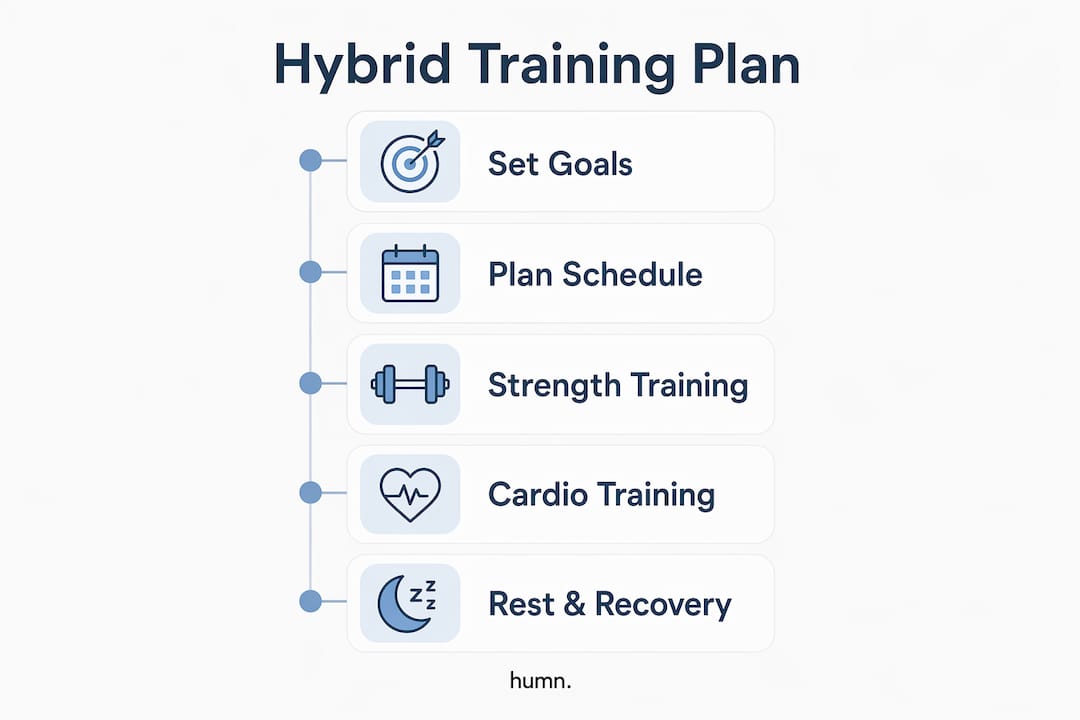
The most effective hybrid schedules balance frequency with recovery. Beginners benefit most from starting with three sessions per week, alternating between strength-focused and cardio-focused days. Consistency over 12 months produces better results than any aggressive short-term program.
Sample weekly frameworks
Beginner (3 sessions per week):
- Monday: Full-body strength (compound lifts, moderate load)
- Wednesday: Cardio focus (30–40 minutes at moderate intensity)
- Friday: Full-body strength with a 15-minute cardio finisher
Intermediate (4 sessions per week):
- Monday: Lower body strength
- Tuesday: Cardio (intervals or steady-state)
- Thursday: Upper body strength
- Saturday: Cardio plus core work
Advanced (5 sessions per week):
- Monday: Lower body strength
- Tuesday: High-intensity interval training
- Wednesday: Upper body strength
- Thursday: Low-intensity steady-state cardio
- Saturday: Full-body strength circuit
| Schedule type | Sessions per week | Strength days | Cardio days |
|---|---|---|---|
| Beginner | 3 | 2 | 1 |
| Intermediate | 4 | 2 | 2 |
| Advanced | 5 | 3 | 2 |
Spacing sessions correctly is one of the most underrated variables in hybrid training. Separating strength and cardio by 6–24 hours allows clearer physiological signaling for both muscle growth and endurance adaptation. When that spacing is not possible, same-day training still works. It just requires careful attention to session order and intensity.
Pro Tip: If you train twice in one day, do your strength session in the morning and cardio in the evening. The gap between sessions gives your nervous system time to recover before the second stimulus.
What is the best order for cardio and strength in one session?
Session order directly affects both performance and long-term adaptation. The rule is simple: lift before you run if strength is your primary goal, and run before you lift if endurance is the priority. Performing heavy squats after a 5K leaves your legs pre-fatigued and your neural drive depleted. The quality of your strength work drops, and so does the adaptation signal.
Understanding the interference effect
The interference effect describes how endurance training can blunt the molecular signals that drive muscle growth. It is real, but largely overstated for most fitness enthusiasts. The effect becomes significant only when cardio volume is very high or when sessions are stacked without adequate recovery. For the average person training 3–5 days per week, smart programming eliminates most of the interference.
Combining cardio and strength in a single session reduces the post-workout metabolic rate elevation that strength training alone produces. Separating sessions preserves more of that afterburn effect and allows each modality to generate a cleaner adaptation signal.
Low-intensity steady-state cardio, such as a 20-minute walk or easy bike ride, is the best cardio accessory for strength-focused athletes. It raises heart rate enough to support cardiovascular health without generating the fatigue that competes with muscle recovery. Use it on rest days or as a session finisher when your primary work is already done.
Practical session sequencing by goal
- Hypertrophy goal: Strength first, then 15–20 minutes of low-intensity cardio
- Fat loss goal: Strength first, then 20–30 minutes of moderate cardio
- Endurance goal: Cardio first, then accessory strength work
- General fitness goal: Circuit training that alternates strength and cardio movements with minimal rest
How to tailor your training to your specific fitness goal
Hybrid training is not one-size-fits-all. The right mix of cardio and strength depends entirely on what you are trying to achieve.
-
Endurance athletes should prioritize cardio volume and use strength training as a support tool. Two strength sessions per week focused on single-leg stability, hip strength, and core control reduce injury risk and improve running or cycling economy. Keep strength loads moderate and avoid training to failure before a key cardio session.
-
Hypertrophy-focused athletes should treat cardio as a recovery and conditioning tool. Two to three cardio sessions per week at low to moderate intensity support heart health and body composition without interfering with muscle growth. High-intensity interval training more than twice per week competes with recovery and should be used sparingly.
-
Fat loss goals respond best to a balanced approach. Strength training preserves muscle mass during a caloric deficit, while cardio increases total energy expenditure. Three strength sessions and two cardio sessions per week, combined with a modest caloric deficit, produces consistent and sustainable results.
-
General fitness and longevity require the least specialization. Three to four sessions per week mixing strength and cardio in any format, including circuit training ideas like timed supersets or AMRAP blocks, builds a broad fitness base that supports health across decades.
Progression is the variable most people neglect. Add load, distance, or intensity gradually over weeks, not days. Starting with a consistent 3-session routine for at least a year before increasing volume is the most reliable path to long-term results without burnout.
Key Takeaways
Combining cardio and strength training, when programmed with clear goals and adequate recovery, reduces mortality risk, preserves muscle, and builds lasting fitness.
| Point | Details |
|---|---|
| Concurrent training reduces mortality risk | Pairing cardio and strength cuts all-cause mortality risk by at least 40%. |
| Cardio does not kill muscle gains | Meta-analysis confirms muscle size and strength are preserved when cardio is programmed correctly. |
| Session order follows your primary goal | Lift first for strength, run first for endurance. Never leave your priority work for last. |
| Space sessions 6–24 hours apart | This gap reduces the interference effect and allows cleaner adaptation signals for both systems. |
| Beginners should start with 3 sessions per week | Consistency over 12 months outperforms any aggressive short-term volume spike. |
The part most training plans get wrong
I have worked with a lot of people who treat cardio as something they owe their body after a heavy week. They pile on a long run after three hard lifting days and wonder why they feel wrecked by Thursday. That mindset is the problem.
Cardio is a training tool, not a penalty. The moment you start treating it that way, your programming gets sharper. You stop adding random miles and start asking: what does this session do for my goal? That question changes everything.
The other mistake I see constantly is ignoring fatigue signals until it is too late. Velocity-based monitoring shows that stopping a set when bar speed drops by 20% prevents the kind of accumulated fatigue that derails hybrid programs. You do not need a sensor to apply this principle. Watch your technique. When form degrades, the set is over. That discipline protects your recovery and keeps your cardio sessions productive.
The people who get the best results from hybrid training are not the ones who train the hardest. They are the ones who train the most consistently, manage their fatigue honestly, and treat both strength and cardio as equal partners in the same long-term plan.
— Josh
What humn offers for hybrid training
Building a hybrid training plan that actually works takes more than a good schedule. It takes programming that fits your body, your goals, and your life.

humn, based in Gaithersburg, MD, builds individualized strength, conditioning, and lifestyle coaching programs that integrate cardio and strength training under one roof. Coaches at humn design your sessions around your primary goal, manage your volume across the week, and adjust your plan as you progress. Membership options include small-group personal training and 1-on-1 coaching, with access to recovery services that support adaptation between sessions. If you want a program built around how you actually live, humn is the place to start.
FAQ
Does cardio really cancel out strength gains?
No. A meta-analysis on concurrent training confirms that cardio does not reduce muscle size, strength, or power when programmed correctly. The key is managing volume and recovery.
How many days per week should I combine cardio and strength?
Beginners should start with 3 sessions per week, balancing strength and cardio across the week. Intermediate and advanced athletes can train 4–5 days with proper spacing between sessions.
Should I do cardio before or after lifting?
Lift before cardio if strength is your primary goal. Do cardio first if endurance is the priority. Performing your main goal first preserves performance quality and adaptation.
How far apart should strength and cardio sessions be?
Spacing sessions 6–24 hours apart reduces the interference effect and allows each system to generate a cleaner adaptation signal. Same-day training works, but the gap matters.
What is the interference effect in hybrid training?
The interference effect describes how endurance training can reduce the molecular signals that drive muscle growth. It is largely manageable for most fitness enthusiasts through smart session sequencing and controlled volume.
No Comments.